
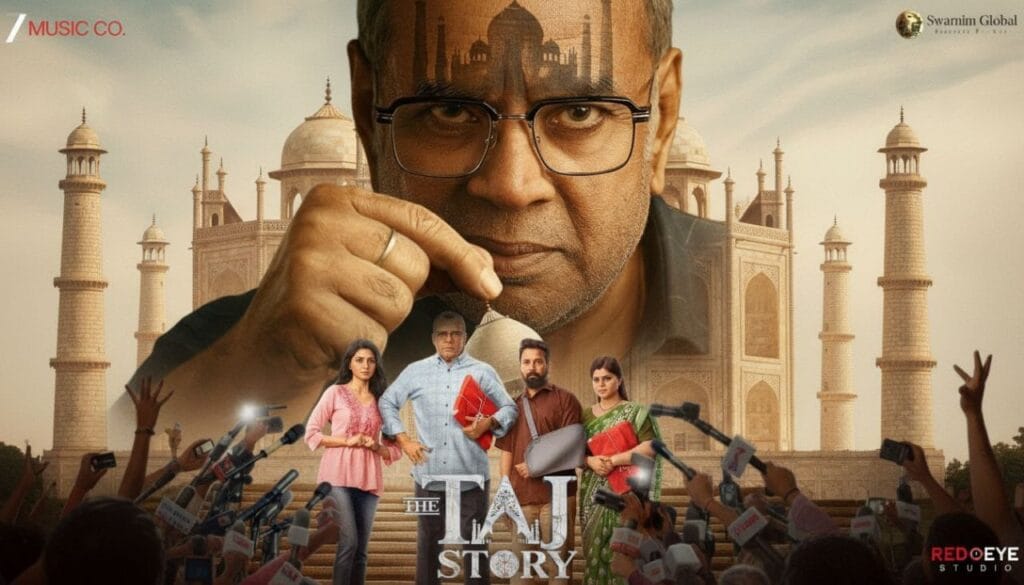
Genre: Courtroom Drama | Historical Debate | Socio-Political Commentary
Lead: Paresh Rawal
Runtime: ~2 hr 45 min
Tone: Serious, confrontational, debate-heavy
The Taj Story Review
🎬 Premise & Narrative Depth
The film revolves around Vishnu Das, an aging, respected Taj Mahal guide whose life collapses when he publicly admits that the romanticized story he narrates to tourists may not be the complete truth. What begins as embarrassment transforms into obsession. Vishnu files a Public Interest Litigation to demand transparency about Taj’s “hidden history” — questioning narratives, asking for investigation into sealed rooms, and challenging the unquestionable reverence the monument enjoys.
The film isn’t a love story. It’s not a Mughal-era epic.
It is a battle of memory vs recorded history, belief vs verification, emotion vs documentation.
🧩 Storytelling Style
Instead of linear storytelling, the film uses:
- Long courtroom segments
- Fiery monologues
- Structured debates
- Flashbacks of Vishnu’s humiliation and personal downfall
- Media trials
- Public reactions
This makes the narrative feel like a theatrical debate staged for cinema, rather than a cinematic narrative.
For some viewers, this is intellectually stimulating. For others, it feels exhausting.
🎭 Character Study
⭐ Paresh Rawal as Vishnu Das
He is the film’s pillar.
Rawal doesn’t play Vishnu as a hero or villain; he plays him as a stubborn, idealistic, slightly broken man who refuses to accept “because we said so” as history.
His standout elements:
- Eyes burning with conviction
- Calm humor masking deep frustration
- A man who starts with curiosity and ends with obsession
- Humanity balanced with ego
You feel:
- His humiliation
- His desperation
- His loneliness
- His unstoppable urge to fight
Even in silence, Rawal’s presence communicates.
🎭 Supporting Characters
They exist more as ideological voices than emotional beings:
- The lawyers represent intellectual schools—liberal vs nationalist vs academic realism.
- Government officials act as protectors of status quo.
- Media is portrayed as opportunistic, sensationalistic, and shallow.
- Family members symbolize the emotional price of obsession.
Good acting—yes.
Deeply human characters—rarely.
🧠 Themes & Symbolism
1️⃣ History vs Ownership
Who owns history?
Scholars? Government? Emotion? Religion?
The film asks whether questioning history equals disrespect.
2️⃣ Truth vs Convenience
Do we love the Taj for what it actually is, or for what we want it to symbolize?
3️⃣ Faith vs Evidence
The film doesn’t solve anything; it opens uncomfortable questions.
4️⃣ National Identity
Taj Mahal is not just a building — it is emotion, politics, culture, tourism economy, pride.
Challenging it shakes everything around it.
🎥 Direction & Screenplay
✔ What Works Brilliantly
- Ambition – Indian mainstream cinema rarely attempts such controversial subjects.
- Boldness – The film dares to touch politically sensitive territory.
- Paresh Rawal’s dominance keeps the film watchable.
- Taj visuals are stunning; frames are poetic, giving the monument a living presence.
❌ Where It Struggles
- Overwritten dialogues
- Many scenes feel like speeches, not conversations
- Too much telling, not enough showing
- Length feels punishing
- Emotional connection weak because film prioritizes debate over feeling
It’s a conceptually powerful film trapped inside heavy writing.
⚖️ Courtroom Drama Quality
This is not like Pink or Jolly LLB where courtroom humor, wit, and human sensitivity flow.
This court is academic, argumentative, ideological.
Highlights:
- Intelligent questioning
- Detailed historical referencing
- Philosophical discussions
Weakness:
- Low cinematic thrill
- Monotony sets in
- Audience fatigue
🎼 Music & Technicals
- Background score is restrained, not melodramatic.
- Camera constantly frames Taj as an emotional presence.
- Editing could have been sharper — many scenes linger too long.
- Production quality decent, but not lavish.
🔥 Controversy & Sensitivity
The film touches:
- National pride
- Religious narratives
- Cultural identity
- Polarized beliefs
The makers repeatedly claim:
“It is about asking questions, not rewriting history.”
But inevitably, the film becomes politically interpreted:
Some see it as brave questioning.
Some see it as agenda-driven provocation.
Some see it as unnecessary disturbance.
And that polarization becomes part of its identity.
👥 Audience Reaction Spectrum
👍 People Who Liked It Said:
- Thought provoking
- Intellectually engaging
- Courageous cinema
- Paresh Rawal exceptional
👎 People Who Disliked It Said:
- Agenda driven
- Slow & lecture-like
- Emotionally cold
- Couldn’t justify its controversy
💰 Box Office Reality
Opened decently due to curiosity and debates.
Then collections dropped because:
- Mixed word of mouth
- Length and heaviness limited repeat viewing
- Not a “mass entertainment” film
This is not popcorn cinema.
🧾 Final Critical Verdict
The Taj Story is:
- Not a masterpiece
- Not a disaster
- It is a serious, bold, flawed, heavy, debate-driven film
A courageous attempt that raises questions more effectively than it tells a story.
⭐ Rating (Critical Style)
- Concept: 9/10
- Performance (Paresh Rawal): 9/10
- Writing Depth: 7/10
- Emotional Grip: 5/10
- Engagement: 5.5/10
- Overall: 6.5 / 10
🎯 Who Should Watch?
- People who enjoy courtroom debates
- History enthusiasts
- Viewers who like ideological cinema
- Paresh Rawal admirers
🚫 Who Should Skip?
- People wanting entertainment
- Those uncomfortable with controversial debates
- Viewers who dislike slow, dialogue-heavy films