
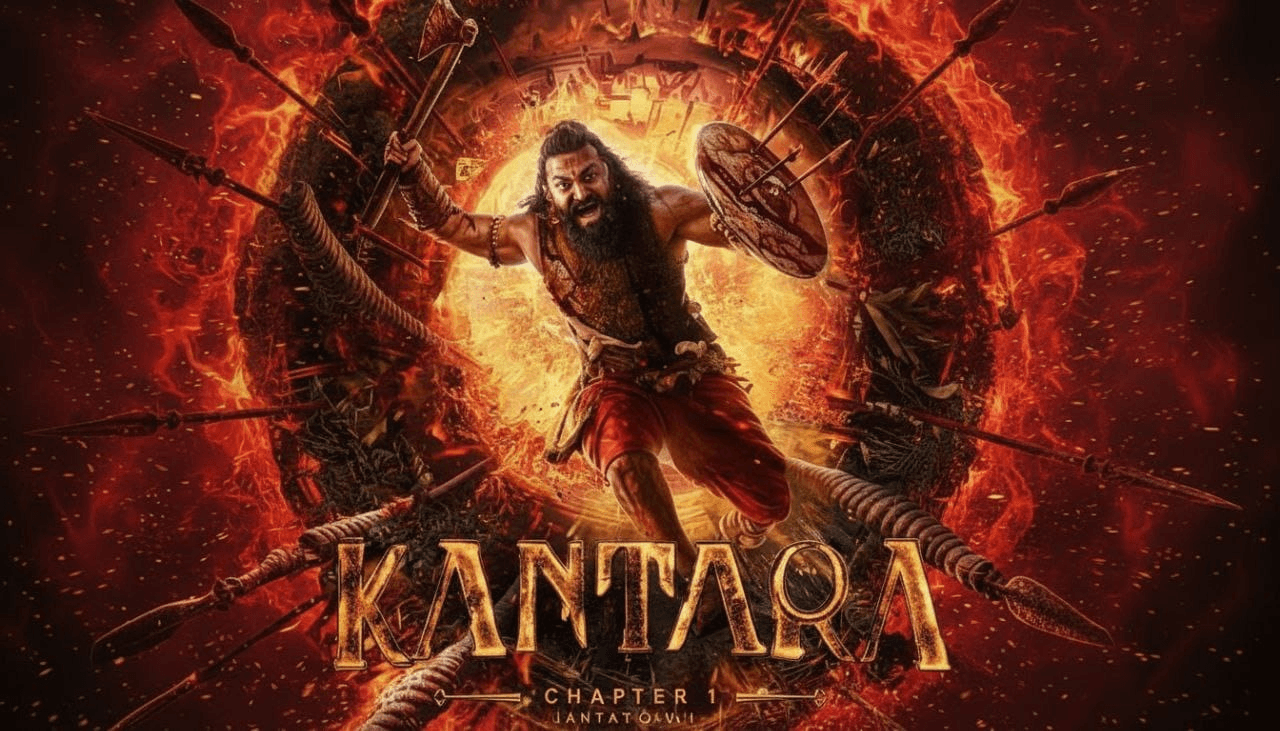
Introduction: Kantara – Not Just a Film, But a Cultural Experience
Kantara is not a film you merely watch—it is a film you experience. Released in 2022, this Kannada-language movie slowly but powerfully carved its place in Indian cinema, eventually becoming a pan-India phenomenon. When audiences walked out of theatres after watching Kantara, the emotions on their faces were not limited to excitement or satisfaction. There was fear, awe, reverence, and a strange spiritual unease—a feeling that something ancient had been awakened.
In an era where cinema is largely driven by glossy visuals, formulaic storytelling, and excessive VFX, Kantara arrived like a reminder from the past. It reminded audiences that the strongest stories are rooted in soil, belief, and tradition. Without chasing trends, Kantara proved that authenticity itself can be cinematic magic.
This film stands as a rare example of how regional folklore, when told honestly, can resonate across languages, cultures, and geographies.
Meaning of the Title “Kantara” & Its Significance
The word “Kantara” refers to forest land, wilderness, or sacred jungle territory. The title is not symbolic—it is literal, thematic, and philosophical.
In the film, the forest is not merely a location. It represents:
- The center of faith
- The source of life and livelihood
- The final court of justice
- The boundary humans are forbidden to cross with greed
Symbolism of Kantara
| Element | Symbolic Meaning |
|---|---|
| Forest | Sacred space, nature’s authority |
| Land | Identity, survival, ancestry |
| Wilderness | Balance between man and nature |
| Devta (Deity) | Moral justice beyond human law |
Kantara constantly reminds us that nature does not belong to humans—humans belong to nature.
Story Overview (Spoiler-Free)
Kantara is set in a coastal village of Karnataka, deeply connected to its land, forest, and local deity known as Panjurli. The villagers believe Panjurli protects their land, their cattle, and their dignity. When human law fails, divine justice prevails.
As time progresses, modern systems enter this ancient ecosystem:
- Government forest laws
- Bureaucratic power
- Political authority
- Greed disguised as development
This creates a sharp conflict between tradition and administration, belief and paperwork, ancestral rights and modern ownership.
At the center of this conflict stands Shiva, a rebellious, aggressive, carefree man who wants nothing to do with responsibility or tradition. He runs from his destiny, but destiny refuses to let him escape.
Shiva: A Man Running from His Identity
Shiva is the backbone of Kantara. At first glance, he appears deeply flawed:
- Alcoholic
- Short-tempered
- Violent
- Irresponsible
But gradually, the film reveals that Shiva’s blood carries history. His ancestors, his lineage, and his spiritual connection to the deity constantly pull him back toward a fate he refuses to accept.
Why Shiva Feels Real
| Aspect | Impact |
|---|---|
| Imperfection | Makes him human and relatable |
| Anger & Confusion | Reflects internal conflict |
| Resistance to destiny | Modern individual vs ancient duty |
| Gradual transformation | Earned, not forced |
Rishab Shetty’s performance brings rawness and honesty that cannot be rehearsed—it feels lived.
Bhoota Kola: The Soul of Kantara
The most unforgettable aspect of Kantara is Bhoota Kola, a real ritual practiced in coastal Karnataka. This is not mythology—it is living tradition.
During Bhoota Kola:
- A performer embodies a deity
- Villagers believe the deity possesses the body
- Justice is delivered through divine speech
The film presents Bhoota Kola without cinematic exaggeration. There are no unnecessary dramatic cues—only silence, fear, belief, and surrender.
Why Bhoota Kola Feels So Powerful
| Reason | Explanation |
|---|---|
| Authentic portrayal | No commercial distortion |
| Minimal acting | Belief dominates performance |
| Silence & music | Creates dread and reverence |
| Cultural honesty | Feels documentary-like |
This is where Kantara transcends cinema and enters spiritual territory.
Panjurli Deity: Symbol of Justice & Warning
Panjurli is not portrayed as a conventional god. Instead, Panjurli represents:
- Justice beyond human law
- Guardian of the forest
- Warning against greed
- Voice of the voiceless
Core Message Through Panjurli
“When humans cross limits driven by greed, nature and tradition will restore balance.”
This belief system forms the moral spine of the film.
Forest, Land & Power: The Central Conflict
Beyond spirituality, Kantara is also a sharp social commentary.
Key Issues Addressed
| Theme | Representation in Film |
|---|---|
| Forest Rights | Ancestral ownership vs legal documents |
| Tribal Identity | Ignored voices of indigenous people |
| Power Politics | Authority exploiting loopholes |
| Rich vs Poor | Control vs survival |
The film never preaches. Instead, it quietly asks:
“Who truly owns the forest—the one who protects it or the one who claims it on paper?”
Music & Background Score
Ajaneesh Loknath’s music is not background—it is narrative force.
Impact of Music
| Aspect | Effect |
|---|---|
| Background score | Builds spiritual tension |
| Folk instruments | Cultural authenticity |
| Silence usage | Heightens fear |
| “Varaha Roopam” | Iconic spiritual intensity |
Music in Kantara does not entertain—it invokes.
Cinematography & Visual Language
Kantara embraces raw, earthy cinematography.
Visual Strengths
- Natural jungle colors
- Fire, mud, rain symbolism
- Night sequences filled with dread
- No artificial lighting glamour
The camera never distracts—it serves the story.
Direction: Rishab Shetty’s Bold Vision
Rishab Shetty took enormous risks:
- Regional folklore
- Non-commercial storytelling
- Local belief systems
- Spiritual climax
Yet these risks made Kantara universal.
Directorial Strengths
| Element | Execution |
|---|---|
| Cultural respect | Deep research |
| Story pacing | Slow but immersive |
| Performances | Extracted raw acting |
| Vision | Fearlessly authentic |
He proved one thing clearly:
Truthful stories don’t need translation.
The Climax: Fear, Faith & Justice
The climax of Kantara is not watched—it is felt.
It is:
- Terrifying
- Emotional
- Divine
The silence in theatres after the climax speaks louder than applause. Audiences sit still, trying to process what they have just witnessed.
Strengths of Kantara
| Strength | Description |
|---|---|
| Rooted storytelling | Deep cultural foundation |
| Performances | Raw and powerful |
| Authentic rituals | No dilution |
| Unique concept | Rare in Indian cinema |
| Spiritual depth | Long-lasting impact |
Weaknesses of Kantara
| Weakness | Impact |
|---|---|
| Slow mid-section | Tests patience |
| Heavy themes | Not for casual viewing |
| Subtitle dependency | For non-Kannada viewers |
These flaws do not reduce the film’s overall power.
Final Verdict
Kantara is cinema that demands respect.
It does not beg to entertain—it commands attention. It reconnects viewers with nature, ancestry, and forgotten belief systems. This is not a one-time watch film—it is a felt experience.
⭐ Kantara Movie Rating
| Category | Rating |
|---|---|
| Story | ⭐⭐⭐⭐⭐ |
| Acting | ⭐⭐⭐⭐⭐ |
| Music | ⭐⭐⭐⭐⭐ |
| Direction | ⭐⭐⭐⭐⭐ |
| Overall Impact | ⭐⭐⭐⭐⭐ |
Overall Rating: ⭐ 4.8 / 5
Frequently Asked Questions (Q&A)
Q1. What genre is Kantara?
Answer:
Kantara is an action-cultural-mythological drama that blends folklore, spirituality, and social commentary.
Q2. Why does Shiva’s character connect so deeply?
Answer:
Because Shiva is flawed, angry, and confused—his internal struggle feels real and human.
Q3. Why is the Bhoota Kola sequence so impactful?
Answer:
Because it feels like belief, not performance. Music, silence, and expressions create spiritual fear.
Q4. What is the core message of Kantara?
Answer:
Respect nature and tradition—when greed breaks balance, consequences follow.
Q5. Is Kantara suitable for family viewing?
Answer:
Yes, but some intense and violent scenes may disturb younger children.
Q6. How is Rishab Shetty’s performance?
Answer:
Outstanding and transformative—one of the finest performances in Indian cinema.
Q7. What makes Kantara special?
Answer:
Its rooted storytelling, cultural honesty, and fearless authenticity.
Q8. How important is music in Kantara?
Answer:
Music is the soul of the film, especially in ritual and climax scenes.
Q9. Is Kantara only for regional audiences?
Answer:
No. Its themes of nature, justice, and faith are universal.
Q10. Why does Kantara deserve a 4.8/5 rating?
Answer:
Because it excels in storytelling, performance, music, message, and emotional impact.