
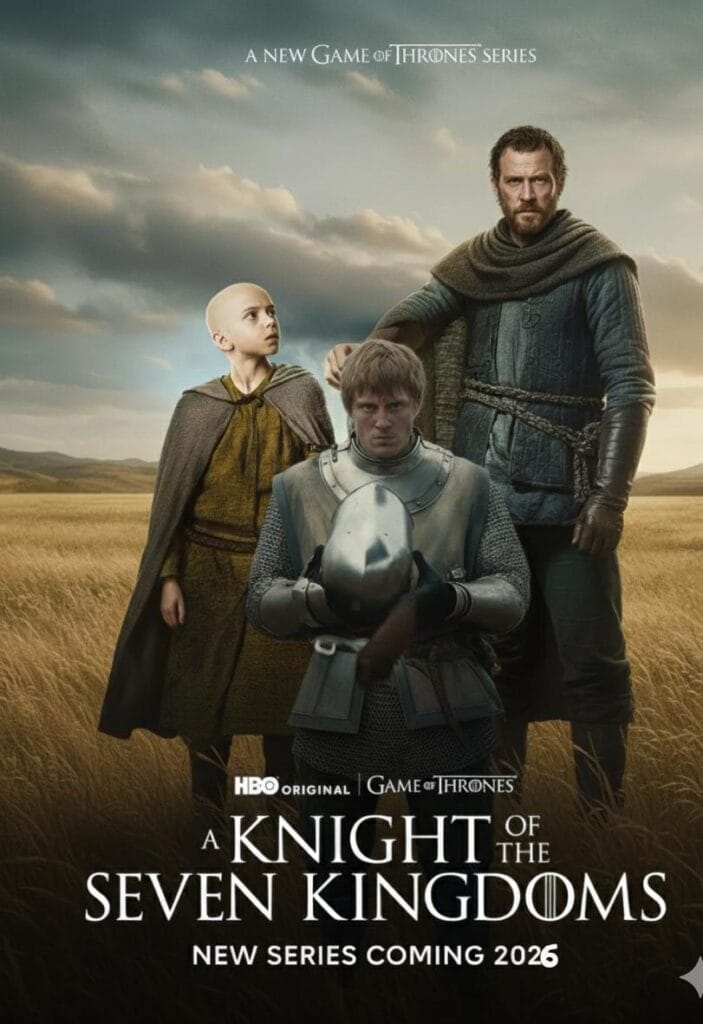
The Most Emotional, Grounded, and Knight-Centric Story from the Game of Thrones Universe
When fantasy television is discussed, the Game of Thrones universe inevitably dominates the conversation. With its dragons, political conspiracies, brutal wars, and unforgettable betrayals, the world of Westeros held audiences captive for nearly a decade. Even after the original series concluded, the universe continued to expand, proving that its mythology still has many untold stories.
Now, a new upcoming series titled “The Seven Kingdoms” is generating intense excitement among fans—but for a very different reason.
Unlike its predecessors, this series steps away from massive dragon battles and throne-centered politics. Instead, The Seven Kingdoms promises a grounded, emotional, and deeply human fantasy narrative, focusing on honor, friendship, knighthood, and moral struggle. It explores Westeros not from the perspective of kings and queens, but from the viewpoint of ordinary knights and common people trying to survive in a morally complex world.
This shift in storytelling approach is precisely what makes The Seven Kingdoms feel both refreshing and powerful.
What Is The Seven Kingdoms Series?
The Seven Kingdoms is an upcoming series set in the past of the Game of Thrones universe, long before the events of the original show. While it exists in the same fantasy world, its narrative focus is entirely different.
At the heart of the series lies the journey of a wandering knight and his young squire, traveling across the diverse regions of Westeros. As they move from one kingdom to another, they encounter different cultures, belief systems, moral codes, and conflicts.
Key Characteristics of the Series:
- Minimal focus on royal politics
- Strong emphasis on personal stories
- Small-scale, intimate conflicts
- Deep exploration of human emotions
Rather than portraying grand wars that decide the fate of the realm, The Seven Kingdoms concentrates on individual choices, personal sacrifices, and moral dilemmas. It proves that the Game of Thrones universe is not only about dragons and thrones, but also about the quiet, often painful struggles of ordinary people.
The Meaning Behind the Title: “The Seven Kingdoms”
The title The Seven Kingdoms carries a meaning far deeper than just geographical divisions.
It represents:
- Different cultures
- Different laws
- Different belief systems
- Different moral values
Each kingdom in Westeros functions almost like a separate world, with its own traditions, customs, and political tensions. The series uses this diversity to enrich its storytelling, showing how a single knight and his squire must constantly adapt to changing environments.
Each Kingdom Represents:
- Its own political dynamics
- Unique traditions and customs
- Distinct social hierarchies
- Conflicts shaped by local values
Through this approach, the series transforms Westeros into a living, breathing world, where no two regions feel the same and every journey brings new emotional and moral challenges.
Storytelling Style: Slow-Burn, Emotional, and Character-Driven
One of the most defining aspects of The Seven Kingdoms is its storytelling style.
This is not a show that relies on constant shock value or sudden twists. Instead, it adopts a slow-burn narrative, allowing emotions and character arcs to develop naturally over time.
What Defines the Storytelling?
- No reliance on instant shocks
- Gradual emotional impact
- Strong character development
- Meaningful conversations
In this series:
- A single conversation can carry enormous weight
- A small decision can permanently alter a character’s journey
- Every action has consequences
This narrative style is ideal for viewers who appreciate thoughtful, meaningful storytelling, rather than fast-paced spectacle.
Core Themes of The Seven Kingdoms
1. Knighthood and Honor
The most prominent theme of the series is true knighthood.
Here, being a knight is not defined by armor or swordsmanship alone. Instead, it means:
- Keeping one’s promises
- Protecting the weak
- Standing by personal principles, even when it hurts
The series challenges the romanticized idea of knighthood and replaces it with a more realistic, morally complex version—one where honor often comes at a heavy cost.
2. Friendship and Loyalty
The emotional backbone of The Seven Kingdoms is the bond between the knight and his squire.
Their relationship explores:
- How trust is built over time
- The price of loyalty
- The emotional weight of mentorship
This dynamic brings warmth and humanity to the narrative, reminding viewers that survival in Westeros often depends not on power, but on relationships.
3. Humanity Over Power
Unlike traditional fantasy stories, The Seven Kingdoms focuses on human vulnerability.
Characters experience:
- Fear
- Doubt
- Regret
- Hope
This makes them deeply relatable, allowing the audience to connect with their struggles on an emotional level.
Characters: Heroes Without Crowns
The characters in The Seven Kingdoms are striking because of what they are not.
They are:
- Not kings
- Not queens
- Not dragon riders
Yet, they feel powerful because they are profoundly human.
What Makes These Characters Compelling?
- They make mistakes
- They struggle with moral choices
- They question their beliefs
- They grow through hardship
This grounded portrayal ensures that viewers see themselves reflected in the characters, making their victories and losses feel deeply personal.
Comparison: Game of Thrones vs. The Seven Kingdoms
| Aspect | Game of Thrones | The Seven Kingdoms |
|---|---|---|
| Scale | Massive wars and large armies | Personal journeys and small conflicts |
| Focus | Power, thrones, and politics | Honor, survival, and morality |
| Fantasy Style | High fantasy | Grounded fantasy |
| Pace | Fast, shocking, unpredictable | Slow, emotional, reflective |
| Characters | Rulers and power players | Ordinary knights and common people |
This comparison highlights that The Seven Kingdoms is not a repetition of Game of Thrones, but a new flavor within the same universe.
Visual Style and Cinematography
Visually, The Seven Kingdoms adopts a realistic and immersive approach.
Visual Characteristics:
- Natural lighting
- Real-world locations
- Minimal use of CGI
This style enhances realism, making the world feel:
- More authentic
- More believable
- More emotionally immersive
Instead of spectacle, the visuals serve the story and characters.
Dialogue and Writing Quality
The writing in The Seven Kingdoms is subtle yet powerful.
Dialogues are:
- Short
- Meaningful
- Free from unnecessary drama
A single line of dialogue can reveal:
- A character’s past
- Their values
- Their internal conflict
This restrained writing style adds depth without overwhelming the audience.
Politics Without Thrones
Politics still exists in The Seven Kingdoms, but it operates on a smaller, more intimate scale.
Political Elements Include:
- Village disputes
- Border tensions
- Conflicts involving small lords
These subtle political struggles often feel more personal and realistic, emphasizing how politics affects ordinary lives.
Music and Background Score
The music in The Seven Kingdoms is minimalistic.
Rather than dominating scenes, the background score:
- Supports emotional moments
- Enhances atmosphere
- Never overpowers dialogue
This restraint ensures the storytelling remains natural and grounded.
Why Are Fans Excited?
Fans are excited about The Seven Kingdoms because:
- It expands the Game of Thrones universe
- It offers a break from over-the-top fantasy
- It delivers character-driven storytelling
It provides a fresh perspective on a familiar world.
Target Audience
The Seven Kingdoms is perfect for viewers who:
- Enjoy slow-burn narratives
- Prefer deep character development
- Appreciate emotional drama
If you are looking only for dragons and large-scale battles, this series may not be for you.
Future Potential
If successful, The Seven Kingdoms could lead to:
- Multiple seasons
- Additional side stories
- Knight-centric spin-offs
It opens a new storytelling pathway within the Game of Thrones universe.
Final Verdict
The Seven Kingdoms is not just another fantasy series—it is a story about:
- Honor
- Friendship
- Humanity
It proves one essential truth:
“Great stories do not need dragons. They only need strong characters.”
For fans of meaningful, character-focused storytelling, The Seven Kingdoms is shaping up to be a must-watch experience.
Frequently Asked Questions (FAQs)
Q1. Which universe is The Seven Kingdoms based in?
It is set in the Game of Thrones universe, focusing on knights rather than kings.
Q2. Will there be dragons in the series?
Dragons will have little to no presence, as the story emphasizes human characters.
Q3. How is it different from Game of Thrones?
It focuses on personal journeys rather than large-scale wars and power struggles.
Q4. Can new viewers watch it without prior knowledge?
Yes, it is designed as a standalone narrative.
Q5. What is the main theme of the series?
Knighthood, loyalty, and humanity.
Q6. Is it action-heavy?
Action exists, but it is limited and meaningful.
Q7. Who is the target audience?
Mature viewers who enjoy slow, emotional storytelling.
Q8. Can the series expand in the future?
Yes, multiple seasons and spin-offs are possible.
Q9. Is it suitable for family viewing?
It may include mature themes; viewer discretion is advised.
Q10. Is The Seven Kingdoms worth watching?
Absolutely—if you value strong storytelling and emotional depth.
Q11. Where can we watch A Knight of the Seven Kingdoms?
Answer:
A Knight of the Seven Kingdoms will be available on HBO and its streaming platform Max (formerly HBO Max), as it is an official part of the Game of Thrones universe. The series is expected to stream exclusively on Max in regions where the service is available, with local distribution partners handling releases in other countries.
Pingback: - awaraasur.awaraasur.com Honestly movie review and download