
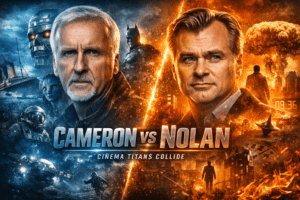
In the pantheon of modern filmmakers, James Cameron and Christopher Nolan stand as towering figures – two visionaries who have each reshaped cinema in profound ways. Cameron’s career – spanning The Terminator (1984) to the Avatar saga – is defined by technological bravura and colossal box-office feats. Nolan’s journey – from indie hit Memento (2000) to blockbuster epics like The Dark Knight (2008) and Oppenheimer (2023) – is marked by mind-bending narratives and a revival of classic film craft. Together, their films have grossed over $15 billion worldwide, placing Cameron (∼$9B, 2nd-highest grossing director) and Nolan (∼$6B, 7th-highest) among the top earners in history. Both are multi-Oscar nominees and occasional winners – Cameron took home Best Director and Best Picture for Titanic, among three Oscars, while Nolan won Best Director and Picture for Oppenheimer (his first Academy Awards).
Yet Cameron and Nolan could not be more different in style. Cameron is the consummate engineer-storyteller: he declares, “All my movies are love stories,” even amid lasers and leviathans. He fuses cutting-edge tech with human emotion, from the liquid-metal terror of Terminator 2 to the submarine romance of Titanic. Nolan, by contrast, treats film as a conceptual playground: his work is suffused with metaphysics and puzzles. He “explores various ways of manipulating story time and the viewer’s experience of it,” often employing nonlinear narratives and impossible visual motifs. Time itself becomes a character: in Memento memory unspools backwards, in Inception dreams loop ad infinitum, in Interstellar relativity warps reality. This comparison will explore how each director’s techniques, innovations, storytelling style, and worldview have revolutionized audience expectations and expanded the boundaries of cinema.
Filmmaking Visionaries: Career Overviews
James Cameron (b. 1954) burst onto Hollywood with The Terminator (1984) – a lean sci-fi actioner he wrote and directed for $6.4 million. He followed with Aliens (1986) and The Abyss (1989), each pushing practical effects and merging human drama with monsters and technology. With Terminator 2 (1991) he unveiled the liquid-metal T-1000 via groundbreaking CGI. The romantic epic Titanic (1997) solidified his blockbuster crown: at nearly $2.2 billion worldwide, it won 11 Oscars (including Best Director/Picture for Cameron). Cameron then took a 12-year break before breaking every box-office record with Avatar (2009) – a fully 3D, motion-captured sci-fi fable that revolutionized visual effects and became, at the time, the highest-grossing film ever. He continued the saga with Avatar: The Way of Water (2022, $2.3B) and Avatar: The Seed Bearer (2025). Along the way he co-founded Lightstorm Entertainment and Digital Domain, led deep-sea expeditions (even diving the Mariana Trench), and championed new filming technologies like the Fusion 3D camera system.
Christopher Nolan (b. 1970), a British-American, also started small. He made Following (1998) on a shoestring, then gained attention with Memento (2000) – a non-linear thriller of memory and murder. His Warner Bros. debut Insomnia (2002) was a critical & commercial success, but Nolan shot to international fame with Batman Begins (2005). This launched his Dark Knight trilogy: The Dark Knight (2008) grossed over $1 billion globally and earned eight Oscar nods; The Dark Knight Rises (2012) similarly crossed the $1B mark. In between, Nolan made smart-genre films (The Prestige 2006, Inception 2010) that became pop-culture touchstones. He continued mixing spectacle and soul with Interstellar (2014, $773M) – a math-laced space odyssey – and Dunkirk (2017, $526M) – a visceral WW2 epic. His 2020 spy thriller Tenet experimented with time inversions, and in 2023 Nolan delivered Oppenheimer, a 35mm biopic on the atomic bomb creator. Oppenheimer not only crossed $950M but swept awards season (13 Oscar nominations, 2 wins). Throughout, Nolan co-wrote many films with his brother Jonathan and produced via Syncopy, often collaborating with actors like Michael Caine (in eight films) and composer Hans Zimmer (from 2005 onward).
Storytelling Styles and Themes
At their cores, Cameron and Nolan both value emotion, but channel it differently. Cameron: “I love solving hard problems… making machines to go into extreme environments”, but he never forgets the audience’s heart. He explicitly says, “all my movies are love stories”. Even in adrenaline-pumping plots, Cameron foregrounds human connection – whether it’s a dystopian father-son bond (Terminator 2), the endurance of the Rose-Jack romance (Titanic), or the bond between Jake Sully and Neytiri (Avatar). His characters are often defined by perseverance and sacrifice. He also consistently centers strong women: from Ripley in Aliens to Sarah Connor in T2 to Rose in Titanic, Cameron’s heroines are gritty and capable. Cameron’s themes frequently pit humanity against technology (the Terminator cyborgs, the moral cost of discovery) and human ambition against nature’s forces. As Smithsonian’s Lorenza Muñoz notes, Cameron’s best films are “morality tales about technology’s risks – created with the most advanced technology”. In Avatar, for example, he casts the battle over Pandora’s ecosystem as a stand against corporate greed and for environmental harmony (an approach continuing in the Avatar sequels). Yet he interweaves these weighty ideas with universal feelings – love, survival, awe – ensuring his blockbusters resonate emotionally.
Nolan’s approach is more cerebral. His films explore reality, memory, and time as literary devices: he crafts puzzles that feel like themselves narratively. Nolan has said that every film he makes has an “odd relationship with time”, and it’s true: whether it’s nonlinear storytelling (Memento unfolds backwards), nested timelines (Inception’s dream levels), or multiple intercut clocks (Dunkirk’s three converging timelines), Nolan uses structure to put the audience inside the character’s mind. He loves mathematical and paradoxical images (Penrose stairs, tessellations) as metaphor for his plots. Nolan’s heroes often wrestle with existential questions: the meaning of justice (The Dark Knight), the loss of memory (Memento), or the gravity of fate (Interstellar’s sacrifice). His films tend to trust the audience: he expects viewers to piece together a story rather than spoon-feed exposition. Narratively, Nolan favors ambiguous, open-ended conclusions that provoke thought (e.g. spinning top in Inception, or the multiverse question in Dark Knight Rises).
These differing styles yield distinctive motifs. Cameron’s recurring themes include technological hubris vs. nature, survival against odds, and resilient love. Notably, “Cameron almost invariably puts genuinely tough female characters at the heart of his movies” – a cinematic trademark. Nolan’s signature is time and perception. As El País observes, Nolan (a fan of Borges) treats time as a puzzle-piece: “Camera sees time… all of his films have had some odd relationship with time”. Table 1 (below) outlines key motifs in their work:
| Recurring Themes & Motifs | James Cameron (Examples) | Christopher Nolan (Examples) |
|---|---|---|
| Time & Reality | Linear timelines; reality as experienced by protagonists (no paradoxes) | Nonlinear time, parallel timelines (Memento, Dunkirk), dream vs. reality (Inception) |
| Human vs. Technology | AI/rebellion (Terminators), human spirit conquers machines | Technology as tool of fate (atomic bomb Oppenheimer); ethics of science (Interstellar) |
| Nature & Environment | Nature as sacred (Pandora in Avatar); underwater frontiers (The Abyss, Titanic) | Rarely overt; Interstellar hints at environmental doom motivating space travel |
| Love & Family | Heroic sacrifice for loved ones (Jack sacrificing himself, Titanic); motherhood (Aliens), cross-species love (Avatar) | Love as motivation (Inception’s father-daughter theme), family bond (Tenet marriage), fallen heroism (Batman) |
| Identity & Duality | Finding self in another (Jake ↔ Na’vi in Avatar); inner heroism (T2 Machine learns humanity) | Doppelgangers and deception (Prestige), multiple selves (Inception’s Yusuf on phone vs. Fischer’s memories) |
| Existential Ethics | Man vs. fate (Judgment Day unstoppable); survival instincts | Moral ambiguity (Joker vs. Batman), sacrifice for greater good (Interstellar), guilt and justice (Memento) |
Each column of the table can almost serve as a checklist of what to expect from their films: Cameron’s are straight-arrow epics where heart and heroism prevail, Nolan’s are intellectual thrillers asking “What is the nature of reality?”.
Cinematic Techniques & Innovations
Technically, Cameron and Nolan are both innovators – but in different arenas. Cameron is a technologist by temperament. Early on he pioneered practical effects: The Terminator used miniatures and stop-motion to simulate a futuristic Los Angeles. With Terminator 2, he ushered in a new CGI era: the liquid-metal T-1000 “was one of the first times CGI was used extensively for a character in a film,” cementing digital effects as a staple. By Abyss (1989) Cameron and ILM pioneered motion-capture scanning for the water-creature sequence. He constantly upgrades the filmmaking toolkit: Titanic’s sinking combined massive practical rigs with CGI crowds. In Avatar he leapt further: real-time virtual production, new facial motion-capture rigs, and true stereoscopic 3D. As RedShark News reports, Avatar “didn’t just use CGI; it completely transformed it”, building a world so immersive that it catapulted theaters back into 3D boom. Even in the 2020s Cameron pushes boundaries (joining Stability AI’s board) to pioneer next-wave tech for Avatar sequels. He famously quips, “I love solving hard problems… [filmmaking] is a technical art form,” marrying engineering to emotion.
**Nolan’s technical innovation is more about presentation and purism. He staunchly advocates film stock and big screens. In a 2012 DGA interview he explained, “it’s cheaper to work on film… it’s far better looking… extremely reliable,” and he’ll wait for a “good reason” to switch to digital. He outright rejects stereoscopic 3D as too “small scale” for an immersive audience experience, preferring “an enormous screen”. Instead, Nolan pioneered the use of large-format and IMAX cinematography in narrative film – calling IMAX “the best film format that was ever invented”. He has shot The Dark Knight, Interstellar and Oppenheimer on IMAX or 65mm film, maximizing resolution and scope. Nolan also favors in-camera reality: when he needs a visual marvel, he builds it physically. The rotating hallway in Inception was a giant practical set, not CGI. For Dunkirk he actually sank real ships and blew up a real fighter plane on film, rather than CGI it. In Tenet, the highway chase and plane crash were done with real vehicles and clever editing. His mantra: a VFX shot “created from no physical elements… if you haven’t shot anything, it’s going to feel like animation”. Thus Nolan’s films tend to feel tactile: “more like real life”.
These philosophies extend to postproduction: Cameron loves 3D post-conversion (even re-releasing old hits in 3D for new spectacles), while Nolan entrusts sound and score to collaborators like Hans Zimmer (his constant since Batman Begins) to create sonic experiments. Nolan’s Interstellar soundtrack was built on a Shepard tone to instill relentless tension. Both directors’ commitment to the theatrical experience is clear – Cameron predicted “there will be movie theaters in 1,000 years” because audiences crave the communal awe, and Nolan has argued fiercely that the theatrical IMAX canvas preserves film’s future. In short, Cameron continually redefines what’s possible on screen with tech, whereas Nolan redefines how audiences perceive what’s on screen with presentation.
Table 1: Box Office Performance of Key Films
| Film (Director) | Year | Worldwide Gross |
|---|---|---|
| Titanic (Cameron) | 1997 | $2.2 billion |
| Avatar (Cameron) | 2009 | $2.9 billion |
| Avatar: The Way of Water (Cameron) | 2022 | $2.3 billion |
| Avatar: Fire and Ash (Cameron) | 2025 | $1.0 billion* |
| Terminator 2: Judgment Day (Cameron) | 1991 | $520 million |
| Aliens (Cameron) | 1986 | $130+ million |
| The Terminator (Cameron) | 1984 | $78 million |
| Film (Director) | Year | Worldwide Gross |
|---|---|---|
| The Dark Knight (Nolan) | 2008 | $1.004 billion |
| The Dark Knight Rises (Nolan) | 2012 | $1.084 billion |
| Oppenheimer (Nolan) | 2023 | $0.975 billion |
| Inception (Nolan) | 2010 | $836 million |
| Interstellar (Nolan) | 2014 | $773 million |
| Dunkirk (Nolan) | 2017 | $526 million |
| Tenet (Nolan) | 2020 | $363 million |
*Charting box-office: Cameron boasts the first four films to cross $1 billion (Titanic, Avatar series) and holds records – he’s the only director with three $2B+ films. Nolan’s two billion-dollar films (the Dark Knight saga) and one near-billion (Oppenheimer) have made him one of the decade’s top earners. These numbers underscore their commercial impact: Cameron’s sci-fi epics and romance thrillers became global events, while Nolan’s cerebral blockbusters proved that filmgoers crave spectacle married to substance.
Awards and Accolades
Both directors have earned ample honors, though Nolan’s recent sweep has brought him to the Oscars’ podium. Cameron’s films earned him three Academy Awards: he personally won Best Director, Picture, and Editing for Titanic (a feat few achieve in one year). He also has multiple Golden Globes (four wins), Emmys (for his documentaries), and numerous guild awards. Nolan, after many nominations, finally won two Oscars for Oppenheimer (Best Director, Best Picture). His total includes eight Oscar nods (with 2 wins) and eight BAFTA nominations (with 2 wins). He has won Golden Globes and Critics’ awards along the way. Table 2 compares their major honors:
| Awards / Nominations | James Cameron | Christopher Nolan |
|---|---|---|
| Academy Awards (Oscars) | 3 wins: Titanic Best Dir/Picture/Editing; 9 other nominations | 2 wins: Oppenheimer Best Dir/Pic; 8 nominations (all others) |
| BAFTA Awards | 0 wins, 6 nominations | 2 wins, 8 nominations |
| Golden Globe Awards | 4 wins (including Titanic Best Dir/Pic) | 1 win, 6 nominations |
| Directors Guild Award | Nominated (Titanic) | 1 win: Outstanding Directorial Achievement (Oppenheimer) |
| Other Honors | Time’s 100 Most Influential (2010); the only director with three $2B films | Commander of the Order of the British Empire (2019); Knighthood (2024); DGA President (2025) |
These accolades reflect critical validation: Titanic swept 11 Oscars in 1998 (including Cameron’s three), and Avatar won three technical Oscars. Nolan’s films earned many nominations: The Dark Knight (8 Oscar noms) and Inception (8 noms) were particularly lauded, though Oppenheimer finally broke through. Nolan has also received lifetime honors – a knighthood for services to film – acknowledging his influence on industry craftsmanship. Cameron’s additional achievements (Emmy wins for Deepsea Challenge) and Golden Globes underline his pop-culture dominance. While Nolan’s style often divides Academy voters, his recent awards run (including 5 Golden Globes and 8 Critics’ Choice Awards for Oppenheimer) shows the industry catching up to his bold, blockbuster vision.
Signature Cinematic Trademarks
Camera and Format: Cameron fearlessly builds the tools he needs. He co-created the Digital Fusion 3D camera that made Avatar possible, and has outfitted submersibles and IMAX rigs. By contrast, Nolan sticks to big film: he famously attached IMAX cameras (which he calls “the gold standard”) to real vehicles, even blowing out aircraft panels (soundproofing for shooting The Odyssey, first all-IMAX feature). Cameron embraced digital and high frame rates (some Avatar scenes were shot at 48fps), while Nolan adamantly shoots on analog film stock and only reluctantly adopts new tech.
Visual Effects: Cameron’s movies are synonymous with visible VFX: from the stuttering stunts of Terminator to Avatar’s entire alien ecosystem. He blends live-action with CG seamlessly – his effects aim to “fool the audience” with spectacle. Nolan uses VFX sparingly; his interest is “fooling the audience…seamlessly,” not flaunting it. Thus he builds much in-camera: huge models for Gotham (as in The Dark Knight), miniatures for Interstellar’s spaceships, and practical explosions. When he does use CGI (as in Prestige’s magic tricks), it’s subtle and image-anchored, never full animation.
Cinematography & Style: Cameron’s visual palette is lush and majestic: bright blues and greens of Pandora, stark blacks of deep-sea, or golden nostalgia of 1912. He uses sweeping tracking shots (the shipboard ballroom in Titanic), underwater long lenses (The Abyss), and immersive 3D framings. He often edits slowly, letting emotional beats breathe. Nolan prefers stark, deliberate framing: symmetrical compositions (hall of mirrors in Batman films), tight handheld action (the chaos of The Dark Knight streets), and bold contrasts (bright IMAX shots in Interstellar). He frequently cuts on action and cross-cuts parallel storylines to heighten suspense. Musically, Cameron’s scores (by James Horner, Simon Franglen) tend to be sweeping romantic themes, whereas Nolan’s collaboration with Hans Zimmer introduced propulsive, rhythmic scores where sound is part of the storytelling (e.g. ticking clocks in Dunkirk).
Collaborations: Cameron often single-hands production under his banner Lightstorm. His notable repeat collaborators include actress Linda Hamilton (Sarah Connor) and producer Jon Landau (Titanic, Avatar). Nolan, meanwhile, relies on a tight troupe: wife Emma Thomas co-produces every film, brother Jonathan co-writes, and Michael Caine almost becomes a Nolan “mascot” (eight films). Cinematographer Wally Pfister shot Nolan’s first five features, and Hoyte van Hoytema the later ones. Composer Hans Zimmer (and occasional teammate David Julyan early on) defines Nolan’s aural world. Both directors work with top crews (Richard King on Nolan’s sound, Stan Winston’s team on Cameron’s effects), cementing “signature” looks and sounds.
Critical, Commercial, and Cultural Legacy
The commercial success of both filmmakers is unquestioned, but their critical reputations differ. Cameron’s name is often uttered alongside Spielberg and Scorsese in box-office terms, yet critics have debated why he isn’t always cited among the “greats.” An analysis notes Cameron has outgrossed peers like Nolan and Spielberg on blockbusters, yet his name sometimes trails in auteur lists. That piece argues Cameron’s films are “actually good” classics – Aliens, T2, Abyss among them – but he’s still a punchline in auteur debates. Nolan, by contrast, is lionized for marrying blockbuster scale with “serious” themes. His films often appear in critics’ “best of” lists for the 2000s and 2010s.
Both have revolutionized audience expectations. Cameron convinced moviegoers that 3D could be more than gimmickry: Avatar made 3D standard for epic premieres, and he has retrofitted past hits for 3D re-release. He showed that an original sci-fi saga (not a sequel or franchise) could become a global phenomenon purely on vision and technology. Nolan proved that audiences will embrace demanding narratives if executed on a grand scale – after Inception, studios greenlit more high-concept thrillers, and theaters re-embraced film stock. Nolan’s championing of IMAX and refusal of streaming windows pressured Hollywood to re-evaluate theatrical exclusivity (Universal’s release deal for Oppenheimer was partly in homage to Nolan’s old-school methods).
Culturally, Cameron’s influence spans from raising awareness of deep-sea and climate issues (through Avatar’s ecosystems) to redefining summer entertainment (after Titanic, long-form romantic blockbusters became feasible). Cameron’s characters and quotes have entered memes, his action scenes influenced video games and theme parks, and the “Shock of the New” he creates – such as the T-1000’s liquid morph in 1991 – remain iconic. Nolan’s impact is seen in how new directors approach screenwriting (nonlinear narrative is now a well-used tool), in cinephiles’ insistence on high frame-rate or film viewing, and in a generation’s taste for films that make them think. Actress/director Tacita Dean suggests Nolan’s Oscar wins will inspire others “to shoot with old-school photochemical film” – a direct nod to his cultural pull.
Finally, both directors have changed how we experience movies. Cameron views cinema as a communal exploration: “we shine a light into the unknown and bring back data,” he says. He believes the “group experience” of theaters will endure. Nolan similarly treats the movie theater as sacred space – screening The Dark Knight Rises in IMAX, he gave colleagues demos to show “what any other technology has to match up to”. In short, Cameron has expanded the spectacle of cinema (crafting new worlds, breeds of creatures, and immersive 3D vistas), while Nolan has expanded the minds of audiences (trusting them with puzzles, paradoxes, and epic yet intimate human stories).
In the end, both Cameron and Nolan have torn down the old boundaries of filmmaking. Cameron built new machines – from submersible cameras to AI toolkits – to let us dive into oceans and alien worlds. Nolan built new narrative machines – crosscutting storylines and brain-bending set-pieces – to let us question time and reality on the big screen. Each revolutionized audience expectations: Cameron made us expect the next summer blockbuster to be a technical wonder, Nolan made us expect it to also be intellectually thrilling. When the lights dim and the curtain rises, their legacies endure: two auteurs who merged artistry with innovation,forever altering the cinematic experience.
Pingback: awaraasur.awaraasur.com Avatar Through Nolan’s Lens