
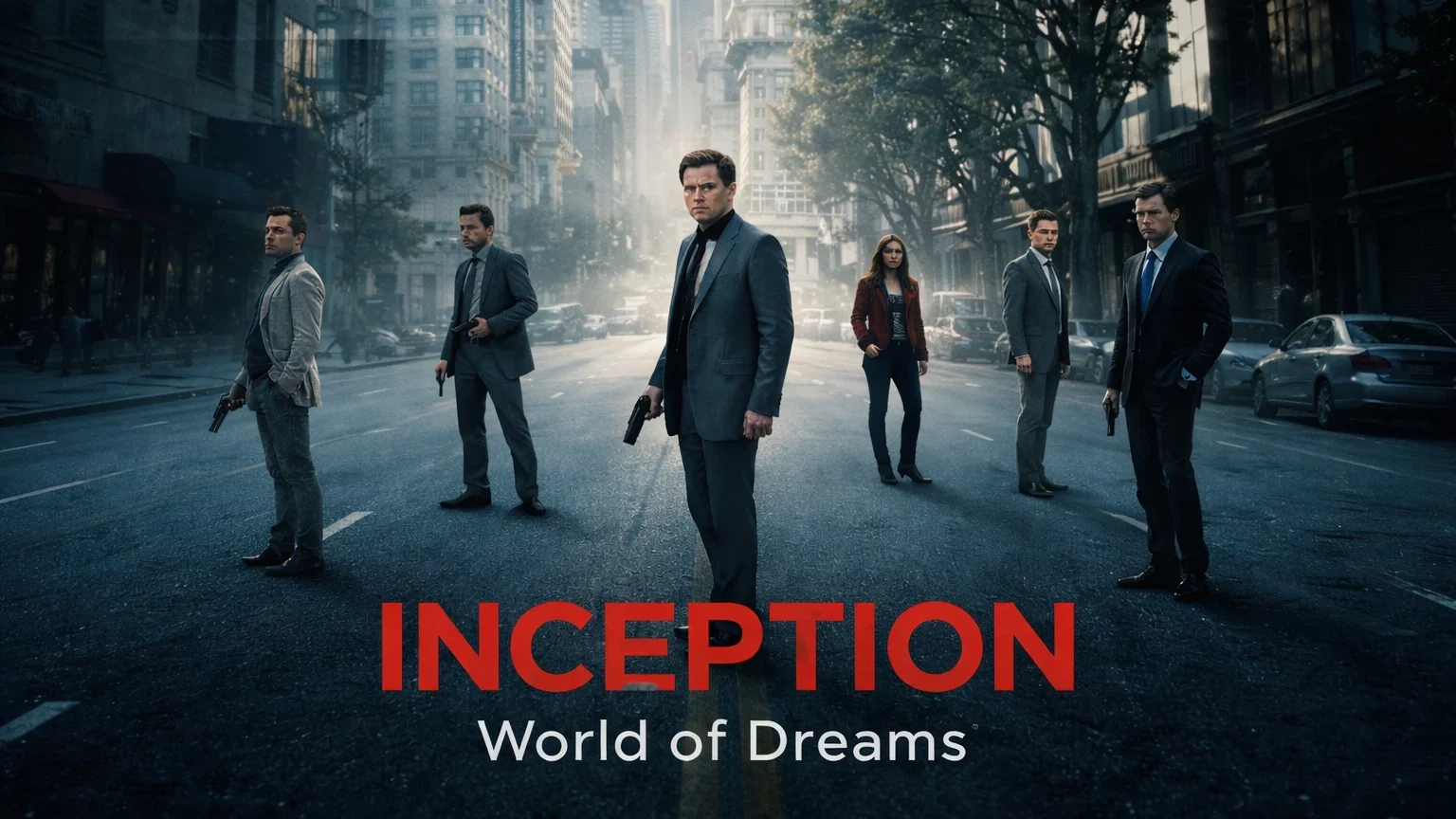
Masterpiece or Overrated Spectacle
Few modern films have inspired as much admiration and frustration as Inception. Released in 2010 and directed by Christopher Nolan, the film arrived with an audacious promise: a science-fiction heist set inside the architecture of the human mind. It proposed a world where technology allows skilled operatives to enter dreams, steal secrets, and even plant ideas so deeply that they feel self-generated. It was marketed as intelligent blockbuster cinema — ambitious, layered, and emotionally resonant.
More than a decade later, Inception remains a cultural touchstone. For some, it is a masterpiece — a rare union of spectacle and philosophy, a film that makes the audience question not only reality but the very act of watching movies. For others, it is a bloated exercise in overproduction, disguising thin imagination beneath thunderous explosions and glossy action sequences.
This divide is fascinating because it reflects a deeper question: what do we want from dream cinema? Should dreams be chaotic, surreal, and unpredictable? Or should they obey structure, logic, and narrative clarity?
At its heart, Inception is a film about illusion — about the stories we construct to survive grief, about the realities we choose to believe, and about the fragile boundary between fantasy and truth. Whether it achieves greatness or falls short depends entirely on what the viewer seeks when the lights dim and the screen flickers to life.
The Romantic View: Cinema as a Perfect Dream
For many viewers, Inception is not simply a film — it is an experience, one that lingers long after the credits roll. It is spectacular, brutal, enigmatic, and deeply absorbing. More than its layered plot mechanics, what resonates is its emotional undercurrent: the longing for a world that feels whole, safe, and complete.
At its center stands Cobb, a man haunted by memory and guilt, navigating dreamscapes that mirror his fractured inner life. For admirers of the film, Cobb is one of the most unforgettable characters of modern cinema — a tragic figure searching for redemption in worlds he can build but never truly control. His journey transforms the film from a cerebral puzzle into something intimate and personal.
This interpretation sees Inception as a film about movies themselves. After all, what is cinema if not a shared dream? A dark room, strangers seated together, surrendering to an illusion carefully constructed by unseen architects. The film’s layered dream worlds echo the filmmaking process — directors as architects, actors as projections, audiences as dreamers. In this sense, Nolan isn’t just telling a story about dreams; he is reflecting on the power of storytelling.
There is also something deeply human in the idea that somewhere, in some constructed reality, a perfect world exists. A world where pain can be rewritten and loss undone. For some viewers, Inception offers a glimpse of that possibility — not literally, but emotionally. It suggests that even if perfection is unreachable in waking life, it might exist within imagination.
Perhaps this is why some admirers hesitate to revisit the film too often. The memory of it feels sacred, almost fragile. To rewatch it risks discovering flaws, and flaws might diminish the magic preserved in memory. In that way, Inception becomes like a cherished dream itself — best remembered in fragments, glowing softly in hindsight.
The Critical View: Style Over Substance
Yet not everyone is convinced. To its critics, Inception represents a missed opportunity — a concept bursting with potential that ultimately collapses under its own weight.
The idea of entering dreams to steal secrets or implant ideas is inherently surreal. Dreams are unpredictable, irrational, and often disturbingly strange. They bend identity, time, and logic in ways that defy explanation. But critics argue that instead of embracing this boundless surrealism, Nolan replaces it with extended action sequences reminiscent of spy thrillers. Rather than exploring the bizarre possibilities of dream logic, the film frequently resorts to explosions, gunfights, and high-speed chases.
Consider the early café scene: when Ariadne first experiences the instability of a dream world, the revelation comes not through uncanny imagery or psychological horror, but through collapsing streets and erupting chaos. For skeptics, this choice reveals the film’s priorities. Instead of diving into the unsettling strangeness of dreams, it opts for blockbuster spectacle.
Some critics suggest that Nolan’s precision is both his strength and his limitation. Where filmmakers like Luis Buñuel and David Lynch embrace ambiguity and irrationality, Nolan constructs dreams that operate like carefully engineered machines. The layered “dream within a dream” structure, while complex, remains tightly controlled. Once the narrative descends to deeper levels, the upper layers largely serve as holding patterns filled with firefights and visual noise.
To these viewers, the film’s much-praised complexity is more architectural than emotional. They see an elaborate puzzle box — impressive in design but lacking the imaginative daring that true dream cinema demands. What could have been wildly surreal becomes, in their view, a polished but predictable action spectacle.
The Central Debate: What Should Dream Cinema Be?
The division over Inception ultimately reveals a deeper disagreement about what dream cinema is supposed to accomplish. Should dreams on screen mirror the chaos and irrationality of real dreams? Or should they function as heightened metaphors, structured carefully to serve narrative and emotional clarity?
For critics of the film, dreams are inherently illogical. They distort faces, fracture time, and collapse identity without warning. In that sense, the cinema of dreams should feel disorienting, unstable, even disturbing. Filmmakers like David Lynch embrace this unpredictability, allowing their narratives to dissolve into abstraction. In contrast, Nolan’s dreamscapes operate like engineered environments — blueprints rather than subconscious storms.
But this precision may be intentional. Nolan’s dreams are not random; they are constructed spaces built by architects within the story. They are controlled simulations, not organic subconscious wanderings. The tension between chaos and control becomes thematic. Cobb’s tragedy lies in his inability to control the most volatile projection of all: his memory of Mal. Even within meticulously designed dream levels, grief disrupts structure.
The famous “dream within a dream within a dream” concept — often compared to a narrative matryoshka doll — is surprisingly easy to follow. This is partly because each level functions with clear rules and objectives. Time dilates predictably. Gravity shifts in spectacular but logical ways. Stakes are explained. Critics argue this clarity reduces the sense of wonder; admirers counter that it allows the audience to participate intellectually.
Then there is the ending — the spinning top that may or may not fall. Rather than providing closure, Nolan leaves the audience suspended between certainty and doubt. Is Cobb finally home? Or is he still dreaming? The ambiguity reframes the entire narrative. Perhaps the question of reality is less important than Cobb’s emotional acceptance. If he chooses not to look at the top, does the truth matter?
In this way, the central debate is not about explosions or pacing. It is about philosophy. Is cinema meant to replicate the unconscious mind’s chaos, or is it meant to impose order on it? Inception sides firmly with order — and whether that choice feels profound or limiting depends entirely on the viewer’s expectations.
Cinematic Craft
Whatever one thinks about its narrative choices, the craftsmanship of Inception is undeniable. It represents blockbuster filmmaking executed with almost obsessive precision. Nolan approaches spectacle not as empty excess, but as engineered architecture. Every set piece is designed with mathematical care, mirroring the film’s own fascination with constructed realities.
One of the most celebrated sequences — the rotating hallway fight — illustrates this philosophy perfectly. Rather than relying entirely on digital trickery, the production team constructed a massive rotating corridor set. The result is a sequence that feels physically grounded despite its impossible physics. Bodies slam against walls and ceilings with tangible weight. The choreography becomes a visual metaphor for instability, yet the execution remains controlled and deliberate. It is chaos performed with discipline.
Similarly, the folding Paris cityscape scene operates on two levels. On the surface, it is a dazzling visual effect: streets bending skyward, gravity dissolving, the world literally turning in on itself. On a thematic level, it reveals how malleable perception can be. Ariadne learns that reality inside a dream is only as solid as belief allows. The spectacle, then, is not merely decorative; it is illustrative of the film’s ideas about perception and control.
Editing plays a crucial role in sustaining the film’s layered tension. As the narrative descends through multiple dream levels, cross-cutting intensifies. Time dilates differently in each layer, yet the pacing never fully collapses into confusion. The intercutting between a snow fortress siege, a zero-gravity corridor fight, and a sinking van in slow motion could easily have become incoherent. Instead, the rhythm remains calculated. The film treats time like elastic — stretching it without letting it snap.
The score by Hans Zimmer elevates this architecture to something almost operatic. Zimmer’s use of deep brass tones and elongated sonic waves creates a sense of looming inevitability. The music does not simply accompany the visuals; it reinforces the film’s structural obsession with time. The slowed-down rendition of “Non, Je Ne Regrette Rien” becomes more than a plot device — it transforms into a meditation on regret itself, stretched and distorted just like the dream layers.
Performance-wise, Leonardo DiCaprio provides the emotional anchor necessary to prevent the film from becoming purely cerebral. Cobb’s grief over Mal is the destabilizing force within the carefully controlled environments. DiCaprio plays him not as a genius mastermind detached from emotion, but as a man barely suppressing collapse. His quiet desperation gives the spectacle emotional stakes. Without that vulnerability, the layered mechanics might feel hollow.
Even those who critique the film’s narrative ambition often concede its technical mastery. The production design, sound engineering, practical effects, and visual composition demonstrate a level of care rarely seen in large-scale cinema. Whether one finds the story profound or excessive, it is difficult to argue that it lacks craftsmanship.
Cultural Impact & Legacy
Few original science-fiction films of the 21st century have left as visible a cultural imprint as Inception. It arrived at a time when franchise filmmaking dominated global box offices, and yet it proved that audiences would embrace a high-concept, intellectually demanding narrative if presented with confidence and scale.
The film’s imagery entered popular consciousness almost immediately. The spinning top became a symbol of ambiguity. The phrase “dream within a dream” evolved into shorthand for layered complexity. Online communities produced diagrams mapping the different dream levels, analyzing timelines, and debating interpretations of the ending. The film transformed into a shared puzzle, inviting participation long after theatrical screenings ended.
Its influence extended beyond internet discussions. Subsequent blockbusters adopted more intricate narrative structures, attempting to replicate the balance between spectacle and intellectual intrigue. The visual motif of bending cities and distorted gravity appeared in advertising campaigns, music videos, and other films. Even the deep, resonant “BRAAAM” sound effect from Zimmer’s score became a staple of modern trailers.
More importantly, Inception solidified the reputation of Christopher Nolan as one of the few directors capable of delivering large-scale original concepts with commercial success. In an industry increasingly dependent on established intellectual property, the film stood as evidence that ambitious, non-franchise storytelling could still dominate globally.
Yet its most enduring legacy may be its divisiveness. Unlike universally adored classics, Inception persists because it sparks argument. Admirers defend its philosophical depth; critics question its emotional authenticity. This friction keeps the film culturally alive. It refuses to settle into comfortable consensus.
In that sense, its legacy mirrors its narrative structure. Just as the characters debate what is real within dreams, audiences continue debating what the film truly achieves. And perhaps that ongoing conversation is the clearest indicator of its impact.
Conclusion
So where does that leave Inception?
It is neither the flawless masterpiece some proclaim nor the hollow spectacle its harshest critics describe. It is an ambitious, meticulously constructed film that occasionally strains under the weight of its own design. Its dreams are not wild subconscious storms but engineered labyrinths. For some viewers, this precision feels limiting; for others, it feels visionary.
The criticism that the film substitutes explosions for imagination is not entirely unfounded. There are moments when action overtakes introspection, when spectacle threatens to overshadow psychological depth. One can imagine a more surreal version of this story — stranger, riskier, less bound by genre convention.
And yet, reducing the film to mere spectacle ignores its emotional core. At its heart lies a story about grief, guilt, and the seductive comfort of illusion. Cobb’s ultimate choice — whether to look at the spinning top or walk away — reframes the narrative from a puzzle about reality into a meditation on acceptance. The film suggests that certainty may matter less than peace.
Perhaps Inception is best understood not as a film about dreams, but as a film about belief. It asks whether reality is defined by objective truth or by emotional conviction. It questions whether we need absolute answers, or whether we simply need to feel whole.
When the screen fades to black and the spinning top continues to wobble, the audience is left suspended between doubt and hope. That suspension is deliberate. It mirrors the human condition itself: we rarely possess perfect certainty, yet we continue forward anyway.
And maybe that is the quiet brilliance of Inception. It does not demand that we choose between dream and reality. It invites us to live in the tension between them — to step out of the cinema carrying both skepticism and wonder.
Like any powerful dream, it lingers.
The Kerala Story 2…..