
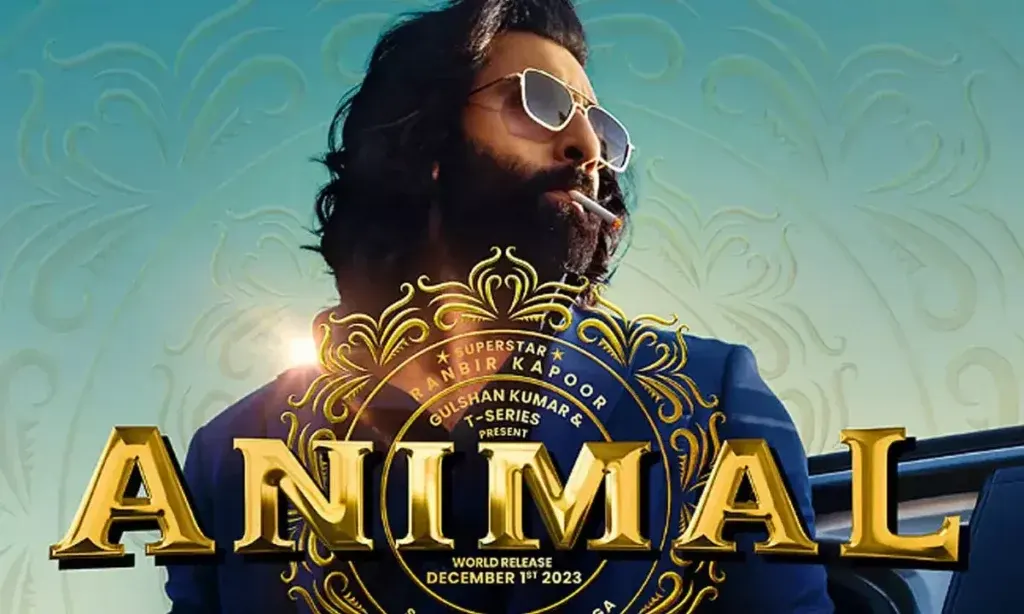
INTRODUCTION — Why This Film Demands Attention
Some films release quietly and disappear just as easily. Others arrive like a cultural disturbance — debated, dissected, defended, and condemned in equal measure. Animal belongs firmly to the latter category. It is not merely a film that people watched; it is a film people argued about. In an industry increasingly shaped by caution, algorithms, and crowd-pleasing formulas, Animal feels almost confrontational in its refusal to be polite.
At its surface, the film appears to be a violent, emotionally extreme drama anchored by a volatile central character. But the intensity of the reactions surrounding it reveals something deeper. The discomfort Animal creates is not accidental — it is fundamental to its design. This is a film that does not guide the audience toward moral clarity or emotional comfort. Instead, it forces viewers to sit inside obsession, damaged masculinity, and unresolved longing, without the relief of easy judgment.
What makes Animal particularly striking is its timing. Indian mainstream cinema, especially in the post-pandemic era, has leaned heavily toward spectacle-driven narratives and sanitized heroism. Even when films explore darkness, they often soften its edges, ensuring moral reassurance by the final act. Animal resists that instinct entirely. It does not offer redemption arcs that neatly resolve trauma, nor does it frame its protagonist as a misunderstood savior. It simply observes — and observation, when it is honest, can be unsettling.
The controversy surrounding the film has largely focused on its violence, runtime, and perceived moral ambiguity. Yet these criticisms often miss the larger question the film raises: what happens when cinema refuses to comfort its audience? Animal does not ask to be admired or emulated; it asks to be experienced. Its rawness is not a stylistic gimmick but an emotional strategy — one that mirrors the psychological chaos of its central relationship.
At its core, Animal is less about brutality and more about inheritance: emotional, psychological, and generational. It explores how love, when filtered through ego and absence, can mutate into obsession. This review examines Animal not as a moral manifesto or a provocation for shock value, but as a deliberately crafted psychological tragedy — one that challenges both cinematic norms and audience expectations.
CONTEXT — Sandeep Reddy Vanga and the Risk of Conviction
To understand Animal, one must first understand the filmmaker behind it. Sandeep Reddy Vanga has, from the beginning of his career, positioned himself as a director uninterested in compromise. His earlier films, Arjun Reddy and Kabir Singh, established a pattern: protagonists who are emotionally volatile, morally flawed, and deeply obsessive. These films polarized audiences, not because of their themes alone, but because of Vanga’s refusal to distance himself from his characters.
Animal does not represent a departure from this philosophy — it is an escalation of it. Where his previous works explored romantic obsession and self-destruction, Animal widens the emotional lens to include legacy, authority, and paternal absence. The obsession here is no longer limited to romantic love; it is rooted in validation, lineage, and the desperate need to be seen by a father figure who remains emotionally distant.
The risks involved in making Animal are not merely thematic. A runtime exceeding 200 minutes is a commercial gamble in an industry where shorter runtimes ensure more daily shows and higher revenue. Opting for an adult certification further narrows the potential audience, especially in a market that prioritizes family-friendly mass appeal. These choices were not forced by circumstance; they were deliberate.
Many filmmakers, when confronted with such constraints, choose to soften their narratives — trimming excess, neutralizing discomfort, and smoothing moral edges. Vanga does the opposite. He allows scenes to linger longer than comfort dictates. He repeats emotional beats instead of resolving them quickly. This is not indulgence born of carelessness; it is a filmmaker insisting on immersion over efficiency.
Animal exists because its director believes cinema should not always reassure its audience. Whether one agrees with his worldview or not, it is impossible to deny the conviction behind the film. Vanga does not seek approval — he seeks expression. And in contemporary Indian cinema, where creative risk is often secondary to market safety, that in itself becomes a radical act.
NARRATIVE STRUCTURE — A Film That Refuses to Let Go
One of the most frequently cited criticisms of Animal is its length. Yet to reduce the film’s structure to a mere issue of runtime is to misunderstand its narrative intent. Animal is not designed to move swiftly from point to point; it is designed to envelop. The film’s pacing mirrors the psychological state of its protagonist — repetitive, obsessive, and incapable of closure.
Traditional narrative structures rely on progression: conflict arises, escalates, and resolves. Animal deliberately disrupts this rhythm. Emotional confrontations recur. Conflicts resurface rather than conclude. The film circles its central wounds instead of stitching them closed. This repetition frustrates some viewers, but it is precisely this refusal to “move on” that defines the film’s emotional architecture.
The extended runtime serves a specific purpose: exhaustion. By the time the film reaches its later stages, the viewer is not merely observing the protagonist’s turmoil — they are feeling its weight. The length becomes a form of experiential storytelling, forcing the audience to share in the character’s inability to escape his own emotional patterns.
Editing, too, reflects this intent. Scenes are allowed to breathe uncomfortably. Silences stretch. Conversations often feel unresolved. Rather than streamlining the narrative for clarity, the film embraces messiness. It resists the instinct to summarize trauma and instead allows it to accumulate.
In a different film, these choices might feel self-indulgent. In Animal, they align too closely with the protagonist’s psychological condition to be accidental. The film’s structure is not inefficient — it is uncompromising. It asks the viewer not for patience, but for endurance.
THE FATHER–SON DYNAMIC — Love, Obsession, and Emotional Damage
At the emotional core of Animal lies a relationship defined less by presence and more by absence. The father is not overtly cruel, nor is he nurturing. His authority is unquestioned, his approval scarce, and his emotional distance profound. This absence becomes the defining force in the son’s psychological development.
The son does not seek affection in conventional terms. What he craves is recognition — validation that his existence matters within the father’s emotional universe. Every act of loyalty, aggression, and defiance stems from this unmet need. Violence becomes not just a behavior, but a language — the only one he believes his father understands.
This dynamic transforms love into obsession. The son’s identity becomes inseparable from his perception of his father’s expectations. Strength is equated with dominance. Vulnerability is treated as weakness. Emotional expression is redirected into action, often destructive in nature. The tragedy of Animal lies not in the son’s aggression alone, but in the emotional vacuum that shaped it.
The film does not romanticize this relationship, nor does it explicitly condemn it. Instead, it presents it as a cycle — one where emotional neglect breeds overcompensation, and authority replaces intimacy. The father’s silence is as damaging as the son’s violence. One wounds through absence; the other through excess.
By focusing so intensely on this relationship, Animal reframes its violence as symptomatic rather than sensational. The brutality is not the story — it is the consequence. At its heart, the film is a study of how unresolved paternal bonds can distort identity, masculinity, and self-worth.
CHARACTER STUDY — Ranbir Kapoor’s Most Dangerous Performance
Ranbir Kapoor’s performance in Animal stands apart not because it seeks sympathy or admiration, but because it resists both. This is not a character designed to be liked, nor a performance shaped to soften the audience’s moral response. Kapoor embraces discomfort, allowing the character’s volatility to unfold without apology or justification.
What makes this performance particularly striking is its control. Despite the character’s explosive tendencies, Kapoor rarely overplays emotion. Rage simmers beneath restraint, surfacing unpredictably rather than theatrically. His physicality — the posture, the gaze, the deliberate stillness before violence — communicates as much as dialogue ever could. This is a performance built on tension rather than release.
Unlike in Sanju, where transformation and vulnerability formed the emotional backbone, Animal demands something more precarious. Kapoor must balance charisma with menace, intimacy with threat. At times, the film invites the viewer to lean into his charm; moments later, it forces them to recoil. This oscillation is intentional, and Kapoor navigates it with unsettling precision.
Crucially, the actor does not attempt to redeem the character through performance. There are no emotional cues asking the audience to forgive him, no softening gestures meant to rationalize his actions. Kapoor plays the character as he is — fractured, obsessive, and emotionally underdeveloped. The danger of this performance lies in its honesty: it refuses to distance itself from the character’s moral ambiguity.
In doing so, Kapoor delivers what may be his most divisive work to date. It is a performance that will be debated, reinterpreted, and resisted — and that resistance is part of its power. Rather than offering closure, it leaves behind a lingering unease, challenging viewers to confront their own thresholds of empathy.
TECHNICAL CRAFT — Sound, Music, Costumes, and Emotional Control
Animal is a film where technical choices are never neutral. Every element — sound, music, costume, and cinematography — is engineered to reinforce emotional dominance and psychological intensity. The craft does not decorate the narrative; it controls the viewer’s experience of it.
The background score operates less as accompaniment and more as psychological pressure. Rather than guiding emotion gently, it amplifies tension, often escalating scenes beyond their visual intensity. Silence, too, is used strategically. Moments of quiet are not calming; they are anticipatory, creating unease rather than relief.
Music placement within the film is deliberate and often ironic. Songs do not interrupt the narrative flow; they heighten emotional contradiction. Romantic undertones clash with violent imagery, reinforcing the film’s central conflict between intimacy and aggression. This dissonance forces the viewer to question emotional responses rather than settle into them.
Costume design functions as visual storytelling. The protagonist’s wardrobe reflects shifts in power, ego, and identity. Clothing becomes armor — signaling dominance, status, and emotional distance. These choices subtly reinforce the character’s internal transformation without explicit exposition.
Cinematography further amplifies this effect. Framing often emphasizes isolation, even in crowded spaces. Close-ups linger longer than comfort allows, denying the viewer emotional escape. The camera does not aestheticize violence; it observes it with a detached insistence that mirrors the film’s thematic refusal to moralize.
Together, these technical elements form a cohesive emotional strategy. Animal does not rely on narrative alone to unsettle its audience — it uses craft as manipulation, guiding sensation as much as interpretation.
VIOLENCE, MORALITY, AND MISINTERPRETATION
The most contentious aspect of Animal is not its violence, but its refusal to explain it away. The film depicts brutality without attaching explicit moral commentary, a choice that has provoked strong reactions. For many viewers, the absence of condemnation feels like endorsement. Yet this interpretation assumes that cinema must always instruct, rather than observe.
Animal operates in a space of moral ambiguity that Indian mainstream cinema rarely occupies. It presents violence as a consequence of psychological damage rather than a spectacle designed for applause. The film does not frame aggression as heroic, nor does it position it as redemptive. It simply allows it to exist — uncomfortable, excessive, and unresolved.
This approach places responsibility on the audience. Viewers are not guided toward predetermined judgments; they are forced to confront their own thresholds for empathy and repulsion. For some, this is unsettling. In a cinematic culture accustomed to moral clarity, ambiguity can feel like provocation.
Criticism of the film’s boldness is not invalid. Discomfort is a legitimate response. However, to equate depiction with endorsement is to reduce cinema to moral instruction. Animal does not celebrate its protagonist’s actions — it contextualizes them within a psychological framework that resists simplification.
The film’s greatest risk lies here: it trusts the audience to engage critically rather than passively. Whether that trust is rewarded or betrayed depends less on the film itself and more on the viewer’s willingness to sit with unresolved complexity.
Animal and Contemporary Indian Cinema — A Necessary Disruption
To fully grasp the significance of Animal, it must be viewed against the broader landscape of contemporary Indian cinema. In recent years, mainstream storytelling has gravitated toward predictability — heroic certainty, sanitized conflict, and narratives engineered for maximum acceptability. Risk, when it appears, is often cosmetic rather than structural.
Animal disrupts this pattern by refusing to reassure. Its protagonist is not aspirational. Its narrative does not resolve neatly. Its emotional weight is allowed to linger uncomfortably. In doing so, the film challenges the unspoken contract between filmmaker and audience — the promise of catharsis.
This does not mean Animal is flawless or universally admirable. Its excesses are real, and its provocations are intentional. But its existence signals a willingness to push against creative stagnation. It reminds the industry that cinema can still unsettle, divide, and provoke thought rather than simply entertain.
By choosing discomfort over consensus, Animal reopens a conversation about what mainstream cinema is allowed to be. It suggests that not every film needs to please everyone — and that artistic risk, even when controversial, is essential for evolution.
In this sense, Animal functions not just as a film, but as a challenge — to audiences, critics, and filmmakers alike. It asks whether Indian cinema is willing to tolerate complexity, or whether it will continue to seek safety in familiarity.
LEGACY AND IMPACT — What Animal Leaves Behind
The true measure of a film like Animal is not found in opening-week numbers or momentary outrage, but in the conversations it sustains long after the credits roll. Films that divide audiences often age more honestly than those that briefly unite them, and Animal seems destined for such a trajectory. Its impact lies not in consensus, but in friction.
In the immediate sense, Animal has already altered expectations. It has demonstrated that mainstream Indian cinema can still accommodate morally ambiguous protagonists without collapsing under controversy. It has proven that audiences will engage — passionately — with films that challenge comfort rather than reaffirm it. Whether embraced or rejected, the film has refused to be ignored.
Over time, Animal is likely to be reassessed. As emotional distance replaces initial reactions, its excesses may be read less as indulgence and more as intention. The film’s length, violence, and refusal to moralize may come to be understood as structural choices rather than provocations. Much like other polarizing works before it, Animal may find clarity not in immediate approval, but in retrospective understanding.
For filmmakers, the film’s success sends a complicated message. It does not suggest that extremity guarantees impact, but that conviction matters. Animal exists because its creator trusted his vision more than audience predictability. That trust — whether one agrees with its outcome or not — is rare in an industry shaped by risk aversion.
Ultimately, Animal leaves behind a question rather than a blueprint: Is Indian cinema willing to embrace discomfort as a legitimate artistic tool? The answer to that question will shape not just how this film is remembered, but what kinds of stories follow in its wake.
CONCLUSION — Not a Film for Everyone, but a Necessary One
Animal is not a film that seeks approval, and it certainly does not beg for affection. It is too abrasive, too indulgent, too emotionally volatile to sit comfortably within the expectations of mainstream Indian cinema. But cinema, at its most vital, has never been about comfort alone. It has been about confrontation — with ideas, with emotions, and sometimes with ourselves. In that sense, Animal is not an anomaly; it is a reminder of what cinema is capable of when it refuses to soften its voice.
At its core, Animal is not a story about violence for spectacle’s sake. It is a story about inheritance — not of wealth or legacy, but of emotional damage. The film examines how masculinity is learned, absorbed, and distorted through silence, authority, and absence. The father does not need to be cruel to cause harm; his emotional distance is enough. The son does not need to justify his actions for the tragedy to unfold; his need for validation propels him forward regardless of consequence. In this dynamic, violence becomes expression, and obsession becomes identity.
What unsettles many viewers is not merely what the film shows, but what it refuses to do. Animal does not pause to explain itself. It does not reassure the audience that morality will eventually prevail. It does not wrap its chaos in redemption or apology. Instead, it presents a psychological reality and steps back, allowing the audience to sit with its discomfort. This refusal to guide interpretation is one of the film’s most radical choices — and also its most divisive.
Indian cinema, particularly in the mainstream, has long relied on moral clarity as a narrative safety net. Even when flawed characters are presented, their flaws are often corrected, punished, or redeemed in ways that restore balance. Animal rejects this structure entirely. Its protagonist is not rehabilitated, nor is he decisively condemned. He exists as a consequence — of upbringing, expectation, and emotional neglect. This ambiguity is not a narrative flaw; it is the film’s thesis.
The controversy surrounding Animal reveals as much about audience expectations as it does about the film itself. There is an understandable fear that depicting brutality without condemnation risks normalizing it. That concern deserves acknowledgment. But it also raises an important question: should cinema always function as moral instruction, or can it serve as observation? Animal chooses the latter, trusting viewers to engage critically rather than passively consume meaning. That trust is risky — and rare.
This risk extends beyond theme into form. The film’s excessive runtime, its lingering scenes, its emotional repetition — all are choices that resist efficiency. In a market driven by optimization, Animal insists on immersion. It asks the viewer not for agreement, but for endurance. By the end, exhaustion is not accidental; it is shared between character and audience. Few mainstream films are willing to ask so much of their viewers.
Ranbir Kapoor’s performance embodies this philosophy. He does not attempt to soften the character or plead for empathy. His portrayal is not designed to be inspirational or redemptive. It is designed to be unsettlingly human — charismatic in one moment, repulsive in the next. This refusal to moralize through performance is what gives the character his dangerous credibility. The audience is left to confront its own reactions, rather than rely on the film to tell them what to feel.
Animal will never be a universally loved film, and that may be its greatest strength. Films that aim for consensus often fade once their moment passes. Films that divide, provoke, and disturb tend to endure — revisited not for comfort, but for understanding. Over time, Animal is likely to be reassessed not as a controversy, but as a cultural artifact that captured a particular anxiety about masculinity, authority, and emotional inheritance.
For Indian cinema, the film represents a challenge more than a template. It does not suggest that extremity is the answer, but that sincerity is essential. It asks whether filmmakers are willing to accept backlash in exchange for honesty, and whether audiences are willing to engage with complexity without immediate resolution. The future of mainstream cinema depends not on films like Animal being replicated, but on their existence being tolerated.
In the end, Animal matters not because it is flawless, but because it is fearless. It stands as proof that cinema can still provoke genuine conversation rather than momentary applause. It reminds us that art does not need to be comforting to be meaningful, nor agreeable to be important.
Animal may not be for everyone — but it is necessary. Because cinema that dares to unsettle, to divide, and to linger long after the screen fades to black is the cinema that refuses to die quietly. And that, in itself, is worth engaging with.
Mercy: Age of ai judge…..