
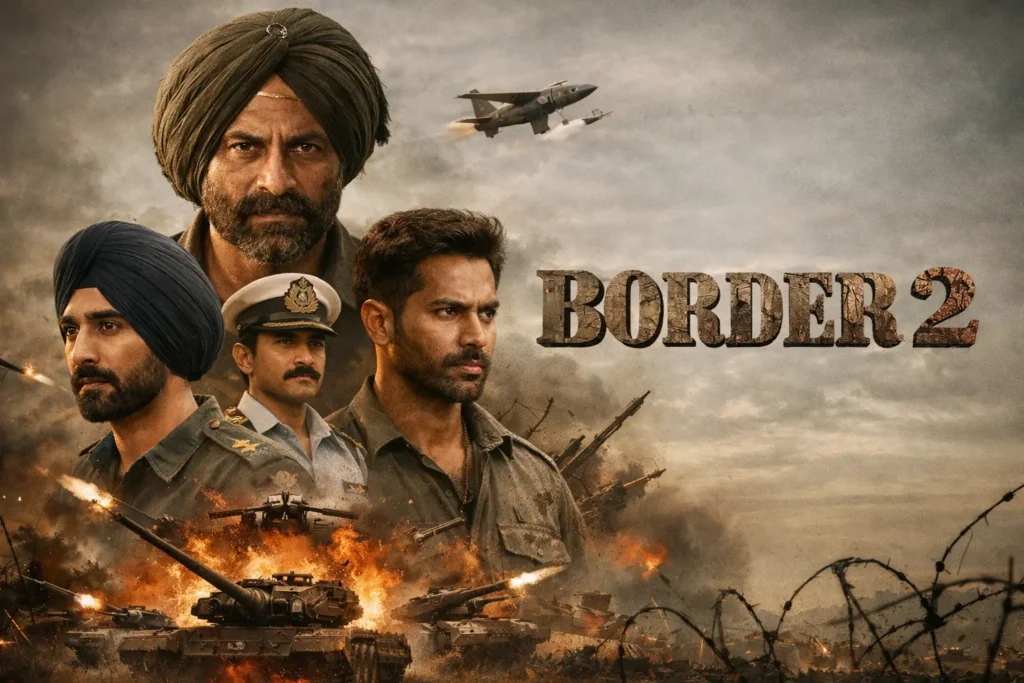
Border 2 (2026): A Film Caught Between Memory, Market, and Meaning
There are films you watch once and forget.
And then there are films you don’t just remember — you inherit.
They are passed down quietly, not through recommendations but through repetition. Through television reruns on lazy afternoons. Through songs that play on old cassette decks during long journeys. Through half-finished conversations at family gatherings where someone inevitably says, “Have you seen Border?” and everyone else already knows the answer.
For an entire generation that grew up in the late 1990s and early 2000s, J.P. Dutta’s Border (1997) was not merely a war film. It was an emotional artifact. A cultural imprint. Something that existed beyond cinema halls — looping endlessly on Doordarshan reruns, echoing through cassette tapes of “Sandese Aate Hain,” surfacing in family conversations where patriotism was never shouted, only felt.
Border arrived at a time when Hindi cinema was still discovering how to talk about nationalism without turning it into noise. Its soldiers were not superheroes. They were ordinary men—nervous, joking, homesick, occasionally afraid. The film lingered on their faces longer than on gunfire, on letters more than on bullets. It allowed silence to do the work that background scores often try to overpower.
Border didn’t ask you to cheer.
It asked you to sit with fear.
To wait with soldiers in the dark.
To understand sacrifice without spectacle.
Its patriotism was patient. Earnest. Almost old-fashioned. It believed that emotion did not need exaggeration to be effective. That bravery could coexist with doubt. That love for the nation could be quiet, even fragile.
And that is precisely why it stayed.
Over time, Border stopped being just a film. It became a reference point. A benchmark for how war stories were told in Hindi cinema. Any military film that followed—no matter how technologically advanced or commercially ambitious—was inevitably measured against it. Not for scale, but for sincerity.
So when Border 2 was announced, excitement arrived hand in hand with anxiety.
Fear of dilution.
Fear of nostalgia being exploited instead of respected.
Fear that subtlety would be replaced by volume.
Fear that memory would be mistaken for marketing.
Sequels to emotionally sacred films are always risky. They don’t just continue stories; they disturb memories. They enter a space that already feels complete. In this case, Border had never demanded a continuation. Its ending felt final, not because the war ended, but because the emotion had found closure.
Walking into Border 2, most viewers carried this emotional baggage — and the film seems acutely aware of it.
From its very first moments, Border 2 signals that it knows what it is stepping into. It acknowledges the legacy it inherits, almost cautiously. There is an effort to reconnect—not just narratively, but emotionally—with the mood, values, and gravity of the original. At times, this feels sincere. At other times, it feels self-conscious, as though the film is constantly checking whether it has earned the right to exist.
Much of Border 2 exists in conversation with this burden of memory. Sometimes it listens carefully, allowing space for stillness and restraint. Sometimes it resists, trying to carve out its own identity in a cinematic landscape that has changed dramatically since 1997. And sometimes, it tries too hard to reassure—repeating familiar emotional beats as if repetition alone can recreate resonance.
This is where Border 2 becomes interesting—not because it always succeeds, but because it is visibly struggling.
It is not a film made out of indifference. Nor is it a cynical cash-grab built entirely on nostalgia. Instead, it feels like a work caught between eras. Between the understated nationalism of the late 90s and the heightened, performance-driven patriotism of contemporary cinema. Between reverence for the past and the pressure to meet modern expectations of scale, speed, and spectacle.
Unlike the original, which trusted the audience to feel, Border 2 often feels compelled to remind. It explains emotions that Border allowed viewers to discover. It amplifies moments that once relied on restraint. This does not make it dishonest—but it does make it different.
And perhaps that difference is inevitable.
Because the world that Border spoke to no longer exists in the same way. The audience has changed. The grammar of mainstream cinema has changed. Even the idea of patriotism has evolved—becoming louder, more performative, more polarized. In such a climate, making a sequel that feels spiritually aligned with Border was always going to be a near-impossible task.
Yet, for all its missteps and moments of excess, Border 2 deserves one crucial acknowledgment:
It is not a lazy sequel.
It does not coast on brand value alone. It does not mock the emotional intelligence of its audience. It attempts—sometimes awkwardly, sometimes earnestly—to engage with the legacy it inherits rather than simply exploit it.
Border 2 is a film torn between respect and reinvention. Between memory and momentum. Between what it wants to be and what it feels obligated to honor.
And in that tension lies its true identity.
It is not a replacement for Border.
It was never meant to be.
It is, instead, a reflection—uneven, conflicted, occasionally moving—of how difficult it is to carry something that was never broken.
⭐ Star Rating (Personal, Not Algorithmic)
After distance, reflection, and emotional cooling, the final assessment settles at:
⭐ 6.5 / 10
Not a masterpiece.
Not a disaster.
Border 2 is a flawed, sincere, emotionally charged, and undeniably overlong film—one that struggles under the weight of both its own ambition and the towering legacy it inherits. It is a film that wants to matter deeply, perhaps too deeply, and in that desire lies both its strength and its weakness.
There is no denying the effort behind it. This is not a film made on autopilot, nor is it a hollow exercise in nostalgia. Border 2 carries genuine emotional intent. It wants to honor sacrifice, evoke pride without cynicism, and reconnect modern audiences with a kind of restrained patriotism that feels increasingly rare. At its best, it succeeds—finding moments of quiet sincerity, fleeting echoes of the original’s emotional discipline, and characters who feel human rather than symbolic.
Yet the film often undermines itself by overreaching. It explains emotions that could have been felt. It repeats sentiments that would have been stronger in silence. It stretches scenes beyond their natural emotional lifespan, mistaking duration for depth. In trying to justify its existence at every turn, Border 2 occasionally forgets to simply trust its audience.
That is where the score settles—not in disappointment, but in recognition.
A 6.5 is not a diplomatic middle ground. It is not an act of nostalgia-driven generosity, nor a harsh judgment shaped by impossible expectations. It is an honest acknowledgment of a film that tries to carry too much at once. A film caught between reverence and reinvention, between memory and modernity, between what it wants to preserve and what it feels compelled to prove.
Importantly, Border 2 never feels cynical. Even in its excess, its heart remains visible. Its missteps come from conviction, not calculation. And in a cinematic landscape increasingly dominated by safe formulas and manufactured emotion, that sincerity matters.
Border 2 may not linger in cultural memory the way Border did. It may not be inherited, replayed, or quietly passed down to another generation. But it does earn something else: respect for trying.
That 6.5 is not compromise.
It is honesty.
Border 2 Is Not a Remake — And That’s Its First Smart Choice
The most intelligent decision Border 2 makes is refusing to recreate Border (1997).
There is no Longewala-style single-location siege. There is no attempt to replicate the original’s intimacy beat-for-beat. Instead, Border 2 expands outward, attempting to depict the 1971 Indo-Pak war across multiple fronts — Army, Air Force, and Navy — through parallel storylines.
The intent is clear:
This is not about one night of survival.
It is about war as a system.
At its thematic core, Border 2 explores:
- Duty versus humanity
- Legacy versus individuality
- Heroism versus survival
- War as lived experience, not legend
Sunny Deol’s character becomes the moral spine — not a mythic warrior, but an aging soldier burdened by memory and loss. The younger generation — played by Varun Dhawan, Diljit Dosanjh, and Ahan Shetty — represents vulnerability rather than invincibility.
This generational contrast is central to the film’s intent.
Whether it succeeds fully is another matter.
Emotional Architecture: Front-Loaded Feelings
Border 2 makes a bold structural gamble: it front-loads emotion.
Before the war truly begins, we spend extensive time with:
- Families waiting back home
- Friendships forming in barracks
- Jokes masking anxiety
- Soldiers confronting fear quietly
Philosophically, this mirrors Border (1997). Tonally, it differs.
The original felt organic — moments unfolded without insisting on importance. Border 2, however, often feels conscious of its emotional construction. You can sense the film saying: “This moment matters.” And that self-awareness slightly weakens authenticity.
Still, when Border 2 lands emotionally, it lands hard.
The final act — particularly the ground battle sequences — captures chaos, fatigue, and inevitability with undeniable force. These moments remind you why war cinema still matters when done sincerely.
The problem is not impact.
The problem is balance.
Performances: An Uneven but Interesting Ensemble
Sunny Deol — The Quiet Anchor
This is not the roaring Sunny Deol of recent years.
This is restrained, reflective, aged Sunny Deol — and it works.
His strength lies in presence rather than volume. There are scenes where he barely speaks, yet commands the frame completely. The film wisely allows him to age instead of forcing invincibility.
Emotionally, he is the most consistent performer in the film.
Varun Dhawan — The Surprise
Varun Dhawan delivers perhaps his most grounded performance to date.
He avoids hero theatrics and embraces vulnerability. His arc feels human rather than symbolic, making him one of the film’s strongest emotional connectors.
This is a performance built on restraint — and it benefits the film immensely.
Diljit Dosanjh — Divisive but Committed
Diljit’s performance will divide audiences.
His sincerity is unquestionable, but there are moments where emotion feels externally projected rather than internally discovered. He is never bad — but sometimes too aware of impact.
Ahan Shetty — Underwritten
This is less an acting failure and more a writing problem.
In a film overflowing with emotional beats, some characters inevitably get sidelined — and his character lacks narrative weight.
The Runtime Problem: Two Films Stitched Together
At over three hours, Border 2 does not simply invite patience—it demands it. The film announces its scale not just through spectacle, but through duration. From the outset, it makes clear that this will be a slow-burn experience, one that prioritizes emotional groundwork over narrative urgency. This is a conscious creative choice, and in principle, it aligns with the film’s stated intention: to humanize its soldiers before placing them in the crucible of war
The first half of Border 2 is emotionally dense, character-focused, and deliberately unhurried. It spends considerable time establishing personal histories, interpersonal bonds, and internal conflicts. Letters from home, conversations about family, moments of doubt, camaraderie, and quiet anticipation dominate the early stretches. These scenes are not without merit. In fact, many of them are well-written and sincerely performed. They echo the emotional grammar of the original Border, where stillness and waiting were essential to building tension.
However, the accumulation of these moments eventually begins to work against the film. Emotional beats are often revisited rather than expanded. Themes of sacrifice, duty, fear, and belonging are stated, restated, and then reinforced once more, not through escalation or complication, but through repetition. What initially feels immersive gradually starts to feel indulgent. The film appears reluctant to let go of its own emotions, as though afraid that moving forward might dilute their impact.
This is where pacing becomes less a matter of rhythm and more a test of endurance. The intention—to make the audience care deeply—is clear. But care is not generated through insistence alone. When emotional moments are allowed to breathe without progression, they risk losing potency. Silence, when stretched too thin, stops being meaningful and becomes static.
The contrast with the second half is striking.
Once the film transitions fully into its war-driven phase, the narrative energy shifts dramatically. The second half is intense, propulsive, and far more focused. Action sequences are staged with clarity, stakes are sharply defined, and the sense of urgency that was missing earlier finally arrives. The waiting ends, and consequence takes center stage. In these moments, Border 2 feels closest to its purpose. The emotional groundwork laid earlier begins to pay dividends, giving the conflict weight beyond strategy or spectacle.
This structural shift is effective precisely because it is so dramatic. The film transforms from introspection to confrontation, from contemplation to chaos. The tonal clarity of the second half suggests that the filmmakers understand how to generate momentum when they choose to. The problem, then, is not an inability to pace—but an unwillingness to cut.
Had the first half been tighter, the contrast would have been even more powerful. A reduction of 30 to 40 minutes would not have compromised the film’s emotional ambition. If anything, it would have sharpened it. Emotional restraint often intensifies impact; repetition rarely does. By trimming redundant scenes and consolidating thematic beats, the film could have preserved its sincerity while gaining urgency.
This is not merely an issue of runtime, but of discipline. Border 2 sometimes confuses emotional gravity with emotional density. The two are not the same. Gravity is achieved through precision—through choosing the right moments to linger and the right moments to move on. Density, when unchecked, becomes weight. And weight, over time, exhausts rather than engages.
Importantly, the uneven pacing does not come from carelessness. On the contrary, it stems from a deep reverence for the material. The film wants to honor its characters, its themes, and its legacy fully. It does not want to rush grief, fear, or sacrifice. That respect is admirable. But reverence without restraint can blur focus. When everything is treated as equally significant, nothing stands out as truly essential.
The second half exposes this imbalance by contrast. Once the narrative commits to forward motion, emotional clarity improves. Moments land with greater force because they are no longer competing for attention. The film trusts action to carry meaning rather than interrupting it with explanation. Ironically, it is here—amid chaos—that Border 2 feels most controlled.
By the time the film reaches its conclusion, the audience has been through an uneven journey. The destination largely works. The path there, however, is longer than it needs to be. This does not invalidate the experience, but it does dilute it. Emotional saturation sets in long before emotional resolution arrives.
Ultimately, Border 2’s pacing reflects its central struggle: the tension between honoring legacy and exercising restraint. It wants to give everything space, to lose nothing in transition. But cinema, especially war cinema, thrives on selection. What is left unsaid, unseen, or removed often speaks louder than what remains.
In asking for patience, Border 2 asks a great deal of its audience. For some, the payoff will justify the wait. For others, the uneven journey will overshadow the destination. A tighter edit would not have changed what the film wants to say—but it might have helped it say it with greater clarity, confidence, and impact.
This is where immersion finally turns into indulgence—and where Border 2 comes closest to undermining its own sincerity.
Writing: Earnest, Ambitious, Overcrowded
The screenplay aims high — perhaps too high.
It tries to:
- Balance multiple protagonists
- Cover multiple military branches
- Juggle domestic emotion with battlefield tension
- Honor history while satisfying mass-cinema expectations
As a result, many characters feel designed rather than discovered.
Some exist primarily to deliver patriotic lines or trigger emotional beats rather than evolve organically.
Dialogue: Powerful, But Overused
There is no shortage of strong dialogue.
The issue is excess.
Extended monologues, repetitive affirmations, and on-the-nose emotional explanations replace silence. The film often explains what we should feel instead of trusting us to feel it.
Great war films trust the audience.
Border 2 sometimes doesn’t.
Direction: Scale Is Controlled, Emotion Less So
Anurag Singh proves himself a capable director when it comes to handling scale and logistics. Large formations, coordinated troop movement, and multi-location action are staged with confidence rather than chaos. The battle sequences—particularly the trench combat—are among the film’s most assured passages. They are clear, intense, and spatially coherent. The audience always understands where characters are positioned, how threats approach, and how each tactical decision affects the unfolding conflict. This clarity is crucial in war cinema, and Border 2 largely gets it right.
The violence is presented with restraint and weight. It is brutal without becoming cartoonish, impactful without slipping into spectacle for its own sake. Gunfire feels dangerous, injuries carry consequence, and death is neither glamorized nor softened. Singh resists the temptation to stylize combat excessively, allowing realism to ground the film’s most visceral moments. These sequences represent Border 2 at its most confident—where intent, execution, and emotion align.
Where the direction begins to falter is not in ambition, but in restraint.
Away from the battlefield, Singh appears less willing to trust silence or understatement. Quiet scenes are frequently accompanied by swelling background score, prolonged reaction shots, and deliberate emotional emphasis. Moments that could have resonated through simplicity are instead reinforced repeatedly, as though the film fears subtlety might be mistaken for absence. When everything is highlighted, nothing truly stands out.
This tendency is most evident in intimate scenes—conversations between soldiers, moments of reflection, or emotional pauses before conflict. Rather than allowing these moments to breathe, the direction often insists on their importance. Music cues arrive early. The camera lingers beyond necessity. Emotional beats are explained instead of experienced. The result is not dishonesty, but overstatement.
Ironically, Sunny Deol’s most effective moments occur when the direction steps back. His presence works best in stillness—when dialogue is sparse, when expression replaces declaration, and when the camera observes rather than instructs. Deol does not need amplification; he needs space. In these restrained moments, the film briefly recaptures the emotional authenticity it otherwise struggles to maintain.
Anurag Singh’s direction, then, reveals a clear paradox. He is confident in chaos but cautious with calm. He trusts action more than silence. With greater restraint, Border 2 might have allowed its strongest emotions to emerge naturally—without insisting on their significance.
Editing: The Film’s Weakest Link
Border 2 has one fundamental structural flaw, and it lies not in writing, performance, or even direction—but in editing.
This is not a case of incompetent editing. The film is coherent, professionally assembled, and technically sound. The problem is not confusion; it is indecision. Border 2 struggles to let go. It holds on to moments long after they have served their purpose, as if afraid that cutting them might weaken their emotional impact.
Throughout the film, emotional beats are repeated across multiple characters, often delivering the same sentiment from different angles without adding new insight. Scenes reinforce emotions that have already been clearly established, reiterating ideas rather than advancing them. The result is emotional saturation. What begins as depth slowly turns into redundancy.
Several subplots exemplify this issue. While they contribute feeling and texture, they rarely provide narrative progression. They exist to reinforce mood rather than to develop conflict or character in a meaningful way. Individually, these moments are not poorly written or acted. Collectively, they accumulate into excess. The film keeps circling emotions it has already articulated, unwilling to move forward decisively.
At over three hours, Border 2 is not long because it is epic—it is long because it hesitates to cut.
Epic cinema earns its length through escalation, complexity, and transformation. Border 2, by contrast, often extends scenes without altering stakes or perspective. The editing prioritizes emotional reassurance over narrative momentum. It repeatedly underlines points that would have resonated more strongly if trusted to land once.
This hesitation affects pacing across the entire film. The first half, in particular, feels weighted down by the need to reassert emotional significance. Even powerful moments lose impact when followed by echoes of themselves. Silence is extended, reactions linger, and musical cues stretch beyond necessity. The film seems caught between confidence in its emotions and fear of letting them speak for themselves.
What makes this flaw especially frustrating is that Border 2 frequently shows signs of knowing better. When the film does cut decisively—particularly in the latter war sequences—the impact is immediate. Momentum builds. Tension sharpens. Emotion clarifies. These moments reveal what the film could have been with firmer editorial discipline.
Ultimately, the editing does not betray the film’s intentions—it reveals its uncertainty. Border 2 wants to be felt deeply, remembered earnestly, and honored respectfully. But in refusing to let go, it overextends itself.
Sometimes, the most powerful edit is the cut you have the courage to make.
Music: Power Without Subtlety
Music in Border (1997) was memory itself.
In Border 2, music is impact.
The background score is effective but overused, often functioning as an emotional shortcut. Silence — one of the most powerful tools in war cinema — is rarely allowed to breathe.
“Sandese Aate Hain” — Memory vs Experience
The reprise is respectful, not exploitative.
But it feels like memory revisited, not emotion reborn.
You don’t cry because the song plays.
You smile because you remember crying once.
New songs are functional but not timeless.
Cinematography & Sound Design
Visually, Border 2 is impressive.
Ground combat is shot with clarity and intensity. Trench warfare feels claustrophobic. Night sequences maintain spatial logic.
But what the film lacks is poetry.
There are few frames that linger in memory as images rather than events. The cinematography favors movement over stillness, scale over contemplation.
Sound design excels during ground battles but falters in aerial and naval sequences due to inconsistent VFX and artificial layering.
Border (1997) vs Border 2: Two Cinematic Philosophies
Border (1997): Cinema of Restraint
- Stillness
- Observation
- Character over choreography
- Patriotism demonstrated, not declared
Fear was allowed. Doubt was allowed. Silence was allowed.
Border 2: Cinema of Scale
- Multiple fronts
- Emotional emphasis
- Declared patriotism
- Organized spectacle
Neither approach is wrong — but only one ages gracefully.
Why Border 2 Sometimes Feels Like a Cash Grab (Even When It Isn’t)
Border 2 benefits from inherited emotional equity.
The title guarantees attention, goodwill, and footfall. Nostalgia is deployed strategically — through music, casting, dialogue echoes.
The extended runtime positions the film as an “event.”
Patriotism acts as emotional insulation — criticism feels uncomfortable.
Yet this is not cynicism.
It is fear.
Fear of alienating audiences.
Fear of subverting expectation.
Fear of letting go of the past.
The Bigger Problem: Hindi War Cinema’s Stagnation
Border 2 does not create this issue — it inherits it.
Hindi war cinema repeatedly returns to 1971 because it is safe:
- Clear moral victory
- Defined enemy
- No unresolved questions
But safety prevents evolution.
Global war cinema explores trauma, disillusionment, and aftermath. Hindi war cinema remains stuck at valor.
Border 2 reinforces the pattern instead of challenging it.
Why Border 2 Feels Dated Despite Superior Technology
Despite better cameras and bigger scale, Border 2 speaks an older cinematic language.
Modern war films rely on:
- Silence over speeches
- Psychology over spectacle
- Precision over proclamation
Border 2 relies on emotional declaration.
This doesn’t make it bad — but it makes it retro.
Did Border 2 Need to Exist?
Artistically? No.
The original already fulfilled its purpose.
Emotionally and commercially? Yes.
For audiences seeking collective nostalgia and patriotic ritual, Border 2 works.
For viewers shaped by modern war cinema, it feels ceremonial rather than lived.
Final Verdict
Border 2 is not a bad film.
It is a safe film in an era that rewards courage.
It salutes the past instead of interrogating it.
It looks backward when it needed to look deeper.
When the credits roll, you don’t leave questioning war —
You leave remembering how war films once made you feel.
Sometimes, that is enough.
Sometimes, it isn’t.
Why Taxidriver is a masterpiece…