
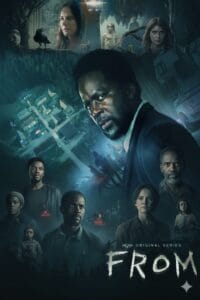
Introduction: More Than Just Horror
FROM is not an ordinary horror–mystery television series. Since its release, it has managed to deeply confuse, disturb, and intellectually engage viewers across the world. While many horror shows rely heavily on jump scares and gore, FROM takes a very different route. It explores fear through uncertainty, psychology, isolation, hope, time, and existence itself.
At first glance, FROM may remind viewers of shows like Lost or Dark, mainly because of its mysterious structure and unanswered questions. However, its tone, pacing, and method of storytelling make it completely unique. FROM does not rush to provide answers—instead, it deliberately creates discomfort by raising deeper questions with every episode.
One of the most fascinating aspects of FROM is that each season answers very little, while opening up many more layers of mystery. This has turned the series into a theory-making playground, where viewers dissect symbols, dialogue, and background details after every episode.
Core Concept of FROM: A Town You Cannot Escape
At its heart, FROM revolves around a mysterious town that traps anyone who enters it. Once you arrive, there is no way out.
This town:
- Does not exist on any map
- Does not follow the normal laws of time, space, or logic
- Loops every road back into itself
No matter which direction you drive, you always end up back in the same place.
Rules of the Town
| Element | Description |
|---|---|
| Roads | Every road loops back into the town |
| Time | Non-linear, distorted |
| Escape | Impossible (until later revelations) |
| Nightfall | Brings deadly creatures |
| Survival | Depends on strict rules |
At night, terrifying creatures emerge—beings that look, speak, and behave like humans. They smile, talk softly, and use emotions to manipulate people. But once they gain access, they kill brutally and without mercy.
The people living in the town are technically alive—but psychologically, they exist in a constant state of fear, knowing that every night could be their last.
Season 1: The Beginning of the Mystery
The Arrival of the Matthews Family
Season 1 begins with the Matthews family, who are on a road trip when they encounter a fallen tree blocking the road. This moment marks the point of no return.
Soon after, they find themselves trapped in the strange town—unable to escape no matter how hard they try.
This is a recurring pattern:
- Most residents entered the town accidentally
- A minor detour leads to permanent imprisonment
Boyd Stevens: The Reluctant Leader
The Matthews family meets Boyd Stevens, the unofficial leader of the town.
Boyd represents order, hope, and responsibility in a place designed to break people mentally.
| Character | Role |
|---|---|
| Boyd Stevens | Leader, protector, moral center |
| Actor | Harold Perrineau |
| Symbolism | Authority vs chaos |
Boyd organizes the town into two distinct living options:
| Location | Description |
|---|---|
| Town | Structured life, families, strict rules |
| Colony House | Freedom, communal living, higher risk |
The Discovery of Talismans
Boyd’s most important contribution is the discovery of Talismans—mysterious stone objects that prevent creatures from entering enclosed spaces.
These talismans introduce a fragile sense of safety, but also reinforce the idea that survival depends on rules and belief, not understanding.
Night Creatures: Fear With a Human Face
The creatures are the most horrifying element of FROM—not because of how they look, but because of how they behave.
Characteristics of the Creatures
| Trait | Description |
|---|---|
| Appearance | Human-like |
| Behavior | Calm, manipulative |
| Speech | Soft, emotional |
| Clothing | Old-fashioned |
| Attack Method | Psychological deception |
They do not break doors or windows unless invited. Instead, they:
- Imitate loved ones
- Speak kindly
- Exploit loneliness and guilt
This turns fear into something deeply personal.
FROM’s horror is not about monsters—it’s about trust.
Victor: The Living Witness
Victor is one of the most disturbing yet important characters in the series.
He has lived in the town since childhood and has survived longer than anyone else.
| Aspect | Meaning |
|---|---|
| Drawings | Memory preservation |
| Behavior | Childlike trauma |
| Knowledge | Fragmented but crucial |
Victor communicates mostly through drawings. At first, he appears mentally unstable—but gradually it becomes clear that his mind is protecting itself from unbearable trauma.
Victor knows far more than he can consciously express.
Season 1 Ending: Questions Without Answers
Season 1 concludes by expanding the mystery instead of resolving it.
Major unanswered questions include:
- Who responded to the radio signal?
- What is the significance of the lighthouse?
- Is the town an experiment?
- Is it supernatural punishment?
Instead of closure, viewers are left with existential dread.
Season 2: Beyond Survival
Season 2 shifts the narrative focus from staying alive to understanding the truth.
Boyd and the Worm Infection
Boyd ventures into the forest and becomes infected with worms inside his blood.
This infection later allows him to kill a creature—proving something crucial:
| Revelation | Meaning |
|---|---|
| Creatures can die | They are not invincible |
| Killing has a cost | Every action demands sacrifice |
Hope exists—but it is painful.
Martin and the Time Loop
Boyd encounters Martin, a chained man who suggests that time in the town is non-linear.
This introduces the idea that:
- Past, present, and future coexist
- Boyd may be “chosen”
- Events repeat or echo
FROM begins to resemble cosmic horror, where reality itself is unstable.
Tabitha and the Underground Truth
Tabitha discovers underground tunnels beneath the town.
Inside them:
- Creatures sleep during the day
- Children’s voices echo
- White-clothed children appear
This introduces theories involving:
- Sacrificed children
- Trapped souls
- Ritualistic origins of the town
Season 2 Ending: The Biggest Twist
In the finale, Tabitha falls from the lighthouse.
The next scene shocks everyone:
She wakes up in a hospital in the real world.
Key Questions Raised
| Question | Implication |
|---|---|
| Did she escape? | Escape might be possible |
| Is this reality? | Could be another illusion |
| Are others still trapped? | Most likely yes |
FROM refuses to confirm anything—forcing viewers to question reality itself.
Season 3: Expected Direction
Season 3 is expected to push the story further into cosmic and existential horror.
Anticipated Themes
| Theme | Focus |
|---|---|
| Real world connection | Is the town a layer of reality? |
| Children’s origin | Victims or creators? |
| Creature creation | Punishment or experiment |
| Boyd’s destiny | Sacrifice or savior |
| Victor’s past | Full revelation |
The show is clearly moving away from simple survival horror into philosophical terror.
Theories About the Meaning of FROM
1. Experiment Theory
The town could be a psychological or military experiment studying fear and obedience.
2. Purgatory Theory
The town may represent a limbo—a place for punishment or purification.
3. Entity Control Theory
An ancient cosmic entity could be feeding on fear, hope, and despair.
Why FROM Is Different
| Element | FROM |
|---|---|
| Jump Scares | Minimal |
| Horror Style | Slow-burn |
| Focus | Psychology & mystery |
| Explanations | Withheld |
| Viewer Role | Active thinker |
FROM does not want passive viewers—it demands engagement.
Final Season: What Might Happen?
Possible outcomes include:
- The origin of the town is revealed
- Creatures’ true nature exposed
- Boyd or Victor sacrifices themselves
- Escape is achieved—or denied forever
Whether the ending is hopeful or tragic, one thing is certain:
FROM will not give easy answers.
10 Frequently Asked Questions (FAQ)
| Question | Answer |
|---|---|
| Genre | Horror–Mystery, Psychological Thriller |
| Boyd Stevens | Leader of the town |
| Talismans | Protective stones |
| Creatures’ appearance | Emotional manipulation |
| Victor’s importance | Keeper of hidden truth |
| Tabitha’s escape | Possibly real, possibly illusion |
| Lighthouse | Boundary between truth and deception |
| Is the town real? | Intentionally unclear |
| Compared to Lost | Mystery-driven storytelling |
| Ending type | Likely bittersweet or tragic |
Final Thoughts
FROM is not just a series—it is an experience.
It challenges the viewer’s understanding of fear, hope, and reality itself.
In a genre flooded with predictable horror, FROM dares to ask:
What if the scariest thing is not the monster—but the unknown?