
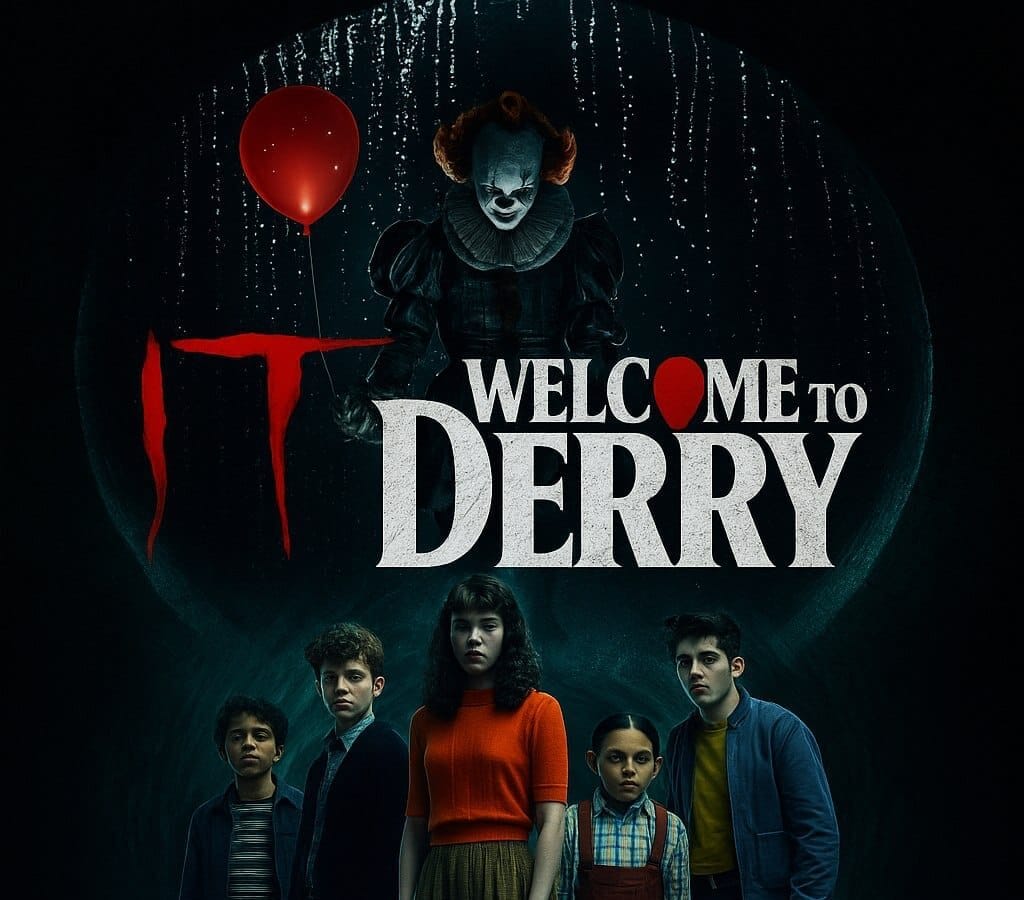
Welcome to Derry – Complete Guide, Story Breakdown, Characters, Horror Depth & Critical Rating Analysis
Introduction
Welcome to Derry is an upcoming horror television series set in the terrifying universe created by legendary author Stephen King. The series is directly connected to the IT films (IT – 2017 and IT Chapter Two – 2019) and serves as a prequel, exploring the dark history of the cursed town of Derry long before the Losers’ Club ever existed.
Unlike typical horror spin-offs that rely only on familiar monsters or shock value, Welcome to Derry aims to expand the mythology of Pennywise the Dancing Clown by revealing the origins of evil, fear cycles, and societal silence that allow such horror to survive. This is not merely a show about a killer clown—it is about a town that repeatedly chooses ignorance over truth, fear over courage, and silence over resistance.
The series promises a deeper, more mature form of horror—one that blends psychological terror, historical tragedy, and emotional dread. By moving across multiple timelines, Welcome to Derry explores how evil is not born overnight but is slowly nurtured by human behavior, denial, and collective guilt.
What Is Welcome to Derry About?
At its core, Welcome to Derry is the story of a town that appears ordinary on the surface but is fundamentally corrupted at its roots. Derry is not just haunted—it is infected. Something ancient and malevolent has lived beneath it for centuries, feeding on fear and human weakness.
The series explores how:
- Children mysteriously disappear without proper investigation
- Violent crimes are ignored, minimized, or forgotten
- Authorities fail to act
- Ordinary people choose silence instead of truth
This culture of denial becomes fertile ground for Pennywise to thrive.
Rather than focusing on a single group of protagonists, the show takes a broader approach, examining entire communities, families, and generations. The horror is not limited to sudden deaths or supernatural events—it exists in uncomfortable conversations, ignored warnings, and moral cowardice.
In Welcome to Derry, fear is not just experienced by individuals; it is institutionalized.
Connection with the IT Movies
The IT films introduced audiences to Pennywise as a terrifying, shape-shifting entity that awakens every 27 years to prey on children. However, due to time constraints, the movies could only hint at the deeper mythology behind the creature and the town it inhabits.
Welcome to Derry fills in those gaps.
The series explores:
- Why Pennywise is so deeply tied to Derry
- How the 27-year cycle first began
- Why adults consistently forget or ignore the horror
- How fear strengthens Pennywise over time
While the films focused on confronting evil, the series focuses on allowing evil to exist.
By setting the story decades earlier, the show reveals how patterns of violence and neglect repeat themselves across generations. It shows that Pennywise does not merely arrive in Derry—he is invited through inaction.
Timeline Structure & Historical Tragedies
One of the most ambitious elements of Welcome to Derry is its multi-timeline narrative. The series reportedly moves across different historical periods, each marked by large-scale tragedy.
Major Timelines Explored
- Early 1900s – Industrial accidents, factory explosions, and unexplained deaths
- 1930s–1940s – Social unrest, economic despair, racial violence
- 1960s – Civil rights tensions, child disappearances, mass trauma
In every era, a pattern emerges:
- A major tragedy occurs
- Children go missing
- The town refuses to confront the truth
- Pennywise feeds and retreats
These events are not always openly supernatural. Many tragedies appear human-made—accidents, riots, hate crimes—but the series suggests that Pennywise subtly influences fear, anger, and hatred, amplifying humanity’s worst instincts.
This structure reinforces the idea that Pennywise is not just a monster who kills—but a force that awakens when society fails.
Pennywise: Origin, Nature & Mythology
In Welcome to Derry, Pennywise is no longer treated as a simple antagonist. Instead, he is explored as a cosmic entity, older than the town itself.
True Nature of Pennywise
- A shape-shifting, interdimensional being
- Feeds on fear rather than flesh alone
- Exists beyond human morality or time
- Uses familiar forms to manipulate victims
The clown form, which appears playful and harmless, is deliberately chosen. It represents the corruption of innocence, making it especially effective against children.
Why Pennywise Stays in Derry
The series explores why Pennywise rarely leaves Derry:
- The town’s fear cycle sustains him
- Derry’s history creates a constant supply of trauma
- The collective denial of its people weakens resistance
After each feeding cycle, Pennywise enters a dormant state—almost like hibernation—until fear reaches a critical mass again.
This portrayal transforms Pennywise from a slasher-style villain into a symbolic embodiment of fear itself.
Themes & Symbolism
Welcome to Derry uses horror as a lens to explore powerful themes that resonate beyond fiction.
Fear vs. Courage
Fear is shown not only as a personal emotion but as a social weapon. The series argues that fear becomes truly dangerous when it is allowed to dictate moral choices.
Silence vs. Truth
One of the most disturbing themes is how silence empowers evil. Every time a character chooses not to speak up, Pennywise grows stronger.
Society’s Role in Creating Monsters
The show suggests that monsters are not always born—they are maintained. When injustice, violence, and abuse are ignored, they become normalized.
Cycles of Trauma
The repeated tragedies in Derry symbolize how unresolved trauma is passed down through generations, resurfacing in new forms.
Horror Style & Tone
The horror in Welcome to Derry is intentionally restrained and intelligent.
Horror Characteristics
- Slow-burn pacing
- Psychological tension over jump scares
- Heavy atmosphere and dread
- Minimal but impactful violence
Rather than relying on loud scares, the show builds discomfort through:
- Long silences
- Subtle background details
- Disturbing implications rather than explicit imagery
This approach aligns more closely with prestige horror dramas than traditional horror television.
Why Welcome to Derry Matters
This series is significant because it represents a shift in how horror stories are told.
It Expands the IT Universe Meaningfully
Instead of retelling familiar stories, it deepens the mythology and adds emotional weight.
It Redefines Pennywise
Pennywise is no longer just a monster to be defeated—he becomes a concept, representing fear, denial, and societal decay.
It Elevates Horror Storytelling
The show blends history, psychology, and symbolism, proving that horror can be both frightening and intellectually engaging.
Rating-Based Questions & In-Depth Answers
1. How would you rate the concept of Welcome to Derry?
The concept deserves a very high rating. By exploring the origins of fear and the town’s dark psychology, the series avoids repetition and offers something fresh within the IT universe.
2. How strong is the horror element expected to be?
The horror is expected to be deeply psychological rather than shock-based. Its strength lies in atmosphere, implication, and emotional unease, making it more disturbing for mature audiences.
3. How important is Pennywise’s character in the series?
Pennywise is central, but not always physically present. His influence is felt through fear, behavior, and tragedy, making him more powerful than a constantly visible villain.
4. How does Welcome to Derry compare to the IT movies?
While the movies focus on confrontation and survival, the series focuses on cause and consequence. It offers more depth, slower pacing, and richer world-building.
5. How effective is the setting of Derry town?
Derry functions as a character itself. Its history, silence, and moral decay create an oppressive atmosphere that enhances the horror significantly.
6. How well does the series handle Stephen King’s lore?
The series respects King’s themes of cyclical evil, childhood trauma, and societal failure while expanding the mythology for modern viewers.
7. Is Welcome to Derry suitable for casual viewers?
Casual viewers can enjoy it, but it is best suited for audiences who appreciate slow, layered, and psychological storytelling rather than fast-paced scares.
8. How strong are the social themes in the series?
The social themes are very strong. Issues like racism, violence, and collective denial are woven into the narrative, making the horror feel grounded and relevant.
9. What rating would you give to the overall storytelling?
The storytelling deserves a high rating for its emotional depth, symbolic richness, and thoughtful pacing. It feels more like a dark historical drama infused with horror.
10. Overall rating for Welcome to Derry?
Overall, Welcome to Derry promises to be a smart, disturbing, and meaningful addition to the IT universe—one that prioritizes substance over spectacle and fear over formula.
Final Verdict
Welcome to Derry is not just another horror series—it is an exploration of how evil survives when people stop asking questions. By blending supernatural horror with historical trauma and psychological realism, the show has the potential to redefine televised horror storytelling.
It does not merely ask, “What is Pennywise?”
It asks something far more unsettling:
“Why do we let monsters exist?”