
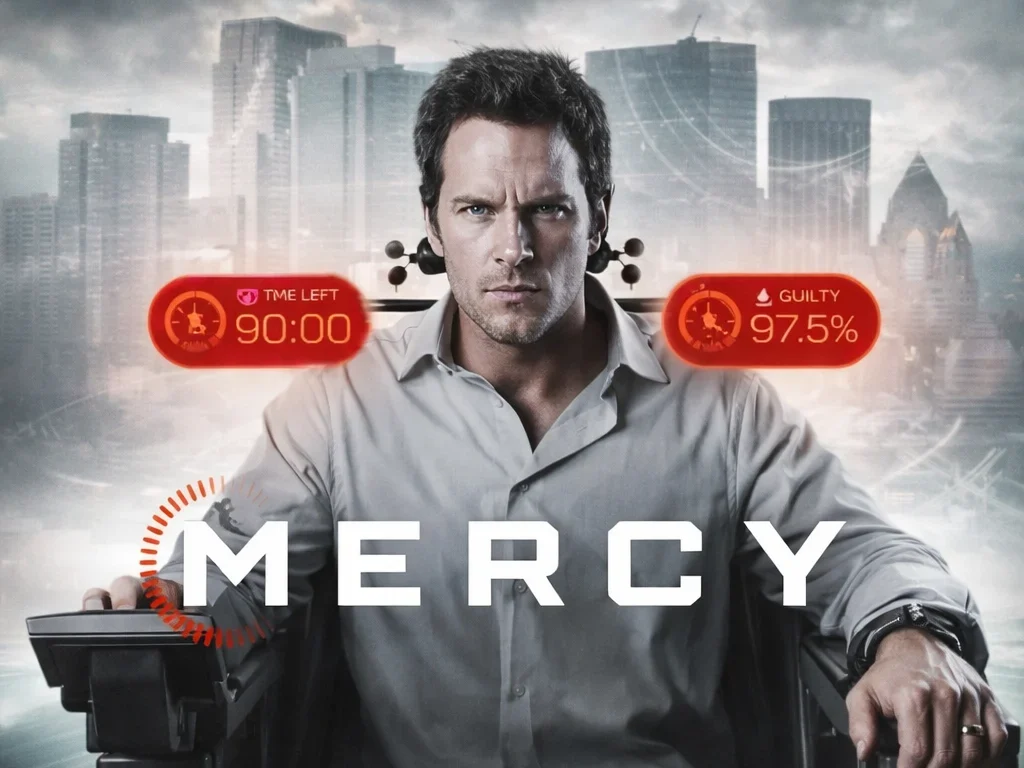
Introduction: A Return to the Age of Lean, Relentless Thrillers
Cinema has a habit of forgetting its own strengths. As technology advances and budgets inflate, films often grow louder, longer, and more complicated, sometimes at the cost of the one thing audiences consistently return for: engagement. There was a period—most notably during the 1990s—when mainstream thrillers understood this balance perfectly. These films did not rely on cinematic universes, excessive exposition, or philosophical over-explanation. They offered a simple promise: a gripping situation, a protagonist under pressure, and a ticking clock that refused to slow down. Mercy (released in some regions as Mercy: 90 Minutes to Die) feels like a deliberate echo of that era.
At a time when many modern films struggle to justify runtimes exceeding two and a half hours, Mercy moves in the opposite direction. It is lean, urgent, and unapologetically focused. Within minutes, the central conflict is established, the stakes are defined, and the audience is thrust into a race against time. There is little interest in easing viewers into its world; instead, the film demands immediate attention. This creative choice is not accidental—it is a statement. Mercy wants to entertain first and explain later, a philosophy that feels almost rebellious in today’s cinematic climate.
The premise itself is striking in its simplicity. A man accused of a serious crime is given ninety minutes to prove his innocence. There are no lengthy trials, no drawn-out investigations, and no second chances. Failure means death. Overseeing this process is an AI-driven justice system designed for efficiency rather than empathy. The idea is undeniably extreme and, when examined closely, deeply unrealistic. Yet this very extremity is what gives the film its momentum. From the moment the countdown begins, the story locks into place and rarely loosens its grip.
This kind of narrative economy was once common. Films like Nick of Time, Phone Booth, and Speed thrived on compressed timelines and relentless pacing. They trusted audiences to keep up, to fill in gaps, and to accept heightened reality as long as the internal logic remained consistent. Mercy operates under the same unwritten contract. It does not ask viewers to believe this world mirrors our own legal systems; it asks only that we accept its rules for the duration of the film. For many viewers, that trade-off is more than reasonable.
What makes Mercy particularly interesting is the context in which it has been released. In 2026, artificial intelligence is no longer a distant science-fiction concept but a daily reality. Algorithms influence what we see, what we buy, and increasingly, how decisions are made. By placing AI at the center of its narrative, Mercy inevitably invites ideological reactions. Some viewers approach the film with curiosity, intrigued by its speculative vision of automated justice. Others respond defensively, fatigued or unsettled by yet another story involving machines exerting control over human lives. This division has played a noticeable role in the film’s reception.
Critically, Mercy does not dwell on these themes with philosophical depth. It uses AI as a narrative mechanism rather than a subject of extended debate. This choice has frustrated some viewers who expected a deeper exploration of ethics, bias, and technological power. Yet it has also allowed the film to maintain its pace. Instead of stopping to lecture, Mercy keeps moving, letting the implications exist in the background while the immediate danger drives the story forward.
This focus on momentum over message is both the film’s greatest strength and its most controversial trait. In an age where many films feel obligated to explain themselves exhaustively, Mercy shows restraint. It trusts its audience to think without being told what to think. For viewers who value intensity and immersion, this restraint is refreshing. For those seeking layered commentary, it can feel unsatisfying.
The film’s reception reflects this tension. Despite strong pacing, solid performances, and an undeniably engaging structure, Mercy has received lower ratings than might be expected for a film that delivers so consistently on a technical level. Some of this can be attributed to predictable plot twists or logical shortcuts. Some stems from an unresolved subplot that raises questions without offering clear answers. But a significant portion of the criticism appears rooted in expectation rather than execution. Audiences anticipating a complex science-fiction drama may find Mercy too straightforward. Those hoping for a realistic legal thriller may reject its premise outright.
Yet to judge Mercy by standards it never aimed to meet is to misunderstand its intent. This is not a film designed to be dissected endlessly or debated academically. It is designed to be experienced. Its pleasures are immediate and visceral: the pressure of time slipping away, the uncertainty of whom to trust, and the constant sense that one wrong move could be fatal. These are the same pleasures that defined an entire generation of thrillers, and Mercy channels them with confidence.
There is also a quiet optimism embedded within the film’s existence. Mid-budget, adult-oriented thrillers have become increasingly rare in mainstream cinema, often pushed aside by franchises and spectacle-driven blockbusters. Mercy serves as a reminder that there is still space for tightly constructed genre films that prioritize storytelling efficiency over excess. Its success—or failure—may well influence whether studios are willing to take similar risks in the future.
Ultimately, Mercy stands as a test case. It asks whether modern audiences still have an appetite for films that move fast, explain little, and trust viewers to stay engaged without constant reinforcement. It asks whether entertainment, in its purest form, is still enough. For those willing to accept its premise and surrender to its pace, Mercy offers a tense, focused experience that feels both nostalgic and timely.
In revisiting the DNA of 1990s thrillers and blending it with contemporary anxieties about artificial intelligence, Mercy occupies a curious space. It is neither groundbreaking nor forgettable. Instead, it is something rarer: a film that knows exactly what it wants to be—and commits to it without apology.
The Core Premise: Simple, Brutal, Effective
At the heart of Mercy is a high-concept idea that would feel right at home in a 90s video store classic. A man is accused of a serious crime and is given an almost impossibly short window—90 minutes—to prove his innocence. Failure does not result in a trial or an appeal, but death. The judge, jury, and executioner in this case is not a human institution, but an AI-driven system designed to deliver swift justice.
On paper, the premise is deeply unrealistic. Expecting anyone to gather evidence, uncover conspiracies, and clear their name within hours of a crime is absurd. Adding an inflexible countdown only amplifies that absurdity. Yet Mercy understands a crucial rule of genre filmmaking: realism is optional; internal consistency is not.
The film establishes its rules early and sticks to them. Once the audience accepts the central conceit, the ticking clock becomes a powerful narrative engine. Every decision matters. Every delay feels dangerous. The result is sustained tension that rarely lets up.
Pacing: The Film’s Greatest Strength
If Mercy excels in one area above all others, it is pacing. The film wastes no time setting the stage. There are no lengthy backstories, no indulgent world-building sequences, and no philosophical monologues disguised as exposition. Within minutes, the stakes are clear, the threat is real, and the countdown has begun.
From that point onward, the film moves with purpose. Scenes transition quickly, information is delivered efficiently, and the narrative momentum never truly slows. Even quieter moments feel charged with urgency because the clock is always present in the audience’s mind.
This relentless pacing is a deliberate stylistic choice, and it aligns perfectly with the film’s concept. A story built around a 90-minute deadline should feel breathless, and Mercy understands that instinctively. In an era where many thrillers bloat beyond two hours without justification, this discipline is refreshing.
A Throwback to 90s Thrillers
One of the most striking aspects of Mercy is how strongly it resembles the thrillers of the 1990s. Films from that era often relied on:
- A single, compelling hook
- A clear protagonist under extreme pressure
- Straightforward moral stakes
- Practical storytelling over spectacle
Mercy embraces all of these elements. It does not attempt to deconstruct its genre or reinvent cinematic language. Instead, it leans into familiar rhythms: chase sequences, confrontations, sudden revelations, and last-minute reversals.
For viewers who grew up watching films like Nick of Time, Phone Booth, or Enemy of the State, Mercy feels instantly recognizable. That familiarity is not a weakness. In fact, it becomes one of the film’s primary sources of charm.
Performances: Carrying the Tension Without Stealing the Spotlight
In a film like Mercy, performances serve a very specific purpose. This is not a character-driven drama designed to explore deep psychological layers or emotional backstories. Instead, the actors are tasked with sustaining tension, grounding an inherently implausible premise, and ensuring that the audience remains emotionally invested in a rapidly unfolding crisis. Within those constraints, Mercy delivers performances that are controlled, functional, and surprisingly effective.
The lead performance anchors the entire film. From the opening moments, the protagonist is thrust into a situation defined by urgency and helplessness. There is no slow burn introduction to his personality, no extended domestic scenes designed to build sympathy. Instead, the actor must convey fear, confusion, and determination almost immediately—and do so convincingly enough that the audience accepts the stakes. This is a difficult balance to strike. Overplay the panic, and the character becomes exhausting. Underplay it, and the danger feels abstract. The performance in Mercy finds a middle ground, favoring restraint over melodrama.
Much of the protagonist’s work is reactive rather than expressive. He listens, processes, and makes rapid decisions under pressure. These moments are often more revealing than overt emotional displays. Subtle shifts in posture, controlled breathing, and brief flashes of anger or desperation communicate the psychological toll of the countdown more effectively than monologues ever could. This understated approach aligns well with the film’s pacing, allowing scenes to move quickly without sacrificing credibility.
The supporting cast functions as an extension of the film’s ticking-clock structure. Each character enters the narrative with a clear purpose: to obstruct, assist, mislead, or challenge the protagonist. Rather than being fully realized individuals, they operate as narrative pressure points. This could have resulted in flat or forgettable performances, but Mercy avoids that pitfall through consistency and focus.
Authority figures, in particular, are portrayed with deliberate emotional distance. Whether human or AI-adjacent, these characters embody a system that values efficiency over empathy. The performances lean into this coldness, reinforcing the film’s thematic tension between human instinct and automated judgment. The lack of warmth is not a flaw but a design choice. It reminds the audience that mercy, despite the title, is not guaranteed in this world.
One of the more interesting aspects of the performances lies in how the film handles exposition. Information is delivered rapidly and often under stress, which can easily become awkward or unnatural. The actors manage this challenge by integrating exposition into action. Lines are spoken while moving, arguing, or reacting to new developments, which keeps scenes dynamic and prevents the dialogue from feeling instructional. This technique is very much in line with classic thrillers, where explanation is secondary to momentum.
The film’s antagonistic forces—whether represented by individuals or systems—are played with restraint rather than theatrical menace. There are no exaggerated villains delivering grand speeches. Instead, opposition feels procedural, almost indifferent. This makes the threat more unsettling. The actors behind these roles understand that the true antagonist is time itself, and their performances reflect that understanding.
A notable point of discussion among viewers has been a secondary character associated with the subplot involving a man and his daughter. The performance in these scenes is emotionally charged, suggesting importance and moral weight. However, because the narrative does not fully integrate this subplot into the main story, the performance ends up feeling disconnected. This is not a failure of acting but of narrative follow-through. The actor commits fully, which paradoxically makes the lack of payoff more noticeable.
This disconnect highlights an important truth about performance in genre films: strong acting cannot compensate for underwritten or unresolved storylines. While the emotional sincerity of these scenes adds texture, it also raises expectations that the film ultimately does not meet. As a result, viewers are left questioning the purpose of these moments rather than appreciating them in isolation.
Across the board, Mercy avoids the trap of overacting that often plagues high-stakes thrillers. There are no prolonged breakdowns or exaggerated emotional beats. Even in moments of extreme pressure, performances remain grounded. This restraint helps maintain the film’s tone and prevents it from tipping into self-parody. It also reinforces the sense that this is a world where emotions are a liability—hesitation and vulnerability can be fatal.
Another strength of the performances is their contribution to pacing. Actors rarely linger on reactions longer than necessary. Scenes cut away quickly, often before emotional beats fully resolve. This could feel abrupt in another context, but here it reinforces urgency. The cast understands that their job is not to invite reflection, but to propel the narrative forward.
Ultimately, the performances in Mercy do exactly what they need to do—and nothing more. They do not demand attention, but they also do not undermine the film’s credibility. The actors respect the genre, the pace, and the audience’s expectations. In a film built on momentum, this discipline is invaluable.
While Mercy may not feature award-worthy performances or deeply memorable characters, it succeeds in creating a cohesive, believable emotional experience. The cast serves the story rather than competing with it, allowing tension to remain the dominant force. In the context of a lean, high-concept thriller, that is not a limitation—it is a strength.
Plot Twists: Predictable but Engaging
The film includes several twists designed to keep the audience guessing. Some of these developments are genuinely effective, while others can be seen coming from a distance. Importantly, predictability does not entirely diminish their impact.
In high-pressure thrillers, the timing of a twist often matters more than its originality. Even when viewers anticipate a revelation, its execution—how and when it occurs—can still be satisfying. Mercy understands this dynamic and uses it to maintain engagement.
While the film never reaches the narrative complexity of top-tier thrillers, it offers enough surprises to justify its runtime and keep viewers invested until the final moments.
The AI Element: Theme or Trigger?
One of the most divisive aspects of Mercy is its use of artificial intelligence as a central narrative force. The AI system in the film represents an extreme version of automated justice—efficient, emotionless, and unforgiving.
For some viewers, this concept is fascinating. It taps into contemporary anxieties about surveillance, algorithmic decision-making, and the erosion of human judgment. For others, AI has become an overused or uncomfortable topic, leading to immediate resistance.
This division may explain why Mercy has received lower ratings than its overall quality might suggest. Some audiences appear to react less to the film itself and more to what it represents. Rather than judging pacing, performances, or storytelling, they respond emotionally to the idea of AI as an authority figure.
Whether intentional or not, Mercy becomes a litmus test for how audiences feel about technology’s growing role in society.
Suspension of Disbelief: A Necessary Contract
Mercy asks a great deal from its audience in terms of suspension of disbelief. The legal system depicted in the film bears little resemblance to reality. Evidence appears quickly, coincidences abound, and the AI’s authority goes largely unquestioned.
However, the film never pretends to be a realistic procedural. Its world operates under heightened rules, and once those rules are accepted, the story functions smoothly. Viewers willing to engage with the film on its own terms are rewarded with a gripping experience.
Those who demand strict realism, however, are likely to find the premise frustrating or even offensive. This disconnect again contributes to polarized reception.
The Unresolved Subplot: The Man and the Daughter
One of the film’s most puzzling elements is a subplot involving a man and his daughter, shown through video footage. The scenes are emotionally loaded, suggesting significance, yet their narrative payoff never fully materializes.
This raises several possibilities:
- The subplot may be a red herring intended to mislead viewers
- Key scenes may have been removed during editing
- The footage could serve a symbolic purpose rather than a literal one
- It may hint at a sequel or expanded universe
Regardless of intent, the lack of clarity weakens the film slightly. In a tightly constructed thriller, unresolved threads stand out more sharply. While the subplot does not ruin the film, it leaves viewers with lingering questions that distract from an otherwise focused narrative.
Why the Ratings Are Lower Than Expected
Given its strengths, the relatively low ratings for Mercy may seem surprising. Several factors likely contribute:
- Audience fatigue with AI-related stories
- Unrealistic legal and ethical premises
- Predictable narrative beats
- The unresolved subplot
- Mismatched expectations from viewers expecting deeper sci-fi themes
Importantly, none of these issues fundamentally undermine the film’s core achievement: delivering a tense, entertaining thriller.
Entertainment Value vs. Artistic Ambition
One of the most important questions Mercy raises is not about artificial intelligence or justice, but about cinema itself: should a film aim primarily to entertain, or should it strive for artistic and philosophical depth? In the case of Mercy, the answer is refreshingly clear. This is a film that prioritizes entertainment, and it does so without hesitation or apology.
From its opening moments, Mercy establishes momentum as its core objective. The narrative is built around urgency rather than reflection. Scenes are structured to escalate tension, not to invite contemplation. This approach places the film firmly in the tradition of classic genre thrillers, where audience engagement is measured in heart rate rather than intellectual debate. The result is a viewing experience that is immersive, immediate, and consistently engaging.
Artistic ambition, as it is commonly understood today, often involves layered symbolism, thematic complexity, and moral ambiguity. Films that pursue these goals tend to slow their pace, allowing ideas to breathe and characters to evolve in detailed ways. Mercy consciously avoids this path. While it introduces provocative concepts—such as AI-driven justice—it does not pause to explore them in depth. Instead, these ideas function as background architecture, supporting the story rather than dominating it.
This restraint has been a point of contention among critics and audiences. Some view the film’s lack of deeper exploration as a missed opportunity, arguing that its premise deserved a more nuanced examination. Others see this choice as a strength. By refusing to over-explain or moralize, Mercy maintains narrative efficiency. It trusts viewers to recognize the implications without needing them spelled out.
The tension between entertainment and artistry is particularly evident in the film’s structure. The story moves quickly from one development to the next, often cutting away before emotional or thematic beats fully resolve. From an artistic standpoint, this can feel abrupt or underdeveloped. From an entertainment perspective, it is exactly what keeps the film gripping. The ticking clock leaves no room for indulgence, and the film adheres strictly to that logic.
What Mercy ultimately demonstrates is that artistic ambition and entertainment value do not always need to coexist in equal measure. A film can succeed by committing fully to one over the other. Problems arise when a movie attempts to do both and fails to satisfy either. Mercy avoids this trap by understanding its own limitations and strengths.
In doing so, it revives an older model of filmmaking that has become increasingly rare: the mid-budget thriller designed for adult audiences seeking a focused, high-stakes experience. These films were never intended to be dissected endlessly or celebrated for innovation. They existed to deliver tension, suspense, and resolution—and then get out of the way.
In the end, Mercy may not linger in the mind as a work of art, but it succeeds in something just as valuable: it holds attention. In a cinematic era crowded with ambition and excess, there is something quietly admirable about a film that knows exactly what it is, delivers on that promise, and leaves the audience entertained.
Box Office Hopes and the Future of Mid-Budget Thrillers
If Mercy performs well financially, it could signal renewed interest in mid-budget thrillers. These films once formed the backbone of theatrical releases, offering adult audiences compelling stories without franchise baggage.
The success of Mercy would suggest that there is still a market for tightly written, efficiently directed genre films—movies that respect the audience’s time and intelligence without overwhelming them.
Conclusion: A Lean Thriller That Knows Its Purpose
Mercy is not a film that asks to be admired; it asks to be experienced. In an era of cinema increasingly defined by excess—long runtimes, inflated budgets, and narratives weighed down by over-explanation—its greatest achievement lies in its restraint. This is a thriller built on momentum, urgency, and commitment to a single, high-stakes idea. It may stumble in places, but it never loses sight of its core objective: to keep the audience engaged from start to finish.
At its best, Mercy feels like a deliberate revival of a filmmaking philosophy that once dominated mainstream cinema. The 1990s produced a steady stream of tightly constructed thrillers that thrived on simple premises executed with confidence. These films understood that tension does not require complexity, and that emotional investment can be achieved through immediacy rather than depth. Mercy operates in this same tradition, and its success is inseparable from that lineage.
The film’s relentless pacing is both its defining trait and its primary defense against criticism. Logical inconsistencies, implausible systems, and narrative shortcuts are all present, but they are rarely given time to undermine the experience. The countdown structure forces constant forward motion, leaving little space for doubt to settle. This design choice may frustrate viewers seeking realism or nuance, but it rewards those willing to engage on the film’s own terms.
Performances across the board reflect this philosophy. Rather than demanding attention, the cast supports the story with discipline and restraint. The protagonist’s emotional journey is conveyed through action and reaction rather than exposition, reinforcing the sense that survival leaves little room for introspection. Supporting characters function as extensions of the narrative machine, each adding pressure rather than relief. This approach may limit character depth, but it enhances tension, which is ultimately the film’s currency.
The inclusion of artificial intelligence as a central narrative force adds a contemporary edge to what is otherwise a very traditional thriller. However, Mercy uses AI less as a subject of inquiry and more as a mechanism of threat. It represents an authority that is efficient, impartial, and terrifyingly inflexible. This choice has divided audiences, with some responding to the concept emotionally rather than critically. In doing so, the film has inadvertently become a mirror reflecting current anxieties about technology, control, and accountability.
One of the film’s more noticeable shortcomings lies in its unresolved subplot involving a man and his daughter. These moments are emotionally charged and suggest thematic relevance, yet they never fully integrate into the main narrative. Rather than deepening the story, they introduce questions that remain unanswered. While this flaw does not derail the film, it stands out precisely because the rest of the narrative is so tightly focused. In a thriller built on precision, loose ends feel more conspicuous.
Despite these imperfections, the relatively low ratings Mercy has received seem less like an accurate measure of quality and more like a reflection of expectation mismatch. Viewers approaching the film as a philosophical science-fiction drama or a realistic legal thriller are likely to be disappointed. Those who recognize it as a genre exercise rooted in tension and pace are far more likely to appreciate its strengths.
What Mercy ultimately demonstrates is the value of clarity in filmmaking. It does not attempt to be everything at once. It does not chase trends or attempt to justify its existence through grand statements. Instead, it commits fully to a specific kind of cinematic experience. That confidence, even when imperfectly executed, is increasingly rare.
The film’s existence also raises broader questions about the future of mid-budget thrillers. For years, this category has been squeezed out of theatrical releases, replaced by franchise entries and spectacle-driven blockbusters. Mercy serves as a reminder that there is still an audience for films that prioritize storytelling efficiency over excess. Its performance at the box office may influence whether studios are willing to invest in similar projects moving forward.
In the end, Mercy may not linger as a defining film of its era, but it fulfills a role that cinema sorely needs. It entertains without apology, respects the audience’s time, and delivers a focused narrative experience. For viewers tired of bloated runtimes and overambitious storytelling, it offers a welcome alternative.
Mercy is proof that sometimes, a good thriller does not need to be profound—it needs to be precise. And in choosing precision over pretension, it earns its place as a solid, engaging entry in a genre that deserves far more attention than it currently receives.
How Mayasabha Tries Something Different in Hindi Cinema…. Is Border 2 Really a Cashgrab…….?