
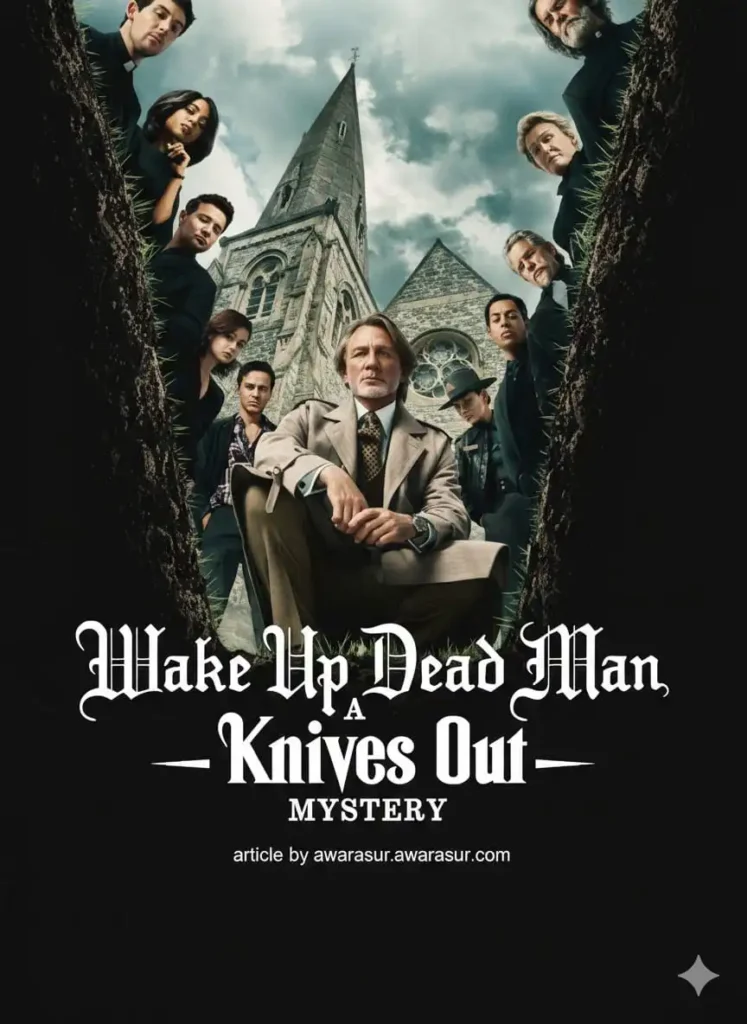
Introduction: The Resurrection of the Whodunit
For decades, the murder-mystery genre—commonly referred to as the whodunit—has occupied a unique position in cinema. Once dominated by literary adaptations and drawing-room mysteries, the genre gradually faded from mainstream relevance as action-driven blockbusters and franchise spectacles took center stage. However, with the release of Knives Out (2019), writer-director Rian Johnson reignited popular interest in intelligent, character-driven mysteries.
The Knives Out franchise not only proved that audiences still crave clever plotting and sharp dialogue, but it also demonstrated that mystery films could be both commercially successful and culturally resonant. Its success has triggered a broader revival of similar franchises and standalone films that combine crime, satire, ensemble casts, and social commentary.
This article explores the Knives Out franchise in depth—its origins, themes, narrative structure, and cultural impact—before expanding into an analysis of similar franchises and films that operate in the same narrative and stylistic tradition.
Part I: Understanding the Knives Out Franchise
1. Origins and Creative Vision
Knives Out was conceived by Rian Johnson as a deliberate homage to classic detective fiction, particularly the works of Agatha Christie. Johnson, known for subverting genre expectations (Brick, Looper, Star Wars: The Last Jedi), sought to both celebrate and modernize the whodunit formula.
Rather than merely recreating the traditional mystery, Johnson infused the genre with contemporary themes: class inequality, immigration, entitlement, and moral hypocrisy. This blend of old and new became the franchise’s defining characteristic.
2. Knives Out (2019): Plot and Structure
At its core, Knives Out follows the mysterious death of bestselling crime novelist Harlan Thrombey. The prime suspects are his dysfunctional, wealthy family members, each motivated by greed, resentment, or desperation.
Enter Benoit Blanc, a Southern-accented private detective portrayed by Daniel Craig. Blanc’s eccentric demeanor masks a razor-sharp intellect, positioning him as both homage to and parody of classic detectives like Hercule Poirot.
What sets Knives Out apart structurally is its inverted mystery. Rather than concealing the crime from the audience, the film reveals key details early on, shifting the tension from who committed the murder to how the truth will be uncovered. This narrative gamble paid off, allowing character psychology and social critique to take center stage.
3. Themes and Social Commentary
The franchise distinguishes itself by embedding sharp political and social observations within its mystery framework:
- Class Divide: The Thrombey family represents inherited privilege, contrasted with Marta Cabrera, a hardworking immigrant nurse.
- Moral Hypocrisy: Characters present themselves as self-made or virtuous while exploiting others.
- Immigration and Identity: Marta’s background becomes a focal point for the family’s casual racism and performative liberalism.
Rather than moralizing overtly, Knives Out allows its characters to reveal their values through dialogue and behavior, making its critique both humorous and biting.
4. Glass Onion: A Knives Out Mystery (2022)
The sequel, Glass Onion, shifts locations, themes, and social targets while retaining Benoit Blanc as its central figure. Set on a private Greek island owned by tech billionaire Miles Bron, the film satirizes:
- Tech-industry arrogance
- Performative intelligence
- The cult of disruption and innovation
Unlike the cozy, Gothic atmosphere of the first film, Glass Onion adopts a sun-drenched, modern aesthetic. Its mystery is more overtly absurd, emphasizing how stupidity can masquerade as genius in elite circles.
Together, the two films establish Knives Out not as a linear story but as an anthology-style franchise, united by tone, detective, and thematic intent rather than continuity.
Part II: Why Knives Out Works as a Franchise
1. The Detective-as-Anchor Model
Much like Sherlock Holmes or Hercule Poirot, Benoit Blanc serves as the connective tissue between stories. This allows each installment to explore new settings, casts, and mysteries without narrative constraints.
2. Ensemble Casting
A defining feature of Knives Out is its use of high-profile ensemble casts. Recognizable actors bring immediate intrigue, while their star personas are often subverted for comedic or dramatic effect.
3. Genre Flexibility
The franchise blends:
- Mystery
- Satire
- Dark comedy
- Social drama
This flexibility prevents stagnation and allows each film to reflect contemporary anxieties.
Part III: Similar Franchises and Films
The success of Knives Out has renewed interest in several related franchises and standalone films that share thematic or structural DNA.
1. Agatha Christie Adaptations (Poirot Franchise)
Key Films
- Murder on the Orient Express (2017)
- Death on the Nile (2022)
- A Haunting in Venice (2023)
Kenneth Branagh’s modern adaptations of Christie’s novels represent a more classical approach to the genre. Unlike Knives Out, these films emphasize atmosphere, period authenticity, and traditional mystery structures.
Comparison to Knives Out:
- More reverent, less satirical
- Focus on psychological trauma and morality
- Less overt social commentary
Despite mixed critical reception, these films indicate continued audience appetite for high-budget mysteries.
2. Sherlock Holmes Franchise
Key Films
- Sherlock Holmes (2009)
- Sherlock Holmes: A Game of Shadows (2011)
Guy Ritchie’s take on Sherlock Holmes transforms cerebral deduction into kinetic spectacle. While structurally different from Knives Out, the franchise shares the concept of an iconic detective navigating complex conspiracies.
Key Differences:
- Action-oriented storytelling
- Serialized antagonists
- Less emphasis on ensemble suspicion
3. Clue (1985): The Cult Predecessor
Often cited as a spiritual ancestor to Knives Out, Clue adapts the board game into a fast-paced comedy-mystery with multiple endings.
Shared Traits:
- Ensemble suspects
- Stylized dialogue
- Absurdist humor
Clue failed commercially upon release but gained cult status—an arc Knives Out avoided through critical acclaim and mainstream appeal.
4. The Hateful Eight (2015)
Quentin Tarantino’s Western mystery unfolds largely in a single location, emphasizing paranoia, dialogue, and moral decay.
Parallels with Knives Out:
- Ensemble cast
- Gradual revelation of secrets
- Commentary on American identity
While far more violent and nihilistic, the film demonstrates how mystery structures can thrive across genres.
5. Murder Mystery Franchise (Netflix)
Films
- Murder Mystery (2019)
- Murder Mystery 2 (2023)
Starring Adam Sandler and Jennifer Aniston, this franchise adopts the whodunit format for broad comedy rather than satire or social critique.
Contrast with Knives Out:
- Simpler plotting
- Less thematic depth
- Greater emphasis on humor
Despite critical skepticism, the films’ popularity underscores the genre’s adaptability.
6. See How They Run (2022)
Set in 1950s London, this meta-mystery revolves around the murder of a film director working on an Agatha Christie adaptation.
Notable Elements:
- Self-aware humor
- Period aesthetics
- Commentary on storytelling itself
Like Knives Out, it treats the genre as both playground and subject of analysis.
Part IV: Television Counterparts
The whodunit revival extends beyond cinema into serialized storytelling.
1. Only Murders in the Building
This series blends mystery, comedy, and podcast culture, featuring amateur detectives investigating murders in their apartment complex.
Shared DNA with Knives Out:
- Humor-driven mystery
- Character-centric storytelling
- Satirical take on obsession and media
2. Poker Face (Created by Rian Johnson)
Starring Natasha Lyonne, Poker Face employs a “howcatchem” structure reminiscent of Columbo. Each episode presents a self-contained mystery.
This series reinforces Johnson’s broader contribution to the modern mystery renaissance.
Part V: The Cultural Impact of the Knives Out Model
1. Reinventing Franchise Logic
Unlike typical franchises driven by lore or spectacle, Knives Out demonstrates that ideas, tone, and character archetypes can sustain long-running series.
2. Audience Intelligence as an Asset
The franchise trusts its audience to follow complex dialogue, thematic nuance, and narrative misdirection—countering the assumption that mass appeal requires simplicity.
3. Economic Viability
With modest budgets and strong returns, mystery franchises present a financially sustainable alternative to CGI-heavy blockbusters.
Why the Knives Out Franchise Matters More Than It Appears
The Knives Out franchise is often described casually as a “fun murder mystery.” This description, while not incorrect, severely underestimates its significance. What Rian Johnson has achieved is not merely a revival of a dormant genre, but a structural re-engineering of the whodunit for the 21st century—one that reflects contemporary power systems, media culture, and moral ambiguity.
To understand why Knives Out stands apart from similar franchises, we must examine how it uses mystery—not just what mystery it presents.
1. The Whodunit as a Social X-Ray
Classic whodunits (Agatha Christie, Dorothy L. Sayers) often used murder as a narrative excuse to gather characters in one location. Knives Out adopts this device but upgrades its function: the investigation becomes a diagnostic tool for society itself.
Class as the True Crime Scene
In Knives Out (2019), the Thrombey mansion is not just a setting—it is a symbolic fortress of inherited privilege. Every staircase, artifact, and hidden passage reflects generational wealth accumulated without accountability.
The murder investigation exposes:
- Who benefits from power
- Who believes they are entitled to it
- Who survives by competence rather than inheritance
Marta Cabrera’s inability to lie without vomiting is not just a plot gimmick—it is a moral mechanism. Truth physically rejects corruption. In contrast, the wealthy characters lie effortlessly, demonstrating how dishonesty becomes normalized within power structures.
This approach elevates the film from a puzzle to a moral autopsy.
2. Benoit Blanc: A Postmodern Detective
Unlike Sherlock Holmes or Hercule Poirot, Benoit Blanc is not defined by superhuman intelligence or emotional detachment.
Why Blanc Is Different
- He listens more than he speaks
- He allows others to underestimate him
- He weaponizes performative eccentricity
Blanc functions less as a solver of crimes and more as a catalyst. His presence accelerates the self-destruction of the guilty. In this sense, he resembles Columbo, but with modern self-awareness.
Importantly, Blanc does not represent authority. He stands outside institutions—law enforcement, courts, corporations. This aligns with contemporary skepticism toward systems of justice and reinforces the idea that truth emerges despite systems, not because of them.
3. Glass Onion: Satire as Structural Critique
If Knives Out dissects old money, Glass Onion dissects new money and intellectual performance.
The Illusion of Genius
Miles Bron is not a criminal mastermind. He is something more dangerous: a mediocre man mistaken for a visionary. This distinction is critical.
The film argues that modern power is not maintained by intelligence, but by:
- Narrative control
- Financial leverage
- The fear of contradicting success
The “glass onion” metaphor reinforces this:
- Layers appear complex
- At the core, everything is obvious
- The truth is visible, yet ignored
This is a direct critique of Silicon Valley culture, influencer capitalism, and media amplification.
4. Anthology Storytelling: The Anti-Cinematic Universe
Unlike Marvel or Star Wars, Knives Out rejects world-building in favor of idea-building.
Each film asks:
- Who holds power now?
- How is truth distorted today?
- What kind of lies are socially acceptable in this moment?
This makes the franchise future-proof. It does not depend on lore, continuity, or escalation. It depends on observation.
5. Comparing Knives Out to Similar Franchises (Deeper Analysis)
Agatha Christie Adaptations
Christie’s stories focus on moral equilibrium. Once the murderer is revealed, order is restored.
Knives Out rejects this closure.
- The guilty are exposed, but systems remain intact
- Justice is partial, not absolute
- Moral clarity does not guarantee social change
This reflects modern realism.
Sherlock Holmes
Holmes stories celebrate rationality and logic as supreme virtues.
Knives Out suggests logic alone is insufficient.
- Emotional intelligence matters
- Social context matters
- Power dynamics distort evidence
Blanc solves crimes by understanding people, not just clues.
Clue
Clue embraces absurdity and chaos, presenting truth as optional.
Knives Out blends humor with consequence. Its jokes reveal character flaws rather than deflecting from them.
The Hateful Eight
Tarantino uses mystery to expose America’s original sin—violence.
Johnson uses mystery to expose America’s modern sin—entitlement without responsibility.
Both trap characters in confined spaces, but Johnson replaces bloodshed with exposure.
Murder Mystery (Netflix)
This franchise uses the genre as a comedic backdrop.
Knives Out uses comedy as a weapon—disarming audiences while delivering critique.
6. Television’s Role in the Mystery Renaissance
Only Murders in the Building
This series reflects our obsession with:
- True crime entertainment
- Amateur investigation
- Voyeuristic justice
It questions whether modern audiences want truth—or just a compelling story.
Poker Face
Here, Johnson experiments with a reversal:
- The audience knows the criminal
- The tension lies in inevitability
This reinforces a core idea of Knives Out: truth is not hidden—it is ignored.
7. Why These Films Work Now (Cultural Context)
The resurgence of mystery films is not accidental.
We Live in an Age of:
- Information overload
- Misinformation
- Performative morality
- Distrust in institutions
Mystery stories offer:
- Structure in chaos
- Moral inquiry without preaching
- The fantasy that truth can still matter
Knives Out acknowledges uncertainty while still insisting on accountability.
8. The Future of the Genre
Future mystery franchises inspired by Knives Out will likely:
- Focus on thematic relevance rather than spectacle
- Use ensemble casts to represent social ecosystems
- Treat truth as contested, not absolute
The genre is evolving from puzzle-solving to power analysis.
Conclusion: The Future of the Modern Mystery
The Knives Out franchise represents more than a successful series of films—it marks a broader cultural shift. In an era saturated with reboots and cinematic universes, Knives Out proves that originality, wit, and narrative intelligence still resonate.
By blending classical mystery structures with modern social commentary, the franchise has inspired a new wave of films and series that treat the whodunit not as a relic, but as a living, evolving form.
As long as storytellers continue to find new ways to explore human greed, deception, and truth, the knives—metaphorical and otherwise—will remain out.
Final Thought
The Knives Out franchise succeeds because it understands a fundamental truth about storytelling today:
Know about the different types of zombie portrayal in pop culture…The real mystery is no longer who committed the crime,
but why society allows it to happen.