
Introduction
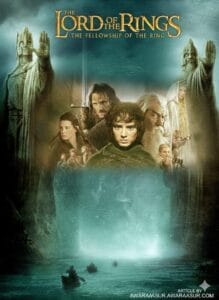
The Lord of the Rings: The Fellowship of the Ring, directed by Peter Jackson and released in 2001, is the opening installment of one of the most ambitious cinematic projects ever undertaken. Adapted from J.R.R. Tolkien’s seminal fantasy novel 𝐓𝐡𝐞 𝐋𝐨𝐫𝐝 𝐨𝐟 𝐭𝐡𝐞 𝐑𝐢𝐧𝐠𝐬: 𝐓𝐡𝐞 𝐅𝐞𝐥𝐥𝐨𝐰𝐬𝐡𝐢𝐩 𝐨𝐟 𝐭𝐡𝐞 𝐑𝐢𝐧𝐠 (𝟐𝟎𝟎𝟏) (1954), the film laid the foundation for a trilogy that would redefine epic storytelling in cinema. More than a fantasy adventure, the film is a meditation on power, friendship, sacrifice, corruption, and moral responsibility. Its success lies not only in its spectacular visuals and groundbreaking technology but also in its emotional depth, narrative structure, and philosophical undertones.
This review examines the film across multiple dimensions: narrative and structure, characterization, themes, world-building, visual effects, sound design, direction, cultural impact, and legacy. By analyzing these aspects in detail, the review seeks to explain why The Fellowship of the Ring remains a landmark achievement in film history more than two decades after its release.
Narrative Structure and Storytelling
At its core, The Fellowship of the Ring follows the classical quest narrative. The story revolves around the One Ring, an object of immense power created by the Dark Lord Sauron to dominate Middle-earth. When the Ring resurfaces, it falls into the hands of Frodo Baggins, a humble hobbit from the Shire. Recognizing the danger the Ring poses, a fellowship is formed to carry it to Mount Doom, where it can be destroyed.
Peter Jackson’s adaptation balances fidelity to Tolkien’s source material with the demands of cinematic pacing. The film opens with a dense prologue that efficiently summarizes the ancient history of the Ring, immediately establishing high stakes and mythic scale. This choice allows new viewers to grasp the significance of the Ring without prior knowledge of the books.
The narrative is carefully structured into three broad movements:
- The Shire and Awakening of the Threat – A pastoral beginning that establishes innocence and normalcy.
- Flight and Formation of the Fellowship – Rising tension, danger, and the expansion of the world.
- Journey, Division, and Loss – Emotional climax and the fragmentation of unity.
This structure mirrors the emotional arc of the characters, particularly Frodo, whose journey transitions from reluctant acceptance to resolute determination.
Characterization and Performances
One of the film’s greatest strengths is its ensemble cast and the depth afforded to each major character. Despite the large number of protagonists, the film manages to give each a distinct identity and narrative purpose.
Key Characters and Their Narrative Roles
| Character | Actor | Narrative Function | Key Traits |
|---|---|---|---|
| Frodo Baggins | Elijah Wood | Ring-bearer, moral center | Innocent, resilient, compassionate |
| Gandalf | Ian McKellen | Mentor and guide | Wise, authoritative, sacrificial |
| Aragorn | Viggo Mortensen | Reluctant leader | Honorable, conflicted, courageous |
| Boromir | Sean Bean | Tragic hero | Proud, loyal, flawed |
| Samwise Gamgee | Sean Astin | Emotional anchor | Loyal, selfless, steadfast |
| Legolas | Orlando Bloom | Skilled warrior | Graceful, perceptive |
| Gimli | John Rhys-Davies | Comic relief and strength | Proud, loyal |
| Saruman | Christopher Lee | Fallen authority | Manipulative, corrupted |
Elijah Wood’s portrayal of Frodo is particularly effective in conveying vulnerability and inner conflict. Rather than presenting Frodo as a traditional heroic figure, the film emphasizes his emotional fragility, making his endurance more compelling.
Ian McKellen’s Gandalf is another standout performance. His presence brings gravitas and warmth, embodying both wisdom and humility. Gandalf’s fall in Moria marks a pivotal emotional moment, reinforcing the idea that no character is invulnerable.
Boromir’s arc deserves special attention. His gradual corruption by the Ring and eventual redemption humanize the abstract concept of temptation, showing how noble intentions can still lead to moral failure.
Themes and Philosophical Depth
Power and Corruption
The central theme of the film is the corrupting nature of power. The Ring does not simply grant strength; it amplifies existing desires and weaknesses. Characters react to the Ring differently, revealing their moral fiber. The refusal of characters like Gandalf and Galadriel to wield the Ring underscores true wisdom: understanding one’s own vulnerability to corruption.
Friendship and Fellowship
The concept of fellowship is not merely a plot device but the emotional core of the film. The unity between vastly different races—hobbits, men, elves, and dwarves—symbolizes hope through cooperation. The breaking of the Fellowship at the film’s conclusion reinforces the idea that unity must be actively maintained and is always fragile.
Sacrifice and Duty
Many characters are driven by duty rather than personal gain. Frodo accepts the burden of the Ring, knowing it will cost him his peace and possibly his life. Gandalf’s sacrifice in Moria epitomizes leadership through selflessness.
World-Building and Mythology
Few films have achieved the level of immersive world-building seen in The Fellowship of the Ring. Middle-earth feels ancient, lived-in, and culturally rich. This is achieved through a combination of detailed production design, costume work, language creation, and geographical diversity.
Key Locations and Their Symbolism
| Location | Symbolic Meaning |
|---|---|
| The Shire | Innocence, simplicity |
| Rivendell | Wisdom, refuge |
| Moria | Lost glory, greed |
| Lothlórien | Timeless beauty, melancholy |
| Isengard | Industrial corruption |
Each setting reinforces thematic elements. For instance, the contrast between the natural beauty of Lothlórien and the industrial devastation of Isengard visually communicates Tolkien’s critique of unchecked industrialization.
Direction and Cinematic Vision
Peter Jackson’s direction is both ambitious and disciplined. Rather than focusing solely on spectacle, he prioritizes emotional continuity and narrative clarity. His use of wide shots establishes scale, while intimate close-ups preserve character focus.
Jackson’s decision to film all three movies simultaneously was unprecedented and risky, yet it ensured visual and tonal consistency across the trilogy. The Fellowship of the Ring benefits from this foresight, as character arcs and visual motifs feel deliberately planted rather than improvised.
Visual Effects and Cinematography
At the time of its release, the film set new standards for visual effects. The integration of practical effects, miniatures (“bigatures”), and CGI created a believable fantasy world without overwhelming the viewer.
Visual Techniques Used
| Technique | Purpose |
|---|---|
| Forced perspective | Size differences between hobbits and others |
| Miniatures | Large-scale environments |
| CGI | Creatures, environments |
| Practical makeup | Realistic character design |
Cinematographer Andrew Lesnie uses lighting and color palettes strategically. The Shire is bathed in warm, earthy tones, while Mordor-associated imagery leans toward dark, oppressive hues.
Music and Sound Design
Howard Shore’s score is integral to the film’s identity. Rather than serving as background accompaniment, the music functions as narrative reinforcement. Each culture and location has its own musical motif, adding emotional depth and continuity.
The “Shire Theme” evokes nostalgia and innocence, while the Fellowship theme conveys unity and resolve. Sound design complements the score, with distinct auditory signatures for environments, weapons, and creatures.
Text-Based Graph: Emotional Intensity Across the Film
Below is a textual bar graph representing the relative emotional intensity at key stages of the film (scale: 1–10).
Prologue                ████████ 8
Life in the Shire       ███ 3
Black Riders Appear     ██████ 6
Council of Elrond       █████ 5
Journey Begins          ██████ 6
Moria and Gandalf’s Fall█████████ 9
Lothlórien              ████ 4
Boromir’s Death         ██████████ 10
Ending / New Resolve    ██████ 6
This progression demonstrates how the film gradually escalates emotional stakes, peaking with loss and sacrifice before settling into determined resolve.
Cultural Impact and Legacy
The Fellowship of the Ring had a profound impact on global cinema. It legitimized fantasy as a serious cinematic genre and paved the way for future franchises. Its success influenced filmmaking techniques, franchise planning, and audience expectations.
The film also rekindled interest in Tolkien’s work, introducing a new generation to Middle-earth. Its critical and commercial success proved that audiences were willing to invest emotionally and intellectually in long-form storytelling.
Strengths and Limitations
Strengths
- Deep thematic complexity
- Strong ensemble performances
- Immersive world-building
- Balanced use of technology and storytelling
Limitations
- Dense exposition may challenge casual viewers
- Slower pacing in early segments
- Some secondary characters receive limited development
Despite these minor limitations, the film’s strengths overwhelmingly outweigh its weaknesses.
Critical Reception Scores
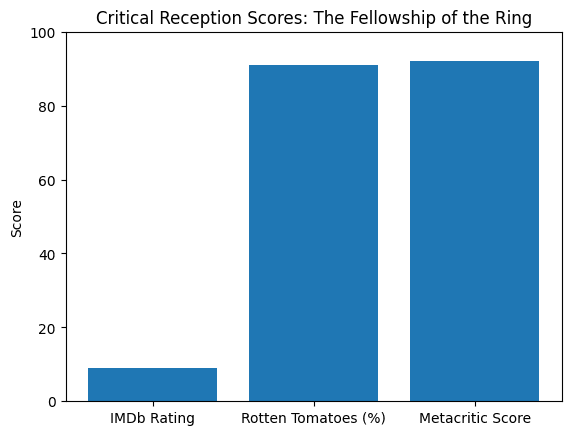
- IMDb Rating: 8.9 / 10
- Rotten Tomatoes: 91% (critics’ score)
- Metacritic: 92 / 100
Interpretation:
The consistently high scores across audience-based and critic-based platforms demonstrate near-universal acclaim, indicating both popular and scholarly appreciation of the film’s narrative depth, technical achievement, and performances.
Conclusion
The Lord of the Rings: The Fellowship of the Ring is not merely the first chapter of a trilogy; it is a masterclass in cinematic storytelling. Through its rich characters, profound themes, and meticulous craftsmanship, the film achieves a rare balance between spectacle and substance. It respects its source material while embracing the strengths of cinema as a medium.
More than twenty years after its release, the film remains relevant, inspiring, and emotionally resonant. Its enduring legacy lies in its reminder that even the smallest individual can change the course of the future—and that true strength often lies in humility, friendship, and moral courage.