
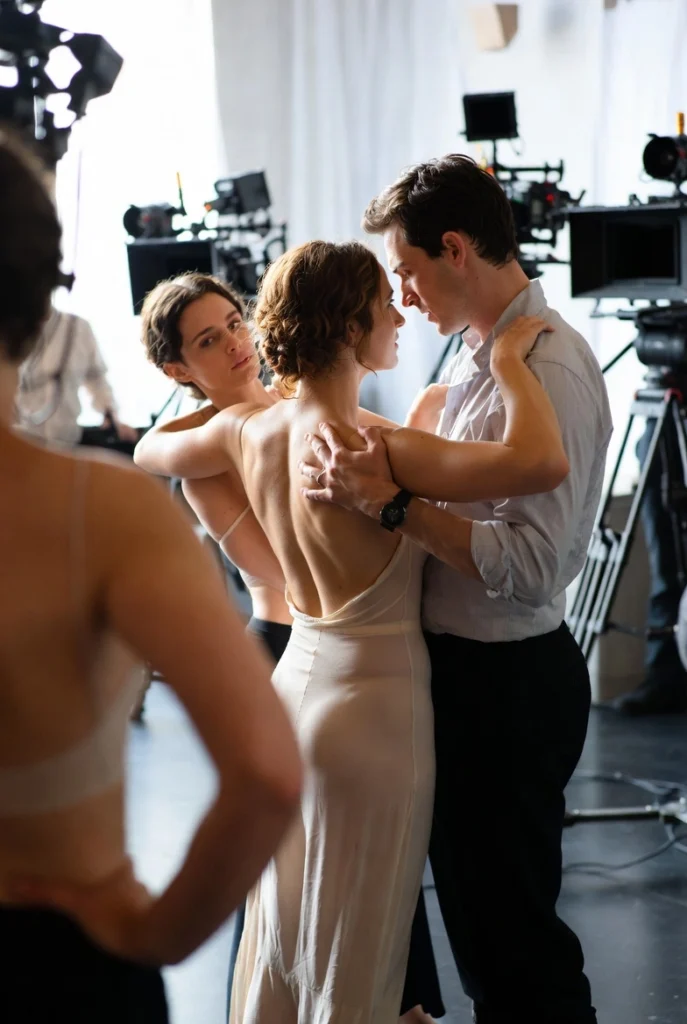
Filming an intimate scene is a highly choreographed and carefully managed process. Far from spontaneity, every kiss, touch, and movement is planned in advance. Actors and crew treat sex scenes much like complex stunt or dance sequences, rehearsing and blocking each move to ensure safety and continuity. Modern productions prioritize consent and comfort: performers know exactly what will happen and can use “safe words” or stop signals if needed. For example, an intimacy coordinator will translate the director’s vision into precise movements—“separating the character’s emotions from the actor’s personal boundaries”—so that “every touch, kiss, or movement is agreed upon in advance”. On set, a closed set policy (only essential crew present) and modesty barriers ensure privacy.
On closed sets, filming an intimate scene is treated much like a stunt or dance number: it is fully rehearsed, shot-listed, and monitored by an intimacy coordinator (photo: Studiovity)
Technical Process: Choreography, Blocking, Camera and Postproduction
Scene Breakdown and Choreography
Before shooting begins, directors, actors and an intimacy coordinator collaboratively break down the scene like any dramatic sequence. They ask story-driven questions – Why are these characters together? What stage is their relationship at? – to inform the movements and tone. This process mirrors fight or dance choreography: every move is scripted, counted, and rehearsed (e.g. “hand on shoulder on count one, kiss on count two”). By involving actors in the planning and rehearsal, the team ensures the scene serves the story and that the performers have agreed to all actions.
On the shooting day, a choreographed “blocking” rehearsal often takes place. The intimacy coordinator (or sometimes the director) coaches the actors through each step, adjusting body position for the camera while respecting each performer’s limits. For instance, Alicia Rodis explains that on The Deuce (an HBO series), she would give specific movement direction or simulated actions to sell the scene “that you’re not actually doing”, much like fight choreography. This layered process means actors do not actually engage in sexual acts on set – SAG-AFTRA explicitly forbids that in union contracts – and every advance contact is simulated with barriers or prosthetics rather than real penetration.
Modesty Garments and Props
To protect privacy and prevent unwanted skin-to-skin contact, performers wear modesty garments or use barriers and props. These wardrobe pieces cover genitals and breasts while remaining invisible in the final frame. Common items include:
- Strapless Thongs (Shibues/Hebues): Thin adhesive thongs for women (shibue) or men (hebue) that cover the genitals or buttocks. Often a silicone flap is added under the fabric for extra protection.
- Adhesive Bras / Tape and Pasties: Silicone or cloth stick-on bras, pasties or tape cover and flatten nipples or breasts. These allow topless shots without exposing sensitive areas.
- Drawstring Pouches and Cups: Tight-fitting pouches or athletic cups (like a sports cup) are used for male actors, covering external genitalia.
- Bandeau Tops and Chest Binders: Strapless binders or bandeaus can cover a performer’s chest or torso where necessary, including for non-binary or transgender actors.
- Other Garments: Crotchless shorts, briefs, or partial body stockings can also be used when a larger area needs covering.
All modesty garments are secured firmly (with special medical tape or adhesives) so they stay in place during movement. Costume and intimacy teams work together to choose garments that fit the scene’s requirements while respecting each actor’s comfort. Each layer is planned in advance: during the script breakdown the production identifies “every prop [and] costume requirement (such as modesty garments)” needed. Actors also have the right to request additional barriers or a midwife on set if they are pregnant, as noted by industry guides.
| Modesty Garment | Coverage/Use | Notes |
|---|---|---|
| Strapless Thong | Covers genitals/buttocks (female/male) | Often with silicone cup underneath; no straps to show |
| Adhesive Bra / Pasties | Covers breasts and nipples | Silicone or cloth stickers; used for upper-body scenes |
| Drawstring Pouch | Covers external male genitals | Similar to a “cock sock”; may be reinforced with foam |
| Athletic Cup | Covers external male genitals | Sports cup worn inside briefs for rigid protection |
| Bandeau / Binder | Covers chest/buttocks as needed | Strapless fabric pieces to cover larger areas |
| Tape & Adhesives | Secures garments in place; can cover nipples | Special cloth or liquid tape; part of the on-set wardrobe kit |
| Body Stocking (optional) | Covers torso and groin, often flesh-colored | Allows some coverage for back/body shots in one piece |
Each garment is chosen so the camera will not capture it. Cinematographers and the intimacy coordinator plan angles (see below) to keep these pieces hidden from view. As a Backstage guide notes, performers can discuss in advance what they are comfortable showing: for example, implying topless nudity without visible nipples (shooting from angles or with garments). In practice, the modesty garments act as “blocking” or protective layers – one coordinator described covering a shibue in silicone to make the actor “like a Barbie doll” under the costumes. In sum, no real body contact occurs without a barrier.
Table: Common modesty garments and barriers used in intimate scenes.
Camera Angles and Cinematography
Even with choreography and modesty garments, filming requires optical “tricks” to create the illusion of intimacy. Cinematographers collaborate closely with the director to devise camera setups and editing so that no explicit contact is seen. Typical techniques include:
- Cheating Angles: Cameras shoot from angles that imply contact without showing it. For example, a shot might cut away just as two bodies are about to meet, or focus on an actor’s face and shoulders while the physical contact happens slightly off-frame.
- Selective Framing: Close-ups on faces or specific body parts (back of the head, shoulders, etc.) are intercut with wider shots to suggest full-body intimacy without ever showing the explicit act. For instance, one can film an actor’s legs and then cut to their face, never showing full view of genitals.
- Long Lenses and Distance: The crew often uses long telephoto lenses to shoot from a distance, making the performers feel less exposed. This also allows the camera to capture a broader view while keeping detailed contact points out of frame.
- Editing and Cutaways: In post-production, editors piece together footage so that any unintended exposure is removed. Scenes may cut away at critical moments or overlay shots (such as fabric blowing or exterior scenery) to cover transitions. Intercutting with parallel action or reaction shots can mask the transitions of the scene.
These visual techniques ensure audiences feel the heat of the moment while revealing nothing unnecessary. One coordinator analogizes sex scenes to fight scenes: both are “high-risk work” that rely on precise camera placement. In more graphic cases, body doubles or digital effects are used (see below). But in all cases, no actual penetration or unsimulated contact is captured. As Alicia Rodis emphasizes, any arousal effects are eliminated by barriers, so that “there are no actual sexual acts on set” and any unintended reactions remain unseen.
Body Doubles, Prosthetics, and CGI
For nudity or acts that cannot be safely simulated, productions often resort to body doubles or visual effects. If an actor is unwilling or unable to perform a nude or explicit shot, a body double with a similar physique may step in for that camera angle. This is common even for non-sex scenes (e.g. stunt doubles), and in sex scenes it preserves the illusion while protecting the principal actors’ modesty. For example, Lars von Trier’s Nymphomaniac famously filmed each intimate act in two parts: the lead actors pretended to have sex (above-waist), while real sex was filmed with porn performers (below-waist), and the shots were digitally composited in post. In that film, “we shot the actors pretending to have sex and then had the body doubles, who really did have sex, and in post we will digitally impose the two”. This kind of VFX compositing (or use of prosthetic body parts) is now industry-standard for ultra-explicit content.
Several modern productions rely on such methods. Netflix’s Romance (2023), for example, reportedly cast adult-film performers and used CGI to simulate the main actors’ sex scene (the public learned the on-screen encounter was not literally Pattinson and Plaza). Even in less extreme cases, prosthetic “faux genitalia” are applied so scenes can appear authentic without actual nudity. These approaches allow filmmakers to achieve realism while adhering to union rules (SAG-AFTRA rules now explicitly forbid unsimulated sex acts on set). In short, any truly explicit contact is faked via doubles, prosthetics, or digital editing, ensuring safety and consent at all times.
Ethical and Safety Protocols
Role of Intimacy Coordinators and Crew
A key development in recent years is the presence of a professional intimacy coordinator on set. Similar to a stunt coordinator, an intimacy coordinator is a trained liaison and choreographer for intimate scenes. SAG-AFTRA defines the role as “a movement coach and/or choreographer” who also serves as an advocate between actors and production. In practice, the intimacy coordinator’s responsibilities include:
- Planning and Advocacy: Meeting with the director and actors before shooting to discuss the scene’s requirements. This includes clarifying exactly what nudity or simulated acts will occur so actors can give informed consent. They help write the nudity rider (contract addendum) and may even screen-test potential performers to match comfort levels.
- Choreography and Safety: Designing the specific movements (blocking) for the scene and rehearsing them with the actors. They monitor the set to enforce boundaries – for example, calling “cut” if an actor steps outside the agreed limits. As Alicia Rodis notes, an IC “assists the director with the language about how to talk about intimate scenes – and how to sell something that you’re not actually doing, just like in the fight world.”.
- Communication and Consent: Serving as a communication bridge, ensuring that all parties understand each step. ICs use clear, clinical language about body parts and actions so that actors feel informed. They reaffirm consent at each stage (from casting through shooting) and encourage actors to voice “no” if needed.
- On-Set Environment: Managing the closed set and privacy protocols. ICs help determine who needs to be present and may oversee modesty arrangements (barrier setup, garment placement). They also remain attentive to performers’ emotional state throughout the shoot.
In short, intimacy coordinators ensure that actors never feel pressured or unsafe during simulated sex. They work alongside directors and department heads – without overruling creative vision – to realize the scene safely. As one coordinator puts it: “We’re there… to make these scenes look authentic and tell the story and make sure everyone stays safe along the way.”. In fact, SAG-AFTRA now recommends hiring a coordinator for any nudity or simulated sex.
Other key personnel have defined duties as well. Below is a summary of the principal roles on an intimate set:
| Personnel | Responsibilities |
|---|---|
| Intimacy Coordinator | Choreographs the scene, ensures actors’ consent and comfort, liaises with director and production staff; implements safety protocols and closed-set rules. |
| Director | Defines the artistic vision and overall context of the scene; collaborates with the IC to block and shoot intimate actions without compromising safety. |
| Producer/AD | Budgets time for choreography and rehearsal; schedules closed-set hours; enforces industry guidelines (e.g. SAG rules, 48-hour notice). |
| Actors | Communicate personal boundaries clearly, rehearse the choreographed actions, and retain the right to stop or alter a scene. Often input their comfort levels and ask for an IC if not provided. |
| Cinematographer / Camera Operator | Chooses angles and lenses (often long lenses or shot compositions) that imply intimacy without explicit detail; works with the IC on the shot list to decide what is shown or hidden. |
| Costume Department | Provides the modesty garments and ensures they are applied correctly; tapes garments in place; can supply props (sheets, etc.) to preserve modesty during filming. |
| Hair & Makeup | Maintains actor appearance and helps with quick removal of adhesives or garments between takes; often monitors coverage of sensitive areas (e.g. hides wardrobe malfunctions). |
| Sound Department | Often turns off audio monitors for private dialogue; may clear the area of unnecessary equipment to maintain privacy; ensures performers’ voices or moans remain confidential among the crew. |
| Wellness / Medical Support | Provides mental health or medical support if needed (on larger productions, a mental health professional or on-set counselor may be present). Midwives or gender consultants are consulted for pregnant performers or transgender sensitivity. |
These checks and balances form a “web of safety”: everyone knows their role in protecting the actors. For example, BECTU’s UK guidance emphasizes that intimate scenes are “a collaborative process” involving intimacy coordinators and camera crew, costume standbys, sound crew, makeup artists, midwives, gender consultants, wellbeing practitioners, etc.. In practice, anyone who might come into contact with an actor’s body (even to adjust wardrobe or remove tape) is briefed on boundaries by the coordinator beforehand. If an actor becomes uncomfortable or triggered at any point, the IC or another trusted crew member can pause shooting to “take a moment” and check in.
Consent, Communication, and Safeguards
Central to all protocols is consent. Actors are informed of every detail in advance (scripts, story context, choreography, nudity riders) so that their agreement is fully informed and voluntary. Alicia Rodis highlights the importance of the “F.R.I.E.S.” criteria (from Planned Parenthood) – consent must be Freely given, Reversible, Informed, Enthusiastic, and Specific. Actors can choose “no” to any element at any time, and it will be respected. They also negotiate specifics in the contract: for example, one might agree to simulate sex but forbid any actual genital contact, or allow toplessness but not full nudity. These agreements are written into the “nudity rider” of the contract. SAG-AFTRA requires that any nudity or simulated sex be explicitly authorized in writing and that at least 48 hours’ notice be given before shooting (to allow actors to back out if uncomfortable).
During shooting, clear communication is maintained. The intimacy coordinator continually checks in with the actors (“Is everyone okay?”) and reaffirms consent before takes. Any change to the shot – even a new camera angle or longer take – is discussed and agreed upon. Actors are explicitly reminded they have the right to stop at any time: “You always have an exit. You can always say, ‘Stop. Cut’”. If an actor does express distress, shooting halts and the issue is addressed privately. This is akin to a stunt performer calling for a cut if a fall goes wrong. Scenes are filmed with short takes and breaks so performers do not become overwhelmed or fatigued. The intimacy coordinator or director will modify choreography on the fly if an actor’s comfort level changes.
Industry Standards and Union Guidelines
The film and television industry has formalized these practices in recent years. SAG-AFTRA (the US actors’ union) now publishes Standards and Protocols for Intimacy Coordinators, which explicitly define the role and advocate for hiring coordinators on any project with sexual content. Those guidelines stress that intimacy coordinators should be involved in scenes with nudity or simulated sex. SAG contracts also forbid actual sexual intercourse on set and require safe working conditions for intimate scenes. For background actors, new SAG rules (as of 2023) even mandate compensation and protections if they are asked to perform nudity without prior notice.
In the UK, unions like BECTU and Equity have similarly issued guidance. In October 2022, BECTU released the first comprehensive Intimacy Coordination Guidance for British film/TV, created by intimacy coordinators and industry reps. This document covers everything from hiring an IC and preparing sets to providing mental health support and signposting clear reporting pathways. It explicitly lists the broad team involved (directors, ADs, camera, costume, hair/makeup, midwives, wellbeing practitioners, etc.) and urges productions to offer counseling or debriefings after intense scenes. (Notably, BECTU’s branch of intimacy coordinators emphasizes an inclusive approach: their guidance stresses diverse perspectives, with gender consultants advising on how different bodies and identities might require special care.)
Beyond union policies, many productions adopt their own best practices. Intimacy coordinators often recommend post-scene check-ins or debriefs, similar to what stunt teams do after dangerous work. Alicia Rodis notes that her training includes “Mental Health First Aid” so she can recognize if an actor is distressed. On large sets, a mental health coordinator or therapist may be available. The goal is to ensure no one leaves a shoot feeling violated or traumatized. As one industry advocate puts it, intimacy coordination provides “vital support for artists during the preparation, rehearsal and shooting of intimate action” and has become a “welcome move to further establish an environment of safety for actors”.
Timeline of Ethical Standards in Filming Sex Scenes
Over the last few decades, standards have evolved significantly:
| Year | Industry Milestone |
|---|---|
| Pre-2010s | Mostly ad hoc: Directors and actors improvised intimate scenes; formal protections were minimal. (The Motion Picture Production Code ended in 1968, removing strict censorship but still no on-set safety protocols.) |
| 2017 | MeToo Era & Ita O’Brien Guidelines: After #MeToo, intimacy became a focus. Intimacy coordinator Ita O’Brien published the pioneering “Intimacy On Set” guidelines (early 2017) that would become industry standard. |
| 2020 | SAG-AFTRA Standards: SAG-AFTRA released its first official Standards and Protocols for the Use of Intimacy Coordinators (2020), formally recommending ICs for any nude/simulated sex scenes. |
| 2022 | BECTU Guidance (UK): The British union BECTU published comprehensive guidance on shooting intimate scenes, emphasizing pre-production planning, consent, and post-scene support. |
| 2023 | Union Contracts: SAG-AFTRA ratified its first collective bargaining agreement specifically covering intimacy coordinators, recognizing them as official crew members with negotiated rates and protections. |
| 2024+ | Continuing Evolution: Industry-wide adoption of intimacy practices continues (e.g. new privacy protocols, diversity training). Many studios now routinely include intimacy coordinators and nudity riders on set. |
These changes reflect a broader shift: sex scenes are no longer treated as mere “adult spice” where “you go by feel.” They are executed with the same care as any other high-risk sequence. As Glamour’s Ita O’Brien notes, the goal is to bring the female gaze and real lived experience into filming, ensuring “a woman’s lived life…from a female perspective” is considered on set. The rise of intimacy coordination marks a new era where performers’ well-being is integral to the creative process.
Examples from Film and Television
- Lars von Trier’s Nymphomaniac (2013): Directors Lars von Trier used pornographic film actors and digital compositing to achieve hyper-realistic sex scenes. The principal actors mimed the actions from the waist up, while doubles performed below the belt; post-production merged the two. The set itself was closed and equipped with prosthetic genitalia and barriers, with the intimacy choreography fully staged.
- HBO’s The Deuce (2017–2019): Set in 1970s New York’s porn industry, this series relied on intimacy coordination for its many simulated porn shoots. Intimacy coordinator Alicia Rodis describes that for a scene with real-life actress Maggie Gyllenhaal (playing a porn director), she would hold an “intimacy meeting” to detail the exact nudity and acts required. Each performer knew ahead of time what was on the table (e.g. “nudity above the waist” or “simulate oral sex with a male performer”). On set, Rodis choreographed movements and used modesty barriers; she checked in constantly to ensure consent and comfort. The result was a gritty yet carefully controlled depiction of porn production.
- Netflix’s Normal People (2020) and Sex Education (2019–): These shows have been praised for their naturalistic, respectful sex scenes. Intimacy coordinator Ita O’Brien (who worked on Normal People) coached the actors on consent and communication. Scenes such as those in Normal People were rehearsed so that young actors could feel safe and maintain authenticity; O’Brien emphasizes that the intimacy should come from character connection, not pressuring the actor. These projects often used careful framing and editing to keep the focus on emotion rather than explicit detail, fitting the producers’ desire for a “female gaze” perspective.
- Mainstream Examples: In most major films today (from dramas like Marriage Story to blockbusters like Deadpool), modesty garments and closed sets are now the norm. For example, Emilia Clarke (in Game of Thrones) later spoke about how scenes were shot with an intimacy coordinator and closed set (even if that show was slower to adopt formal ICs early on). Streaming series like Bridgerton and Outlander also rely on coordinators and VFX for sex scenes. Even Hollywood comedies with sex content (e.g. Bridesmaids, Thor: Love and Thunder) use modesty garments and editing to imply passion safely.
Conclusion
Filming sex scenes in movies and TV is a highly technical endeavor underpinned by strict ethical safeguards. The creative intent is achieved through meticulous choreography, camera work, and post-production editing – not by actual sexual activity on set. At every stage, trained intimacy professionals collaborate with the director, actors, and crew to honor the story while protecting everyone involved. Modern industry standards (from SAG-AFTRA protocols to BECTU guidelines) enshrine these practices: scenes are planned in pre-production, shot with closed sets and barriers, and shot lists govern exactly what the audience will see.
These measures have transformed intimate scenes from risky improvisations into safe, controlled performances. Actors report feeling empowered rather than exploited when intimacy coordinators are involved. As a result, filmmakers can shoot intimate content that feels real and emotional without compromising comfort. When trust and communication are prioritized, “the result is a production that looks dangerous on screen but is safe, controlled, and professional behind the scenes”
How The Knives Out franchise revived the modern whodunit…