
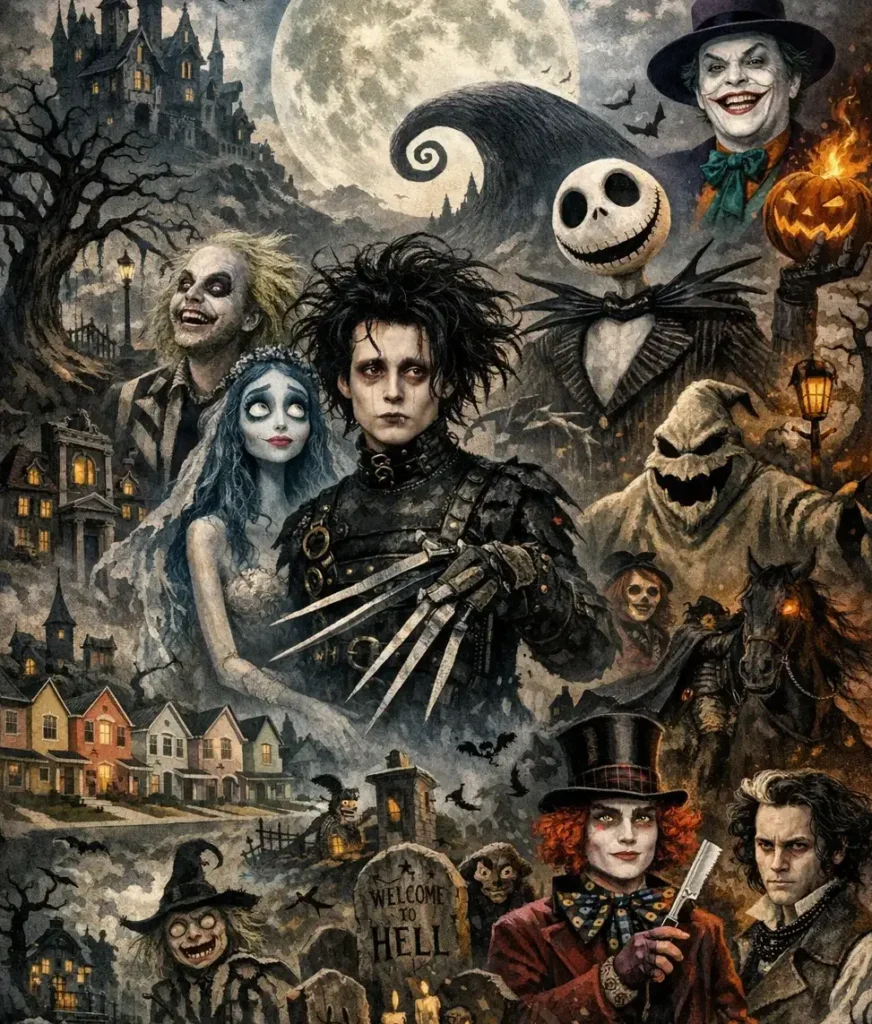
Tim Burton’s films are instantly recognizable for their darkly whimsical, gothic aesthetic and outlandish characters. The worlds he creates – from pastel suburban neighborhoods to fog-shrouded forests – blend fairytale lightness with macabre surrealism. Across his oeuvre, Burton repeatedly portrays outsiders and peculiar figures: spindly misanthropic protagonists who are endearing in their oddness. Critics even coined the term “Burtonesque” to describe this signature style – “a dark, whimsical, and fantastical world filled with eccentric characters, gothic imagery, and a fascination with death and the afterlife”. Central themes recur: isolation versus community, innocence versus corruption, and the tension between conformity and individuality. This report examines how Burton’s absurd, surreal characters embody these themes, analyzing their psychology and symbolism, the narrative role of absurdity, and Burton’s literary and artistic influences.
Psychological Traits of Burton’s Protagonists and Antagonists
Burton’s protagonists are almost always misunderstood outsiders. As curator Jenny He notes, Burton’s central characters (e.g. Edward Scissorhands, Jack Skellington, Ichabod Crane) form a “triumvirate of archetypes” centered on “the misunderstood outcast.” These heroes are “well-intentioned” and passionately idealistic, but their worldview is “in dramatic contrast to those around them”. They are endearing precisely because their earnest, naïve innocence clashes with a conformist society that labels them “monsters.” Edward Scissorhands exemplifies this: a stitched-together creation (“Burton’s most literal Frankenstein’s monster”) who can sculpt hedges into gorgeous creations but cannot touch humans without harming them. He embodies “isolation,” both physically (with scissors for hands) and socially (a childlike, largely mute soul). When Edward’s gentle creativity and sincerity are rebuffed by suburban neighbors, their rejection – calling him a “freak” and “not even human” – confirms his outsider status. Yet Edward never loses his innocence or kind heart, only showing rage when driven to despair. In Burton’s words, Edward’s “physical manifestation of isolation” is his scissor-hands – a potent symbol that he cannot fully participate in normal life, only in artistic expression.
Likewise, Jack Skellington (The Nightmare Before Christmas) is a monstrous yet sympathetic antihero. A macabre “Pumpkin King” obsessed with scaring, Jack grows discontent in his Halloween-perfect world. He is hungry for new meaning when he stumbles on Christmas, but his single-minded enthusiasm leads him into comedic disaster. As the MoMA essay observes, Jack is a “misunderstood outcast” who simply cannot grasp why his grandest undertakings (such as becoming Santa) end up disastrous. He “never means harm” and earnestly believes in the value of his actions, embodying Burton’s duality of idealism and pessimism. Jack’s exaggerated, lanky skeleton design and expressive gestures make him both absurd and endearing, and his mania (rolling out with skeletal deer and coffin sleds) satirizes the absurd extremes of his obsession. Crucially, even as Jack bungles things (not out of malice but innocent zeal), the audience sympathizes with his desire to break free from monotony.
In general, Burton’s heroes share:
- Naïve idealism: They pursue personal passions (sculpting ice, celebrating Christmas, filmmaking, candy making) with unwavering optimism, even when society scolds them.
- Emotional sensitivity: Despite grotesque or exaggerated exteriors, they are “deeply innocent and sensitive”. Edward’s soft heart and Jack’s earnest face belie their scary appearances.
- Social alienation: Each hero is fundamentally isolated – by circumstance (Edward’s castle), by nature (Sweeney’s vengeance), or by a literal divide (Big Fish’s distance from his son). They stand apart from “normal” society, often literally living in haunted houses or far-off lands (Batcave, Victorian woods).
- Artistic or creative focus: Their inner richness often comes through creativity – Edward’s hedge sculptures, Wonka’s candy inventions, William Bloom’s (Big Fish) tall tales, for example. Creativity is their only genuine form of expression with the world.
These traits derive in part from Burton himself. As David Breskin notes, Burton is a self-described “happy-go-lucky manic depressive”, simultaneously lively and dark, “morbid and ironic,” a flake who channels personal isolation into art. Burton’s protagonists often mirror his own psyche: spiky, whimsical, yet melancholic. For example, Johnny Depp observed that Burton’s drawings of Edward “said everything” about the character’s vulnerability and naive sincerity.
Burton’s antagonists also reflect this outsider motif, though often from the opposite side. The true villains in many films are not fantastical beasts but society itself – the angry mob of neighbors in Edward Scissorhands, the uptight socialites in Beetlejuice and Wedding Crashers, or the snobbish aristocrats in Corpse Bride. Burton frequently portrays a “village mob” or institutional antagonist that persecutes the hero. The MoMA essay explicitly identifies this trope: Burton’s outcast heroes “often incur the protestations of the ‘village mob,’ the underlying antagonist ever-present in Burton’s films”. These mobs are typically petty, conformist, and fearful, reacting with ridicule or violence toward anything that differs from the norm. In Edward Scissorhands, it is suburban housewives who turn on Edward the moment he fails to conform, ultimately chasing him with pitchforks. In Beetlejuice, it is the well-to-do Deetz and their lawyers who scramble to get the Maitlands’ house and then summon the chaotic Betelgeuse to eliminate the living. In Sleepy Hollow, the town’s misogynistic and superstitious townsfolk project their anxieties onto Ichabod and the Headless Horseman. Even in Batman, the public can be mass hysteria-prone and swayed by villains like the Joker. Thus Burton’s antagonists often consist of ordinary people representing oppressive norms.
That said, Burton also creates memorable monstrous villains who are almost as absurd as his heroes. Examples include Jack Nicholson’s Joker (Batman 1989) – a grotesque, grinning clown maniac who personifies chaos and mirrors Batman’s duality – and Tim Burton’s own strange creatures (e.g. Oogie Boogie’s burlap sack body in TNBC, the murderous townsfolk of Sleepy Hollow, the undead bride in Corpse Bride). These characters often have psychological quirks of their own: Catwoman is a battered, unstable woman reborn; Sweeney Todd is driven by grief and revenge; Beetlejuice is a mischievous trickster relishing bedlam. While Burton’s protagonists seek connection and meaning, his villains frequently seek either control or liberation through destruction. Yet even in madness, Burton gives them creativity: the Joker’s theatrical flair, Beetlejuice’s slapstick showmanship, Sweeney’s vengeful artistry. In sum, Burton populates his films with a gallery of grotesque characters – from sympathetic maniacs to monstrous caricatures – who all reflect aspects of human psychology at extreme. The heroes are usually “endearing monsters” that elicit empathy, while the villains remind us of society’s fears and hypocrisies, a hallmark Burton inherited from Gothic and expressionist traditions.
Symbolism in Character Design, Costumes, Settings, and Dialogue
Visual symbolism is paramount in Burton’s cinema. His characters’ designs, clothing, and the worlds they inhabit are rich with symbolic contrast. Burton and his collaborators (especially costume designer Colleen Atwood and production designer Rick Heinrichs) use exaggerated colors, shapes, and motifs to externalize inner themes.
Characters and Costumes
Burton’s characters often have exaggerated physical features that hint at their nature. StudioBinder notes that Burton’s figures are defined by “exaggerated features: long frizzled hair, baggy eyes, gangly limbs,” which mask a fundamentally human side. For instance, Burton’s leading men like Edward Scissorhands and Victor Van Dort (Corpse Bride) have unnaturally thin, elongated bodies, spiky hair, and pallid skin. These distortions make them look uncanny, but also visibly differentiate them as “other.” By contrast, characters in the “normal” world (like suburbia or Victorian society) are dressed in neat, conventional attire – a visual cue of conformity and repression. For example, the Van Dort family in Corpse Bride wear prim, rigid clothing (white suits and formal dresses) and have elongated, wooden physiques, symbolizing their cold, lifeless approach to life. In contrast, the Corpse Bride and other denizens of the Land of the Dead burst with color and fluid, lively motion. This stark costume contrast (monochrome rigid vs. rainbow vibrancy) literally signals the film’s thematic reversal: death becomes more joyous and freeing than the stifling so-called “living.”
Costumes also often signal a character’s role or psyche. Beetlejuice’s iconic black-and-white striped suit and wild green hair immediately read as clownish and grotesque, reflecting his role as the irreverent trickster spirit. In Batman, Burton dressed Bruce Wayne/Batman in brooding black, using catwalk-like costumes for Catwoman (Michelle Pfeiffer’s latex catsuit) that exaggerate her feline transformation. The Joker’s purple suit and chalk-white face underscore his deranged, decadent flamboyance. Similarly, Willy Wonka’s tiny top hat, purple coat, and candy-colored vest signal both his whimsical genius and childlike, eccentric soul. Costume colors often echo character themes: the color palette for the pure-hearted in Edward Scissorhands (like Kim’s light dresses) are soft pastels, whereas Edward wears dark leather to emphasize his “Frankenstein” creation nature.
Settings and Production Design
Burton masterfully uses sets and locations as symbolic extensions of his characters. A classic Burton motif is the juxtapositional dichotomy between a stark, gothic realm and a bland American reality. Edward Scissorhands provides the clearest example: Edward’s home is a Gothic, decaying castle on a hill – “distorted architecture, sharp spires, and elongated shadows” paying homage to German Expressionism – whereas the new town below is a pastel-colored 1950s suburb of cookie-cutter houses and bright lawns. This deliberate visual contrast underlines Edward’s isolation: he quite literally inhabits another realm. The castle’s dark walls and metal spikes mirror his fragmented, lonely soul, while the town’s cheerful symmetry and warm palette symbolize safe uniformity but also superficiality. When Edward removes his “normal” clothes and destroys the hedges, Burton visually depicts him shedding conformity and severing ties to that fake perfection.
A similar duality appears in Corpse Bride: the living world is shown in a bleak, monochrome palette, with straight angular architecture (rigid lines of townhouses, formal gardens) and a cold atmosphere (grey, blues, blacks). In stark contrast, the Land of the Dead is ablaze with bright, saturated colors (deep oranges, greens, purples) and flowing, organic shapes. Burton explicitly flips Gothic convention by making the afterlife more vibrant than life itself – suggesting liberation through the macabre. The oppressive living world conveys stagnation (the Van Dort family “embody rigid formality”), whereas the dead world’s playful buildings and swirling designs represent freedom and acceptance of individuality. Even environmental symbols recur: Burton’s twisted tree motif appears in Corpse Bride’s forest (twisted branches that almost seem alive) and numerous films, symbolizing the uncanny border between worlds. In Beetlejuice, the interior of the Maitlands’ haunted house shifts from idyllic to nightmarish – white walls turn to peeling green, and suddenly the space warps with looping staircases and tortured wallpaper. This visual “house gone bad” reflects how normalcy can hide horror, a common Burton symbol.
Burton also uses everyday settings ironically. He often frames American suburbia as secretly monstrous. StudioBinder notes Burton’s “ironic” use of bright, normal facades to hint “where the true villainy lives”. In Beetlejuice, the normal bedrooms and kitchens are invaded by supernatural chaos (a dinner party where lobster claws move on their own, for example). In The Nightmare Before Christmas, the cozy look of Halloween Town (Jack’s line of ghostly townspeople with tidy houses) gives way to absurd slayings by Halloween monsters acting as toymakers. In Big Fish, the quaint Alabama town with ordinary houses and gentle rivers contrasts with the flamboyant, surreal circus and giant fish of Edward Bloom’s tales, underscoring the gap between mundane reality and boundless imagination. In all these, Burton uses color, shape, and style as symbols: ordered lines and pale hues denote the conformist everyday; twisted shapes, asymmetry and saturated or unusual colors denote the dreamlike or repressed.
Dialogue and Behavior
Even dialogue in Burton’s films often contains symbolic or ironic weight. Protagonists frequently speak in childlike simplicity, underscoring their innocent worldview. For example, Edward Scissorhands can barely form words; his silence speaks to his fragility. Jack Skellington’s grand declarations about Christmas are humorously misguided – he confidently says “They’re celebrating… they’re thanking us!” when the military fires at him, oblivious to his failure. This line brilliantly encapsulates Burton’s absurdist humor: Jack’s naïve rhetoric contrasts the violent reality, underscoring his fundamental disconnection from how the world actually perceives him. Such moments – where character dialogue is sincere but situation is ironic – reinforce themes of misunderstanding and absurdity.
Likewise, villainous dialogue often exposes social hypocrisy. Burton’s antagonists spout clichés and prejudices. In Edward Scissorhands, neighbor Joyce haughtily invites Edward to join a petty crime before promptly rejecting him sexually – highlighting her superficiality. In Beetlejuice, Barbara’s scream “THAT KNOB!” at Beetlejuice’s insufferable antics turns the ghost’s grotesqueness into comic relief. The dialogue of Burton’s brood of “normal” folk is rarely profound; they often deliver snappy one-liners or panicky cries that underscore their narrow-mindedness. In musicals like The Nightmare Before Christmas and Sweeney Todd, song lyrics serve as symbolic commentary: Jack’s “Kidnap the Sandy Claws” sequence, or the demon barber’s reprise about systemic oppression, carry thematic weight about rebellion against rigid social roles.
Absurdity and Surrealism in Narrative and Character Interaction
Absurdity and surrealism are woven into Burton’s storytelling. Many of his most memorable scenes revel in illogical, dreamlike twists. Abstract ideas (death, fear, conformity) often manifest in bizarre visuals or events.
In narrative structure, Burton frequently blends mundane reality with fantastical intrusions. Beetlejuice is a good example: a young married couple plans a normal move into the countryside, only to find themselves interacting with eccentric ghosts and eventually the over-the-top demon Betelgeuse. The film’s logic follows a rules-of-its-own absurdity: for instance, the idea of a “waiting room” for the dead (complete with a harried bureaucrat Juno) satirizes bureaucracy in a wildly surreal way. The film literally ties together ghostly affairs with comic commentary on suburban life. Beetlejuice himself – as a character and symbol – is the ultimate embodiment of absurd chaos. His scenes (the enchanted dinner with a giant hand, the growing-shrinking of the Deetz son) are pure cartoon slapstick in a horror setting.
The Nightmare Before Christmas similarly mixes holidays with genre. Halloween Town’s approach to Christmas – reanimating roadkill reindeer and delivering snakes as pets – is a manic, surreal comedic twist on a beloved myth. Jack’s efforts to re-create Christmas in Halloween style (jaillike toy factory, serpentine reindeer, etc.) are jarringly outlandish. Yet within the story’s internal logic, they make sense. This blurring of reality and dream is classic surrealism: Burton let a Depression-era puppet show romance with Frankenstein’s monster open his imagination, and this tendency shows up as “nightmare logic” – things happen in his worlds because they are emotionally or thematically resonant, not because they make literal sense. A soldier firing cannons at Jack, while absurd, symbolically portrays society’s violent pushback on nonconformity.
In Charlie and the Chocolate Factory, the very design of Willy Wonka’s world is surreal. The glass elevator that flies through bizarre rooms, the gravity-defying fudge room, and the Oompa Loompas’ strange industrial dance – these embody an absurd fantasyland. Willy’s extremely odd behavior (wandering factory halls with a small hat, scolding girls for swearing) highlights Burton’s liking for “strange and unusual” people surrounded by impossibly whimsical settings. Likewise, in Alice in Wonderland, everyday settings (gardens, tea parties) become twisted through warped perspectives – the Mad Hatter’s warped hat-shop, the floating teapots, and ever-changing sizes of Alice herself.
Even the mundane moments in Burton’s films often carry a surreal edge. The Dinner for One scene in Beetlejuice (shrimp cocktails come to life, faces melt) is grotesque dark humor. Sweeney Todd includes ridiculously operatic violence (the chorused Victorians singing about pie-making while bodies pile up), blending absurdity with gothic horror. Burton is not afraid to make us laugh at frightening or disturbing events; this is absurdist comedy at work (as one critic noted, Beetlejuice was “pie-in-your-face existentialism” – an irreverent smash into a schoolroom of death).
Underlying all this absurdity is Burton’s willingness to subvert genre conventions. In fairy-tale terms, he often gives stories an inverted moral. For instance, ghosts are friendly, death is beautiful, and the freak is the truest artist. As noted by a film theorist, Burton “subverts the conventions of traditional fairy tales,” using irony and humor to critique notions of “happily ever after”. Each film mixes the whimsical with the grotesque: nightmares are funny, and normal life feels nightmarish. This core absurdism invites viewers to feel disoriented – just as Burton himself grew up reacting against the sunny normalcy of suburban Burbank. He juxtaposes the grotesque and the ordinary “on their head”, forcing audiences to reconsider what is beautiful or monstrous.
Philosophical Influences: Existentialism, Absurdism, Romanticism
Burton’s storytelling reflects strands of existential and romantic philosophy, often filtered through irony. His characters frequently grapple with identity, purpose, and alienation – classic existential themes. A Burton hero might well ask, “What is the meaning of my life when everyone else lives another way?” Edward Scissorhands, for example, is virtually an existential figure: created without personal history, he constructs meaning through art (ice sculptures) but never fully integrates into society. His tragedy is that even an act of beauty (carving an ice angel) leads to alienation – echoing the existential notion that society can punish authenticity. Jack Skellington’s quest to redefine his role (from Halloween to Christmas) also illustrates existential angst and the search for meaning beyond one’s assigned identity. He discovers that, like Sisyphus rolling the rock, he finds absurdity in unending repetition of scare-and-holiday cycles – though Jack’s spirit remains almost defiantly optimistic (even amid cannon fire).
Indeed, Burton often mixes absurdism with dark optimism. Critics have noted that Burton’s comic sensibility is literally existential. As David Breskin observed of Beetlejuice: “when it worked, Burton’s pie-in-your-face existentialism worked like magic”. This phrase captures Burton’s style: confronting grim realities (death, rejection, fear) head-on with a manic grin. Burton’s worlds reject comforting metaphysics; instead, characters must create their own values (Edward through creativity, Jack through devotion to Halloween). In Big Fish, Edward Bloom literally fabricates meaning through grand stories, hinting at Nietzschean or Camus-like themes: that crafted myth can be more vital than objective truth. Will Bloom learns that embracing his father’s tall tales is preferable to rational literalism, which has an almost anti-nihilist flavor – a choice to live by stories rather than stark reality. In Ed Wood, the eponymous director pursues his vision despite certain failure; his faith in creating art parallels an existential hero’s defiant creativity in a seemingly indifferent universe.
At the same time, Burton’s sensibility owes much to Romantic and Dark Romantic literature. Like the Romantics, he often valorizes emotion and the individual’s inner life. Many of Burton’s stories are essentially modern fairy tales or Gothic romances – lonely creatives longing for love or acceptance. Burton explicitly emulates Edgar Allan Poe and Mary Shelley, childhood heroes he “felt close to”. His early short Vincent is an ode to Poe, and Frankenweenie is a suburban reimagining of Shelley’s Frankenstein. These roots show: Burton shares the Romantics’ fascination with the grotesque and sublime, with nature’s darker side, and with anguish turned into art. For instance, Sweeney Todd’s murderous narrative has more in common with Poe’s grim tales of vengeance and horror than with standard musicals. The Burton universe is imbued with a melancholic beauty – as one writer put it, a “fabulous celebration of the melancholy”. His characters suffer intense longing (e.g. Victor waiting for Emily in Corpse Bride, Jonathan yearning for a darker love in Alice in Wonderland), reflecting romantic ideals of love and loneliness.
Burton also draws from Gothic philosophy. He often highlights themes of the uncanny and the grotesque, reminiscent of Freud’s uncanny or Camus’s absurd hero. The haunting beauty of Burton’s imagery (twisted trees, ghostly figures) invokes existential unease – the feeling that the world is strange and we are strangers in it. Yet there’s also playful absurdism: death is trivialized (as in Beetlejuice’s slapstick afterlife) and the uncanny becomes comic. Burton’s own comments mirror this: after seeing Poe’s work as a child, he let “horror movies and imagination” inform his vision. He often resists the tragic outcome (characters rarely end up truly destroyed; Edward returns to safety, Sally and Jack unite, etc.), aligning with dark romanticism’s bittersweet hope.
Gothic Literature and German Expressionism
Burton’s style and stories are deeply influenced by 19th-century Gothic literature and early 20th-century German Expressionist cinema, two traditions concerned with mood, visuals, and the outsider.
From Gothic novels, Burton borrows the idea of sympathetic monsters and doomed romance. Edward Scissorhands parallels Frankenstein (the innocent creation rejected by society). The Victorian setting and headless specter of Sleepy Hollow come directly from Washington Irving’s 1820 story, updated with Burton’s flair. The tragic longing of Corpse Bride echoes Gothic ghost stories, while Alice in Wonderland – though not Gothic – is a classic British absurdist tale that Burton reinterprets with a darker, more twisted lens. Burton’s characters share DNA with Gothic protagonists: they are often tormented souls, caught between worlds (life and death, love and loss). Moreover, Burton’s use of Gothic iconography (ruined castles, cemeteries, lightning-split trees, fog) is unmistakable. The MoMA essay notes that Burton’s characters like Edward and Sally are themselves versions of Frankenstein’s monster, directly connecting to Shelley’s legacy. His casting of Vincent Price (a star of horror) and others also evokes Universal/Hammer horror films – part of the Gothic-revival influence.
German Expressionism is visible everywhere in Burton’s visual palette. This early film movement (films like Nosferatu, Caligari, Metropolis) emphasized skewed sets, stark light and shadow, and psychological sets. StudioBinder and film critics agree Burton’s theatrical side is “heavily inspired by German Expressionism”. For example, the exaggerated angles and shadows of Edward’s castle are pure Caligari – jagged turrets, warped corridors (Burton even said Vincent was “heavy on German Expressionist sensibility”). The Domus piece describes Burton’s Gotham (Batman 1989) as a “dark, decaying metropolis” with “distorted buildings, damp streets, [and] dim lighting” that embody a chilling expressionist feel. Burton loves tilted walls and impossible architecture: the Nevermore Academy in Wednesday is explicitly compared to castles from medieval Germany by critics. The Backstage article cites the BFI noting that Burton’s films often mimic the “bizarre, distorted world” of The Cabinet of Dr. Caligari, with “trees with spiky leaves, grass that looks like knives” – an image Roger Ebert himself used for Burton’s style.
This expressionist influence shapes not just sets but mood: high-contrast lighting (chiaroscuro) is a Burton staple. Many Burton films (especially the stop-motion ones) look like moving etchings, all blacks and whites. The film Ed Wood even uses black-and-white cinematography to evoke the 1950s, but in a stylized way. Batman’s scenes in this era are nightlit cityscapes with neon glows; Sleepy Hollow’s fog-shrouded village is a textbook example of Expressionist ambience. Even Big Fish, a mostly bright film, uses shadow in its dream flashbacks. Burton’s music collaborator Danny Elfman often scores with dark, foreboding leitmotifs that echo organ sounds – tying back to Gothic and expressionist horror conventions.
By combining these traditions, Burton creates something at once nostalgic and novel. He takes the emotional intensity of German Expressionism and marries it to American pop culture (suburbia, cartoons, rock music). The result is “Batman Goes Gothic,” “a circus in reverse,” etc., styles critics struggle to label. But as Domus notes, Burton has “built his gothic and fabulous worlds” by fusing dark fantasy with humor. His Gothic influences let him explore fear, death, and the uncanny; his expressionist roots give his visuals their surreal distortions. In this way, Burton’s films pay homage to literary and cinematic ghosts, while reanimating them through cartoon eyes and oddball charm.
Conclusion
Tim Burton’s films use absurd, fantastical characters as avatars of very real psychology and philosophy. His protagonists – outsiders and naive idealists – embody creative innocence stranded in a conformist world, while his antagonists often personify that world’s fears and hypocrisies. Costumes and settings speak symbolically: pastel conformity versus gothic oddness, monochrome order versus vibrant chaos. Scenes of wild absurdity (singing corpses, bureaucratic afterlives, murderous puppets) both entertain and underscore the senselessness underlying social norms. Burton’s storytelling draws on existential and romantic ideas: his heroes search for meaning in absurd circumstances, and he treats the grotesque with a strangely lyrical heart. Underneath the glittery make-up and candy-colored facades lies a darker truth – an influence from Gothic literature and expressionist film – that life is strange, sometimes frightening, but strangely beautiful when embraced with imagination.
In summary, Burton’s characters and worlds are more than just quirky fun. They reflect universal themes of alienation, identity, and individuality through a twisted fairy-tale lens. As one critic observes, Burton’s style is a “celebration of the melancholy”, in which nightmares and fairy tales cohabit. Ultimately, Burton invites us to find humor and humanity in the absurd. By populating his universe with “eccentric characters” and warped, cinematic poetry, he reminds us that being different can be a source of both wonder and wisdom.
Have you ever given a thought on how the World of Pandora would look if Christopher Nolan directed it?