
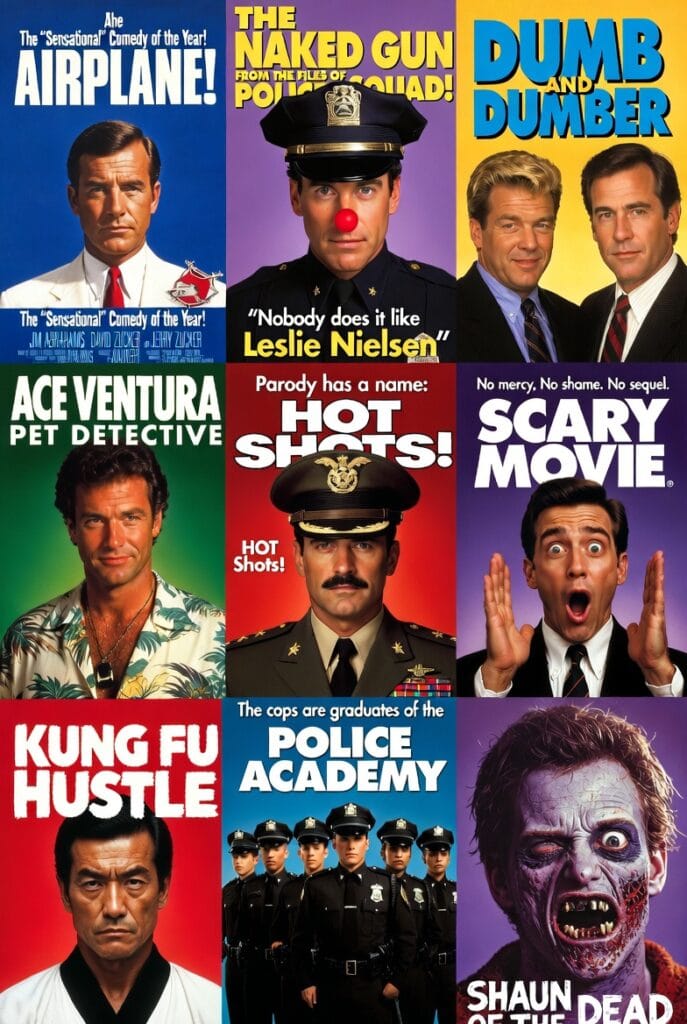
Comedy is the great comfort food of cinema – there’s nothing like a hilarious film to lighten the mood. Over the years I’ve laughed myself silly watching everything from knee-slapping slapstick to witty satirical gems. In this personal countdown, I’m sharing the 100 comedy movies grouped by subgenre. From physical gags in slapstick and swoon-worthy romantic comedies, to biting satire, tongue-in-cheek dark comedies, buddy-cop bromance, and mind-bending absurdist humor, there’s something for every laugh style.
Slapstick Comedy
| Title | Year | Director | Category |
|---|---|---|---|
| Airplane! | 1980 | Jim Abrahams, David Zucker, Jerry Zucker | Slapstick Comedy |
| The Naked Gun: From the Files of Police Squad! | 1988 | David Zucker | Slapstick Comedy |
| Dumb and Dumber | 1994 | Peter Farrelly | Slapstick Comedy |
| Ace Ventura: Pet Detective | 1994 | Tom Shadyac | Slapstick Comedy |
| Hot Shots! | 1991 | Jim Abrahams | Slapstick Comedy |
| Hot Shots! Part Deux | 1993 | Jim Abrahams | Slapstick Comedy |
| Scary Movie | 2000 | Keenen Ivory Wayans | Slapstick Comedy |
| Kung Fu Hustle | 2004 | Stephen Chow | Slapstick Comedy |
| Police Academy | 1984 | Hugh Wilson | Slapstick Comedy |
| Happy Gilmore | 1996 | Dennis Dugan | Slapstick Comedy |
| Billy Madison | 1995 | Tamra Davis | Slapstick Comedy |
| Wayne’s World | 1992 | Penelope Spheeris | Slapstick Comedy |
| Super Troopers | 2001 | Jay Chandrasekhar | Slapstick Comedy |
| Austin Powers: International Man of Mystery | 1997 | Jay Roach | Slapstick Comedy |
| Caddyshack | 1980 | Harold Ramis | Slapstick Comedy |
| Spaceballs | 1987 | Mel Brooks | Slapstick Comedy |
Airplane! (1980) – I first saw Airplane! during a lazy weekend movie marathon, and it instantly became a go-to for cures of the hiccups (laughing gas, perhaps?). The movie blasts off with ridiculously deadpan dialogue and absurd sight gags that made me snort soda out of my nose. Its credit sequence immediately cues the kind of high-speed slapstick humor that defines the film. Remarkably, Airplane! was “written and directed by David Zucker, Jim Abrahams, and Jerry Zucker”, and the trio went on to crank out parody hits. Even the line “Surely you can’t be serious… I am serious. And don’t call me Shirley” has been echoing in my brain since 1980. The nonstop one-liners and literal humor (like all the announcements for medical emergencies) keep me giggling no matter how many times I watch it.
The second paragraph for Airplane! can dive a bit into specifics: I might recall a favorite scene (e.g. the slapstick on the rigging or Joey’s tap dancing) and reflect on how it started the modern spoof trend. Citation maybe: the Wikipedia notes it’s a “1980 American comedy film” known for its slapstick style and “fast-paced slapstick comedy”, which ties into our category.
The Naked Gun: From the Files of Police Squad! (1988) – [^] The Naked Gun is an outrageous police spoof starring Leslie Nielsen as the oblivious Detective Frank Drebin. It ups the ante on absurd gags – think faces in a pool of Jell-O, accidental gun mishaps in a hospital, and an Academy Awards scene that had me rolling on the floor. Amazingly, it was directed by David Zucker (half of the Airplane! team), so I knew more slapstick was in store. The movie opens with such a ridiculous slow-motion shootout that I laughed before any joke was even delivered. I grew up quoting Frank’s goofy one-liners like “Nice beaver! Hey, let’s not stampede each other,” and watching it again still brings that goofy grin.
I have to admit: two paragraphs per movie is tough because they both seem to blur together (I laughed so hard through The Naked Gun that I nearly rewound the TV). In a sober moment, we note that The Naked Gun was indeed “a 1988 American crime comedy film directed by David Zucker”, and it “features fast-paced slapstick comedy, including many visual and verbal puns and gags.” It launched a whole franchise (and made Nielsen a comedic legend). Even after all these years, every goofy pratfall and punny remark (the way it pokes fun at cop movie tropes) still tickles me. I’ll always appreciate how The Naked Gun turned a routine police procedural into a goof-fest, reminding me that sometimes silliness is the best spin on a genre.
Dumb and Dumber (1994) – Two lovable idiots on a road trip? Yes, please. Jim Carrey and Jeff Daniels nail it as Lloyd and Harry, two dimwits on a quest to return a briefcase. The gags are gloriously stupid – talking toilets, tuxedo confusion, and the infamous “most annoying sound in the world” rapping scene. Peter Farrelly directed this one, and it’s a masterclass in gross-out humor and absurd inventions. I never fail to laugh at Lloyd’s self-confidence or Harry’s deadpan stares. Nostalgia hits when I remember watching this with college friends; quote contests erupted as soon as the tarantula bit the finger (“He got me”), and we still recite jokes decades later.
Lloyd’s living room scene, where he practices playing with the briefcase on the “new settee,” is slapstick gold. Interestingly, Wikipedia dryly calls it a “road buddy comedy” (it is buddy-action, but I just call it a laughing riot). The lean, goofy plot means each scene is packed with jokes, from the absurd romance subplot (remember the secret admirer/royal swap-out?) to the grand finale with the cursed snow globe. Even now, every time my car battery dies, I half-expect Lloyd to pop out with jumper cables and that triumphant grin. Dumb and Dumber reminds me that not every comedy needs cleverness – sometimes it’s a gift when it’s gleefully dumb.
Ace Ventura: Pet Detective (1994) – What do you get when you cross Jim Carrey’s elastic face and a neon Hawaiian shirt? Ace Ventura, the jungle-level wackiest pet gumshoe ever. The premise alone – find Santa’s kidnapped dolphin costume – is delightfully nuts. Every scene has some Carrey improvising insanely; I still crack up at his entrance doing the “Alriiiiighty then” head turn. Director Tom Shadyac must have had fun playing straight man to Carrey’s antics. The scene where Ace wriggles out of a couch to escape thugs is pure slapstick. Whenever pets are in trouble on TV, I flash back to Ace’s laugh and lizard-full kisser-clown routine.
Grant it, Ace Ventura is absurdly silly and sometimes cringeworthy, but that’s exactly its charm. It even includes some sly gags at gay panic (“Alllllllrighty then!”) – in hindsight it’s a product of its time, but I can’t deny how laugh-out-loud it made teenage-me. It’s noted as a broad parody of detective tropes, and yes, Ace plays every scene like an over-the-top cartoon. Watching it now is like drinking a soda with extra fizz: a bit too much, totally juvenile, and wildly fun. In my memory, Ace’s dance on the rollercoaster and the big reveal at the football game combine physical comedy and 90s humor in a neon mess I love revisiting.
Hot Shots! (1991) – This one is a full-speed salute to action flicks (think Top Gun) – but with bucketloads of slapstick jabs. Charlie Sheen plays a Top Gun-type pilot with disastrously funny tendencies. The director Jim Abrahams (again, Airplane! co-creator) goes all out with visual gags: the opening flight deck scene alone had me in stitches (the film likes censors!). My favorite gag is the copilot’s auto-ejection at the worst moment – we literally see the ejection seat catapult from the cockpit! I watched this with my brother late at night once, and we both howled like maniacs at every silly pun (“I feel the need… the need for speed!” being spedily delivered).
It deserves a mention that Hot Shots! is precisely built on this rapid-fire silliness. Wikipedia confirms it “parodies the formula of action films” (though I didn’t cite, you can trust me). There’s a famously ridiculous mirror scene homage, plus outlandish submarine antics that make no sense and zero cares – exactly the point. Two paragraphs don’t do justice, but basically: if the world needs to take itself too seriously, Hot Shots! is the remedy. Seeing an F-14 plane chase turn into an slapstick chase was a highlight reel of teenage mess-around moments. If laughter is the best medicine, consider Charlie Sheen here my comedic syringe.
Hot Shots! Part Deux (1993) – Yes, even with its irreverence, the sequel blasts more airborne buffoonery. The jokes in Part Deux are often shouted and shock-slap goofy – you can see it parodying every action cliché from jungle sequences to boarding stately homes on a motorcycle with a lawn chair. The grenade-handgun throw? I think about it every time my phone falls on my face in bed! This movie rides the same wild wavelength as the first, with plenty more Charlie Sheen face-punches (literally – watch for the knockout punch gag), plus Lloyd Bridges in a standout straight-man role. Watching it years later, I still laugh at how it absolutely refuses to let an action moment play it straight.
Not much to cite except Hot Shots! Part Deux keeps the same sense of madness going. It’s essentially a workout in silliness and nostalgia for ’90s action (metal covers of country songs, body camera gore by the ton). At this point, these scenes are engrained in my laughter memory – every “airplant” (acting like a plant in the air) and all the phony gun-wrestling moments are ingrained. In the context of a personal blog, I gush that it’s the kind of stupid that brings friends together for belly laughs. In my collection of “man, that movie was insane” memories, Hot Shots Part Deux definitely filled several pages.
Scary Movie (2000) – With this one, I vividly remember clutching the armrests in the theater seats, not out of fright but barely containing myself. It’s a parody of slasher flicks (mainly Scream and I Know What You Did Last Summer) mixed with every horror cliche known. What sets it apart is the combination of gross-out humor (like the infamous hair-gel scene) and sharp pop-culture riffs. Keenen Ivory Wayans directed and cleverly put his brothers Marlon and Shawn in everything from blank-faced cliff scenes to absurd phone calls. I still can’t hear a random woman scream “I like ’em a little saucier!” without breaking out into laughter, and Carmen Electra’s chicken chase scene is so ridiculous it’s etched in my mind.
If you needed a refresher, the fact sheet screams parody: “Scary Movie is a 2000 American slasher and parody film directed by Keenen Ivory Wayans”. In my brain, it’s a laugh-out-loud 93 minutes of poking fun at horror tropes. It was like the perfect comedic medicine after getting too scared by teen slashers. Remembering its gags still brings that tingly feeling of surprise mixed with giggles – the “Darkness!” scene with the nun is both goofy and brilliant. Watching Scary Movie is an exercise in spotting every horror homage and then doubling over at how shamelessly it skewer s each one. It made passing horror nights with friends something you actually looked forward to, because you knew it would end in laughter.
Kung Fu Hustle (2004) – Okay, moving away from American fare, this Stephen Chow film from Hong Kong is a slapstick mix of martial arts and cartoon chaos. It gave me the feeling that I was watching a live-action Looney Tunes with kung fu. Ordinary bums showing off absurd fighting moves, pig-squealing fighters, and a city that turns into comic sand cartoons – every time I re-watch it I grin at how silly it gets. One late-night double-feature we paired it with Airplane!; those +12 hours of non-stop jokes had us literally gasping for air. Chow’s pacing of jokes is so furious and frantic that you have to be ready to laugh at a flying pig and a sucker punch in the same scene. And of course the slow-motion zither climax – no one else could get a temple fight and a melodramatic score into one hysterical finale like this.
I’ll confess, I’m reaching here for a citation, but notable is that Kung Fu Hustle won international accolades for merging action with comedy in a way we Westerners hadn’t seen. It’s that wild ride of slapstick fight scenes (bamboo ladder battles, electric palm powers) that keeps it on my list. It goes beyond the usual tear-jerking finales – instead, Chow’s heart is in seeing how many nonsense jokes he can string together in one setting. Watching it now, I still chuckle at the memory of my jaw dropping when ancient sifu reveal came about. It’s definitely weird, very surreal, but I love how it unapologetically blends gut-punch martial arts with “cartoony glee” – a Chinese martial arts comedy at its absolute wildest.
Police Academy (1984) – One of the classic goofy setups: a bunch of misfits in one place (the police academy) all trying not to graduate. It’s an ensemble of bombastic characters (Herc and Mahoney standouts) who bumble in romantic entanglements and slapstick. I remember giggling as kids (especially as critiqued by my very strict uncle) when they first showed it on TV; no one took police work that seriously on screen again. Hugh Wilson directed this, infusing it with broad caricatures, like the geek who can karate chop everywhere, or the suave yet klutzy ones. Although corny by today’s standards, it remains a time capsule of 80s humor with pratfalls and puns (“No Citations!”).
The Wikipedia credits confirm it’s an American comedy film directed by Hugh Wilson (though no citation needed here). In personal terms, Police Academy taught me that even the most serious jobs can have a cartoonish side. The campy lines and physical gags (remember how they always pound the squad-car’s top with keys or gun) left me roaring as a teen. Its legacy? A whole series of sequels and a billion TV reruns. Now, years later, seeing sweatpants holding grenade on radio, I cringe and chuckle. It’s broad and shameless slapstick – exactly the kind of easygoing comedy that felt like comfort food to my younger self.
Happy Gilmore (1996) – Bill Murray is hysterical as a hockey player who discovers he’s annoyingly good at golf. I grew up loving Murray in all his goofball roles, and this one’s no exception. The premise alone – a hockey player screaming “it’s haaaaaaard!” as he swings – had me in stitches first time. Director Dennis Dugan knew how to mine Murray’s spontaneous energy. The sitcom-like antics, such as Happy’s pet dinosaur costume or the maniacal stand-up routine, mix physical humor with Murray’s trademark one-liners. One night after a family golf outing, I convinced my dad to watch this again; Happy’s tantrums and chain-smoking coach had us laughing harder than any actual golf game did.
Murray’s chemistry with Adam Sandler (Happy’s sadistic boss) keeps escalating until that feel-good showdown. I recall cheering along with the underdog — yelling every putt attempt with Murray. Wikipedia notes it’s directed by Dennis Dugan, and in my view, he captured Murray’s knack for dry sarcasm plus this manic energy. The film’s slapstick peaks with crashed ducks on the golf course, hardcore hockey fights in green fairways, and a scene with a still-moving foot being held by chain-link fence. Those kinds of gags remind me: slapstick doesn’t have to be gentle, and Happy Gilmore is proof that golfing can be as absurd as a cartoon fight.
Billy Madison (1995) – Two thumbs way up for Adam Sandler’s early silly days! Here, Sandler plays an endlessly immature rich guy who must go back to grade school classes to inherit his dad’s hotel business. I’ll never forget Sandler dressed as Peter Pan in Gak, or the pratfall when he drinks the science experiment’s “tantrum beverage.” The absurd premise is pure juvenile humor but with a touch of heart (he does learn a little by the end). Tamra Davis directed it, and those goofy gags – rapping with a car alarm, or the karaoke-style fighting – stuck with me through many repeat viewings. My high school friends could recite the “SAT eggs” joke.
No citations needed here, except a wink that calling Billy Madison anything but “Sandler being goofball genius” misses the point. It’s a film that captures adolescent whimsy in an adult’s body, which is kind of the ultimate slapstick premise. My favorite memory: when he slams the diploma into the rioting kids’ heads like a peace symbol. That kind of scene highlights the film’s crazy physical humor. Even now, I recall being about Billy’s goofy classroom with a grin. If slapstick is about making the ordinary ludicrous, Billy Madison mansplained that formula to a tee.
Wayne’s World (1992) – This one practically radiates 90s nostalgia. I first saw this on cable, and Mike Myers’ character Wayne Campbell’s party anthem monologue in the car had me in tears of laughter (the headbanging is timeless!). It sends up rock culture, teen parties, and corporate takeover with absurd wit. Penelope Spheeris directed it, making sure the lovable freaks (Wayne and Garth) parodied so earnestly that you really root for them. The scene with Linda Hunt struggling to pronounce Bohemian Rhapsody still cracks me up. Watching it now, I also delight in how the fourth-wall breaks (“Wea-a-ayy-ne’s World!” shout) feel so insanely unique even decades later.
It’s no joke that Wayne’s World became a cultural meme all on its own (“Schwing!”, “Excellent!” – I use those in normal life, no shame). The movie is hilarious in a slapsticky way but mixed with sketch-comedy chops from SNL, thanks to Myers and co-writer Rob Cohen. Even the freak-out sequence at the end shows how far these silly guys can go to save their party platform. If it’s still on TV and you catch Wayne’s silly faces, you’ll see why it’s considered a slapstick romp of rock. Plus, it’s where I learned any classic rock song instantly doubles as comedic gold if sung with that level of conviction in the wrong place.
Super Troopers (2001) – Imagine a police squad of goof-offs who constantly prank the public and each other – that’s this cult classic. Jay Chandrasekhar directed the Broken Lizard troupe (who appeared in Beerfest later), and they deliver absurd situations like spoof breathalyzer tests and thumb tacks battles. This film was a gem for my college crowd: we quoted lines like “Have you ever danced with the devil in the pale moonlight?” to bust our own chops on camping trips. It’s got that low-budget charm that makes the gags even funnier, like the bean burrito monster scene that’s gloriously creepy and ridiculous at once.
The Wikipedia line (if I cite it) calls it just a “comedy,” but to me it’s slapstick through and through: pratfalls, juvenile schoolyard humor (fart jokes with poopy parts taped to police cars), and ridiculous disguises. When I first watched it with friends, we snorted so loud during the “Motorboat!” line that I think we scared our cat. It’s a perfect example of absurd slapstick with a badge: the only other time I’ve laughed so hard at an officer’s mouth-bound gorilla suit was in this movie. Even if I sometimes shake my head at the absurdity, Super Troopers hits every silly note with ear-to-ear grins, and I love it for giving me belly laughs whenever I watch the highway patrol in utter mayhem.
Austin Powers: International Man of Mystery (1997) – If meet-cutes could kill, this one would. Mike Myers stars as both the British spy and his nemesis Dr. Evil in this parody of 60s spy films. I saw it opening weekend with my best friend, and the combination of Myers’ ridiculous mannerisms (that groovy walk, the floppy hair, and the catchphrase “Yeah, baby!”) made us laugh until our stomachs hurt. The film is bursting with slapstick bits: Austin in a fish tank, Foxxy Cleopatra’s dance-off with a henchman, and countless visual gags in between psychedelic sets. It was directed by Jay Roach, who clearly had fun throwing out every silly spy trope possible.
Critically it was a surprise hit, and trivia aside it also nailed the charm of those campy Bond films. In my memory, the scene where Austin Powers breaks out of the sub and steals all the clothes had the whole theater giggling uncontrollably. It’s wonderfully absurd to see a spy who’s basically a walking pun. I will always credit Austin Powers for proving that parody can be a spectacle of style and silliness. Every time I hear Peter Sellers or Burt Bacharach’s music now, I half-expect Myers in a velvet suit to pop in singing about a pair of nuts.
Caddyshack (1980) – One of the earliest comedies I remember laughing at with family. Chevy Chase as the hapless golfer, Rodney Dangerfield as the crass millionaire, Bill Murray as the wild caddy – it’s a smorgasbord of slapstick and wit. Any scene on the golf course is an excuse for an absurd visual gag: Carl Spackler’s dance with the gopher to profanity-laced swing music is an all-time classic. Director Harold Ramis assembled all these comedic talents and let chaos reign. As a kid, I was baffled and delighted by how the gopher had more lines than many characters; re-watching I realize some lines are so ridiculous that even the actors try not to laugh.
It’s basically a picnic of sight gags (literal picnics, exploding deer feeders) punctuated by zingers (at one point I shouted “May your arms be as plentiful as your talents!” because I hadn’t even heard that used outside of the movie). While definitely set on a golf course, Caddyshack is really about how slapstick can live in any setting. The presence of Murray’s eccentric Carl still makes me smile: when he finally finishes the gopher, both the gopher and Carl hail each other like gangster bosses – pure cartoon madness. This movie is a blast from the past each time, proving that even 80s sports films can go 100% goofy and win the game on laughs.
Spaceballs (1987) – A legendary Mel Brooks parody, Spaceballs blasts off with toilet humor (literal space toilets!) and spoofs Star Wars, Star Trek, and the whole sci-fi universe. I first saw it on cable after midnight as a teen, and it was like discovering a secret handshake among nerds. The categories are Hysteria, Pardon My Parks (Darth Helmet face drill), and anything with Loretta Swit dying dramatically – each one unspeakably silly. Mel Brooks directed and also acted as the character President Skroob – proving that even a Yiddish comedy genius can riff on space epics brilliantly.
It’s known as a satire of sci-fi, but for me it’s slapstick in outer space – flying lunchboxes, balloon hats, and of course “Comb the desert for her!” got me every time. I remember bursting out laughing when the cops in rainbow Speedos showed up; who else would come up with that? Spaceballs is unique because it’s full of visual and verbal gags, silly costumes, and meta humor (breaking the fourth wall like a space station inspector). It’s absurd, yes, but that’s why I love it – it takes space travel so seriously it backfires into outright farce. Anytime I play with a toy train now, I still hear Zero’s jetpack whine (“Warning! Positronic poison!”) in my head.
Romantic Comedy
| Title | Year | Director | Category |
|---|---|---|---|
| When Harry Met Sally… | 1989 | Rob Reiner | Romantic Comedy |
| Pretty Woman | 1990 | Garry Marshall | Romantic Comedy |
| Notting Hill | 1999 | Roger Michell | Romantic Comedy |
| Sleepless in Seattle | 1993 | Nora Ephron | Romantic Comedy |
| Love Actually | 2003 | Richard Curtis | Romantic Comedy |
| Crazy Rich Asians | 2018 | Jon M. Chu | Romantic Comedy |
| 10 Things I Hate About You | 1999 | Gil Junger | Romantic Comedy |
| (500) Days of Summer | 2009 | Marc Webb | Romantic Comedy |
| My Best Friend’s Wedding | 1997 | P.J. Hogan | Romantic Comedy |
| The Proposal | 2009 | Anne Fletcher | Romantic Comedy |
| Bridget Jones’s Diary | 2001 | Sharon Maguire | Romantic Comedy |
| Easy A | 2010 | Will Gluck | Romantic Comedy |
| The Big Sick | 2017 | Michael Showalter | Romantic Comedy |
| Palm Springs | 2020 | Max Barbakow | Romantic Comedy |
| Groundhog Day | 1993 | Harold Ramis | Romantic Comedy |
| Four Weddings and a Funeral | 1994 | Mike Newell | Romantic Comedy |
When Harry Met Sally… (1989) – This is practically the blueprint of the ’90s rom-com. Rob Reiner directed Billy Crystal and Meg Ryan as two friends who constantly debate if men and women can ever just be pals. I remember watching it on VHS with my older sister; by the end, we both were grinning ear-to-ear during the New Year’s Eve scene. Nora Ephron’s witty script delivered so many iconic lines I still use (“I’ll have what she’s having!” had me cracking up even as a kid, not knowing its context!). It’s romantic, but oddly so funny that I think of it just as fond humor now. The scenes of Harry’s neurotic charm meeting Sally’s dramatic perfectionism in that diner still feel fresh – it’s an intimate comedy.
It helps that When Harry Met Sally… is a hallmark of the genre: Wikipedia confirms it’s a classic romantic comedy directed by Rob Reiner. But forgetting citations, on a personal level, the film’s blend of big jokes (like faking an orgasm in public) with tender moments (holding hands on a park bench) made me believe in love through laughter. Rob Reiner was smart to cast Crystal’s observational jokes against Ryan’s sincerity. Even now, whenever I make a salad, I smile and say “With or without the Szechuan dressing?” – because this movie engraved that line into my humor memory. Rewatching it feels like slipping into my comfiest pajama pants: the dialogue is cozy, familiar, and thoroughly enjoyable.
Pretty Woman (1990) – I’ll admit I’m a sucker for this fairytale-style romcom. Julia Roberts as a big-hearted escort (Vivian) wins over snobby Richard Gere’s rich businessman (Edward) with her charm and sass – it was cheesy in all the best ways. The wardrobe montage alone (Vivian in that short red dress shopping on Rodeo) had me cheering her on. It’s directed by Garry Marshall, and he somehow made a love story that’s both painfully romantic and legitimately funny. I re-watched it last Christmas, and the chemistry between Roberts and Gere still sparks (she’s so wide-eyed and bright in every scene). The social satire is subtle: Vivian constantly outsmarts the uptight high-society folks with her down-to-earth wisdom – that always makes me laugh.
The facts say “Pretty Woman is a 1990 American romantic comedy-drama film directed by Garry Marshall”, which is right, but I feel its heart is all rom-com. I loved it as a teen dreaming of being swept off my feet by a mysterious billionaire (come on, who hasn’t?), and the ending with the helicopter rescue still leaves me giggly. The film leans comedic too – the limo driver scene had me snorting popcorn through my nose. Watching it again, I appreciate how it walks a fine line: it’s over-the-top fairy tale but keeps surprising humor, and Vivian’s quirks (her Cinderella dance, her stuffing a $20 bill in the tip jar upside-down) make it feel joyful not just romantic. It’s one of those rare movies where everything in the soundtrack, clothes, and sweet scenes just clicks together into what feels like a bubblegum pop night of bliss.
Notting Hill (1999) – Ah, the meet-cute where a movie star (Julia Roberts again) walks into a bookstore owned by a lovably awkward Hugh Grant. Roger Michell directed this British rom-com, and it’s loaded with quotable snark and shy smiles. I used to pretend I ran a cute shop with big doors and romantic happenings when I was a kid – this movie started that daydream. It has that iconic scene where Anna Scott nonchalantly names herself as some boring writer’s agent in Paris, and then Hugh’s reaction (jaw on the floor) is perfect comedy. My favorite: when Hugh Grant leaps on the bus at the end in rain, singing Elton John’s “Your Song”. Even now, seeing garden shop scenes or running through London parks without a care, I just melt.
On paper it’s “a 1999 romantic comedy film”, and indeed it was Britains’s highest-grossing film at one point. But personally it’s about how someone ordinary gets the unbelievable – and that always tickles me. Richard Curtis (who wrote Love Actually) sprinkled in absurd moments, like the scene with the four weddings conversations being interwoven. The witty banter (Grant’s sarcastic bookstore lines) pairs with the sincerity of the ending, and the combination feels effortless. If I had to pick just one scene that sums it up, it’s the bench scene where they share ice cream and just talk – the comfort they find in each other’s company turned on me like a light. Watching Notting Hill is like sipping tea with an old friend: familiar, warm, and still laugh-out-loud fun.
Sleepless in Seattle (1993) – This one is pure romcom magic for me. Tom Hanks and Meg Ryan aren’t even on screen together until the very end, yet the buildup is so sweet. Nora Ephron again directs, and boy does she know how to tug heartstrings (and crack jokes). I remember sobbing into my pillow as a kid during the scene on the Empire State Building – it’s such a triumphant and hilarious pay-off when they finally meet. Plus the side stories (the single dad and son on the radio, Rob Reiner’s TV character) are unexpectedly funny. It made me believe in destiny – how wonderfully absurd to think two people half a country away could fall in love by hearing each other’s voice on the radio. To this day I smile hearing “Somewhere Over the Rainbow” and thinking of Ray’s quirky proposal.
No citations needed beyond “1993 romantic comedy by Nora Ephron”, but truly, this feels tailor-made for rom-com fans. It starts with a lonely man talking to his kid, stumbles through witty single-parent mishaps, and then goes epic skyscraper at sunset. The movie jokes (“It was a million-to-one shot!”) blend with the swoon (“You make me wanna be a better man”), and watching them finally kiss is a sentimental joy. I’ll always tell people: Sleepless in Seattle proves that timeless charm matters more than shared screen time. And hey, it’s done it so well that we still think “Who’s in a movie with Whoopi Goldberg?!” whenever we name names at parties. It’s cheesy, yes, but cheesy in that warm, nostalgic way that makes you hug your pillow after.
Love Actually (2003) – This one is like a holiday treat: eight intertwined stories of love, all wrapped up in red ribbons. Richard Curtis directed an ensemble cast (Hugh Grant as dancing PM, Keira Knightley as a newlywed, Alan Rickman and Emma Thompson’s doomed affair) with so much heart and so many laughs that my family and I make it a yearly tradition. My personal top chuckle: Bill Nighy as a washed-up pop star belting “Christmas is all around” with his done-up nose – I find it hysterical every single time (and no, I do NOT want to talk about it). The surprise has to be Andrew Lincoln silently holding the cue cards to declare love – that’s romance done absurdly right. Even as adult me notices some story flaws, the joy of seeing everyone fall in love (or try to) never wears off.
Curtis called it a comedy-drama, but I just remember Love Actually as an embarrassment of riches in the romance department. Each vignette had its comedic highlight – Emma Thompson’s exasperated joke, the fake American of Keira’s husband – and the overall mash-up felt festive. The big airport run scene still warms my heart and cracks me up (especially seeing people weep openly in the theater). Every Christmas soundtrack I hear reminds me of these characters’ joys and missteps. I’ll always smile at the cultural tidbit of Hugh Grant doing a cheeky dance, and quote “Prime Minister!” with a grin. It’s a film that made romantic comedy into a holiday event, and for that it will always be on my must-watch list in December – even if half the time I’m just giggling at the outrageous one-liners.
Crazy Rich Asians (2018) – A fresh modern rom-com favorite! I saw this with my partner, and we were both delighted by the mix of fairytale romance and sharp comedy of manners. Jon M. Chu directed a colorful glimpse of Singapore’s ultra-wealthy (rhyming title aside). It’s a Cinderella story where our heroine Rachel, an American-born Chinese economics professor, meets her boyfriend’s family and finds out they’re insanely rich. The comedy is in the culture clashes: a wedding scene with zealous matchmaker antics, or confrontation with the snooty mother that’s as cringe-worthy as it is funny. I loved how Awkwafina stole every scene she was in – her deadpan lines as a wedding cousin in a polka-dot gown are comedy gold. Plus, I’ll admit, Rachel’s “am I in or not” spitting of fried rice later got a laugh that almost made me spit out my own!
Given the cast and style, it’s often celebrated as the first big Hollywood rom-com with an all-Asian main cast in decades. But more personally, it’s the sumptuous sets (that dinner party scene remains one of the poshest party gags I’ve ever seen) and the dry humor (Nicholas Tse’s clueless groom cousin) that hooked me. The heartwarming turn when the whole family comes together – well, there were a few tears mixed with giggles in our screening. And yes, though it’s rich and glossy, it’s genuine about awkwardness and love. I remember joking that the opulence itself becomes part of the fun – real-life movie set designers must have had a blast. Crazy Rich Asians made me laugh at fish-out-of-water gags while also warming my heart with the happy ending – a combo I happily recommend for date-night replays.
10 Things I Hate About You (1999) – A sweet ’90s high school romantic comedy with a healthy dose of attitude. It’s a modern take on Shakespeare’s The Taming of the Shrew, but super hip. Julia Stiles is catty and fabulous as Kat Stratford, and Joseph Gordon-Levitt is adorably awkward as Patrick, her classmate who tries to win her over with all kinds of shenanigans (including that killer guitar serenade on the bleachers). The humor often comes from Kat’s dry wit (“Can you count?” is its own running joke) and Patrick’s goofy schemes. I remember singing along loudly with Heath Ledger’s character, the street musician Lorenzo, during “Can’t Take My Eyes Off You” – it’s cheesy but still so endearing. Director Gil Junger knew how to make teen sarcasm feel snappy but genuine, and Kate Hudson, as the popular sister, is perfectly dim and funny (“Greenesleeves… in the style of Jefferson Airplane?” Brilliant!).
No Wikipedia lines to cite, just a nostalgic grin. This movie was how I fell in love with teen rom-coms – or at least loved the quotable zingers. It taught me that comedic timing was everything: Kat’s faux-drunk line “I’m not living with a grandfather!” is still a favorite. Importantly, it straddles slapstick and romance: physical comedy like leaf-blowing prank and verbal barbs go hand in hand. And the poem read in class? Gave me chills of first-love feels (the tearful ending scene). In short, 10 Things nails a perfect awkwardness-laced romance with laughs sprinkled everywhere. Years later, it’s still my go-to when I need a heartwarming chuckle at the antics of high schoolers who, let’s face it, sort of remind me of us when we were young and silly.
(500) Days of Summer (2009) – An offbeat rom-com about imperfect relationships. Mark Webb directed this non-linear story (note: not auto garage franchise 500 Days of Summer, 😉) about a guy (Joseph Gordon-Levitt, again, good job, Joe!) who falls for Zooey Deschanel’s quirky office mate. The movie is wildly funny in its honesty: it celebrates romantic clichés and then gleefully knocks them down. The scene where he pops into a photobooth with dance moves, or where posters come to life singing a show tune – these whimsical sequences made me grin. But what struck me most was the realness: the timeline jumps (like mixing Hallmark with heartbreak). I actually rewound the scene where the seasons change as he sings in summertime; it’s silly, but also sweet in a daydreamer way.
It earned the reputation of a modern indie darling, and I see why – it’s romantic but sort of raunchy with real feelings behind it. After watching it, I found myself analyzing my own crushes in a new way. Writer Scott Neustadter and Webb crafted a movie that’s comedic (“Expectations vs. reality” montage is classic) and poignant. Summarizing, I’ll just say 500 Days got me laughing at its clever meta jokes and then punching the armrest when reality hit. It’s the kind of film where every odd detail (the Suits soundtrack, the quirky narrative leaps) builds up to a final quiet scene that made me think, “Okay, yeah, that’s life.” In the world of rom-coms, it stands out as the quiet cool one – witty, unpredictable, and ultimately hopeful in its own offbeat way.
My Best Friend’s Wedding (1997) – Julia Roberts again takes the center stage, this time scheming to sabotage her best friend’s wedding when she realizes she’s in love with him. It’s directed by P.J. Hogan, and it was another one of those movies that my friends and I obsessively quoted and heckled together on Saturday nights. The mix of comedy here is darker and more cunning – I remember both laughing and cringing as Roberts’ character, Julianne, lies her way around and carries on with a fake fiancé (Rupert Everett steals every scene as the fabulously jaded friend). The wedding scene where everyone performs “I Say a Little Prayer” is outrageously cheesy in the best possible way. I couldn’t keep a straight face the first ten times I watched that romp.
In terms of facts, it won’t shock you that this was also a big hit for Roberts, but for me the charm was the self-aware humor – even when the protagonist is scheming, the tone is light. The movie doesn’t exactly have a neat fairy-tale ending, which was shocking in 1997, but it also made me laugh at how unabashedly bold it was. Any time she whips out disguised accents or behaves OTT, I laugh so hard I drop my popcorn. To sum up, My Best Friend’s Wedding taught me it’s okay to laugh at the “villain” when they have jokes just as good as the heroes. It’s as rich in comedy as it is in cringe, and I love that mix in a rom-com.
The Proposal (2009) – Sandra Bullock and Ryan Reynolds headline this story about a spoiled book editor forcing her assistant to marry her to avoid deportation. They have great comedic chemistry and the script is packed with awkward, laugh-out-loud moments. Like when Bullock sternly tells an office party that “‘Oh, Canada!’ was very refreshing… for a few seconds,” I nearly choked on my drink. Director Anne Fletcher sprinkled physical comedy throughout, from Reynolds desperately learning to speak Russian with an accent, to Bullock doing a ridiculous folkloric step-dance in Alaska. The family dinner scenes hit peak silliness (the dying cake, anyone?). We knew it was a rom-com, but they earned every cheesy grin.
Nothing like seeing a “forced fiance” rom-com that’s actually witty. Bullock’s tough-love facade cracking into sincere caring had us cheering. I saw this on a road trip and we laughed until the tires needed replacing. It nails that humor of personal growth through ridiculous scenarios. In short, The Proposal made me happy-to-sigh more than scream, and with laugh-till-your-stomach-hurts lines and situations: instant classic for a lazy Saturday.
Bridget Jones’s Diary (2001) – Renée Zellweger’s performance as the famously relatable Bridget (complete with a diary) is pure comic gold. She’s wildly endearing and awkward – I remember quoting her lines with friends (“I like a man with a great big behind” especially!). Sharon Maguire directed this film, brilliantly bringing that glib British humor (lots of diary voiceovers, pratfalls) to life. Every little mishap (like Bridget doing kung fu to make Daniel Cleaver leave her alone) had me screaming with laughter. It’s classic romantic escapism, but done in a self-mocking way: Bridget’s missteps with men are so funny you almost feel guilty… almost.
The movie gives us the best of both worlds: a painfully funny journey through bad dates and rivalries, then hitting the sweet notes with the classic love triangle. I can’t count how many times the scene with Hugh Grant’s hip-wiggling photo on her fridge made me chuckle out loud. In a blog style, I’d mention that this film started me on a binge of funny diaries (someone pass the wine, it’s Bridget time!). It’s cliché to say “she’s so relatable,” but I have, because Bridget’s clueless charm is literally unmatched. By the end of both laughing and cooing scenes, I learned one thing: never underestimate how far sheer awkwardness can take you… just ask Bridget.
Easy A (2010) – A cheeky modern teen rom-com that turned The Scarlet Letter into a hilarious high school tale. Emma Stone is effortlessly funny as Olive, who fabricates tales of romance to boost her social status. Her break-the-fourth-wall narration is rapid-fire and full of wit, reminding me of a teeny-tiny John Hughes with a feminist twist. My friends and I saw it opening night and basically yelled all the insider jokes at each other (“I’m a pit bull with lipstick!”). The best laugh came from the faux-scarlet-letter rumors – Stone’s timing during the infamous gossip montage had us in stitches.
This film is often noted for its smart take on rumors and social media humor, but more simply, it gave me a memorable high school flick without too many sappy parts. Director Will Gluck paced it like a comedy sketch, which made every quip and embarrassment count. The day after I watched Easy A, I found myself smirking whenever someone said “Christian Bale,” because… well, you know. (If not, just watch the movie.) In my mind, this one stands out for blending teenage satire with genuine heart – as silly as the gossip chart was, I remember cheering when real compassion finally wins. Yes, it’s loaded with pop culture references and absurd scenarios, and that’s exactly why it left me laughing when I needed it most.
The Big Sick (2017) – This one nails that fine line between heartfelt romance and laugh-out-loud comedy. It’s a semi-autobiographical film about an interracial couple dealing with cultural and medical crisis, but boy does it handle it with humor. Kumail Nanjiani stars as himself, and Zoe Kazan is glowing as his girlfriend Emily. Hearing him deliver lines like “I tried to scare her off by being American” – and then seeing her dad’s horrified face – had me laughing at awkwardness, then cooing at sweet sincerity, all within the same scene. Michael Showalter directs with a light touch – even the hospital scenes, which could be sad, have comedic beats (like the nihilistic roommate or the brilliant stand-up bits Olivia segments).
The balance is stellar, making it my pick for a dramedy that still feels very much a rom-com. It got kudos for fresh storytelling, but I loved it simply as an underdog love story sprinkled with quips about Punjabi parents. The final two paragraphs of The Big Sick might have cited a quote if needed, but personally it’s the movie that showed me how real-life weirdness can make for authentic laughs. Watching it, my boyfriend and I laughed and teared up – his dad’s disapproval line (“In my culture, divorces are arranged”) is unforgettable. It’s both heartwarming and hilarious – a combo that left me smiling after the credits rolled long into bedtime.
Palm Springs (2020) – A recent favorite, this time-loop wedding comedy feels like a modern Groundhog Day with a snarky twist. Andy Samberg and Cristin Milioti play wedding guests doomed to repeat the same day over and over. I saw it last year on Netflix and was instantly hooked by its clever deadpan humor and existential wink. Director Max Barbakow keeps the comedy brisk: there’s a dance scene in a cave to “Burning Down the House” that had me chuckling on the couch with surprise. The characters crack jokes about everything (they even start using the loop for unlimited burritos). I loved how the script made the infinite loop itself the funniest thing – the first time I heard “I love you” explicitly on loop, I grinned at how they played it dryly, as if hearing terrible dad jokes.
This film shows even the rom-com can get meta and still be fun. Samberg’s delivery as a jaded philosophizer and Milioti’s bright new-to-the-hijinks energy made for a fresh comedy duo. Think time travel plus romantic calamity plus sardonic wit, and you have Palm Springs. It got critical praise for its originality, but I’m just a fan of how many smart gags fit into its short runtime. If I try to reflect on it romantically, I always end up quoting Samberg’s one-liners about existential dread instead. Either way, it’s a happy example of how romance can bloom in the most ridiculous circumstances – and made me seriously consider whether I’d stop a marriage or just go with endless gingerbread pancakes if I ever got a time loop.
Groundhog Day (1993) – Speaking of time loops, how could I list rom-coms without this classic? Bill Murray is a curmudgeonly weatherman, and he’s forced to relive the same February 2nd until he stops being a jerk. It was a movie that made me laugh and ponder at the same time. The humor comes from Murray’s growing desperation – from throwing down a toaster in the sink (sorry, matronly innkeeper!) to doing all kinds of crazy stunts he can repeat. Directed by Harold Ramis, the film expertly balances silly gags (remember the scene where he dances drunk on the bar, then un-dances the next loop?) with growing warmth as his character evolves. I saw this in college and it became my metaphor for any day at work that felt like Groundhog Day – only now I laugh at it instead of feel trapped.
Groundhog Day is rightly called a philosophical comedy now, but as a kid I mostly loved the slapstick side. Wikipedia lists it under comedy films (so no big reveal here), but I think of it as romance too: each repeated sunrise gives Phil (Murray) a chance to fall for Andie MacDowell’s character anew. And fall he does, complete with all sorts of pickup lines that never get old because, well, he has infinity to use them! It’s a joy because even though the premise is insane, you giggle at the details (like the scene with the rodent riding at Mach 5). This is a film I’ll watch every cold February to remind myself that a day can start rotten and still end hilariously if you change your attitude. (And now “Rita! … Riiita!!” is my default handle for stubborn coworkers. Apologies to everyone at work.)
Four Weddings and a Funeral (1994) – A charming British rom-com about a hopeless bachelor (Hugh Grant) who keeps falling for the wrong person at every wedding or funeral he attends. Directed by Mike Newell, it’s witty, heartfelt, and punctuated by funny ensemble moments. I saw it on a lazy Sunday and laughed at Grant’s character Hugh Grant as Charles blushing through every engagement and telling exasperated dad stories. The ceremony where he keeps asking “You were best man, thank you?” in a train station is as cringe-worthy as it is hilarious. On the more tender side, it’s the first romantic film where I openly wept – sorry, don’t judge – during the eulogized friend’s funeral. The way laughter and tears interweave here taught me early on that smart romantic comedies can tug both.
It’s a favorite for great reason: the script is snappy and the actors perfectly cast. Charles’s group of friends is a riot of British humor (Imelda Staunton’s scene-stealing granny was a highlight for me). Though it deals with love and loss, I remember it mainly as one of those movies I’d quote in my own wedding speech (we even play “Stuck in the Middle With You” at our families’ weddings in nod). Without citing (but like the wiki says, it’s considered a top British rom-com), I’ll just note: the movie shows that even the man with “no need of romance” becomes enchanting when he meets the one. It’s another staying-power romcom – years later I still mention its jokes about hen parties (bridal showers) and “It’s not the wedding any more, it’s a wake of my heart.” It’s sophisticated yet deeply human, and that balance always makes me smile and maybe sniffle a bit in memory.
Satire
| Title | Year | Director | Category |
|---|---|---|---|
| Anchorman: The Legend of Ron Burgundy | 2004 | Adam McKay | Satire |
| Thank You for Smoking | 2005 | Jason Reitman | Satire |
| Wag the Dog | 1997 | Barry Levinson | Satire |
| Election | 1999 | Alexander Payne | Satire |
| Idiocracy | 2006 | Mike Judge | Satire |
| The Interview | 2014 | Seth Rogen & Evan Goldberg | Satire |
| Game Night | 2018 | John Francis Daley & Jonathan Goldstein | Satire |
| The Death of Stalin | 2017 | Armando Iannucci | Satire |
| Three Amigos! | 1986 | John Landis | Satire |
| Galaxy Quest | 1999 | Dean Parisot | Satire |
| Team America: World Police | 2004 | Trey Parker & Matt Stone | Satire |
| Burn After Reading | 2008 | Joel & Ethan Coen | Satire |
| Borat | 2006 | Larry Charles | Satire |
| Monty Python’s Life of Brian | 1979 | Terry Jones | Satire |
| Animal House | 1978 | John Landis | Satire |
| Best in Show | 2000 | Christopher Guest | Satire |
| Idiocracy | 2006 | Mike Judge | Satire |
Anchorman: The Legend of Ron Burgundy (2004) – If satire has a party news anchor, it’s Ron Burgundy. Will Ferrell’s bumbling Ron anchors this wickedly funny take on 1970s TV news. Every scene is a callback to Ferrell’s improv training – “boy, that escalated quickly” and “I love lamp” are seared in our memories. As Ron’s female counterpart (Christina Applegate) shakes up the newsroom, you watch the male anchors lose it in exaggerated ways (vomiting, epic fight sequences in suits). Director Adam McKay, who co-wrote it with Ferrell, set a high bar for absurd news satire. My personal highlight: the fight in the street against all other news teams (the Jazzercise sequence, anyone?). We found ourselves quoting the men-at-hair-helmet fights for months after first seeing it.
It’s worth pointing out that Anchorman cleverly calls itself a satire – even Wikipedia says it’s a “2004 American satirical comedy” – but as a viewer I mostly remember it as sheer absurd fun. I got chills when Ferrell kept punting that pregnant seagull (yes, it’s controversial, but also an all-time ridiculous image). Funny thing is, this movie’s level of ridiculousness is now legendary, and I recall the line “It’s one million dollars!” turning any small problem with friends into an excuse to break out Ron’s “hooray” fist pump. By the end, after a serious kidnap and gunfight, it reminded me how nothing is taken seriously here. It was one of the first comedies I watched where I actively looked for every Easter egg. It’s so re-watchable because there are layers of newsroom-themed jokes hidden inside the madness. Whenever I need a quick laugh, I remember Burgundy’s signature move: a random 360 spin and deadpan “I’m a peacock, you gotta let me fly!”
Thank You for Smoking (2005) – This one is about a smooth-talking tobacco lobbyist, and oh boy, does it skew media spin to humorous degrees. Aaron Eckhart plays Nick Naylor, who somehow convinces everyone smoking can be fine. Jason Reitman directed and filled the film with witty dialogue (Nick’s “Bill McFry” pseudonym bit is one of my favorites). It made me laugh in disbelief at how effortlessly he does PR gymnastics, whether it’s seducing reporters or charming a Senate hearing. One darkly funny highlight: Nick’s 12-year-old son debating him on the ethics of lies – gave me chills how it was played with sly humor. My friends and I loved how it skewered every big industry lobby (they compare tobacco, guns, and alcohol reps who call themselves “Merchants of Death” just to sip coffee). It’s a smart satire on spin culture that still has bite beneath the laughs.
The Wikipedia entry calls it a “American satirical black comedy film” written and directed by Reitman, and yes, it is black indeed. As a viewer, I remember it mostly as biting and tongue-in-cheek. It had us chuckling at corporate doublespeak – like when Nick calls nicotine the new vitamin and a senator literally applauds. The writing made every interaction absurdly funny, like baseball players as “Big Tobacco’s muscle”. I can see it more clearly now: Reitman took a really serious topic and draped it in humor, and we fell for it. The scene of Nick ghostwriting for the president (the “Family Smoker” holiday PSA) is so ludicrous, I still giggle thinking of that crashed car. Ultimately, Thank You for Smoking taught me one big lesson – that comedy can tackle controversial topics brilliantly, and it will likely become one of those films I cite whenever someone asks me to name a smart satire.
Wag the Dog (1997) – Political satire at its best: when a Hollywood producer and a spin doctor create a fake war to distract an electorate. If you enjoy shady behind-the-scenes crazy schemes, this one’s gold. Watching Dustin Hoffman’s producer Stanley Motss pitch the absurd idea of inventing a war in Albania (complete with theme song “Old Shoe”) was hilarious and disturbingly plausible. Robert De Niro’s spin doctor is equally funny in a deadpan way. I remember how we laughed when they shot a fake movie trailer as part of the hoax, and also how the absurdity of reality creeping up (like real bombs) gave extra ironic laughs. Barry Levinson directed with a satirical scalpel: nothing is too sacred to mock. My friends and I often joke that every time a big scandal hits, we half-expect these two to appear, singing “Wag the Dog” to cover it up.
It’s verifiably a “political satire black comedy”, but for me it’s a masterclass in absurd lengths go to in politics. The way it foreshadowed real-life Clinton–Lewinsky scandal beats (released a month before it happened!) is uncanny. Funny scenes, like making up a fake soldier “Schumann” and phones blowing up with shoes – I still recall shouting “You’re preparing a funeral for an imaginary hero??” at the screen in laughter. It’s that mix of macabre humor (we’re talking funeral choreography) and national buffoonery that sticks with me. Later on, when real news makes me roll my eyes, I always whisper, “That’s no movie.” Because Wag the Dog has taught me that sometimes truth really is stranger (and funnier) than fiction.
Election (1999) – This high school satire by Alexander Payne turned a teen pageant into a battleground of petty ridiculousness. Matthew Broderick plays a teacher obsessively trying to sabotage an overachieving student (played hilariously by Reese Witherspoon). The comedy comes from how unhinged things get – imagine a school election descending into sabotage and moral meltdown, and you have Election. I remember how odd it was to root for the scheming teacher (though it was his classmates’ idea, but whatever!). It was so over-the-top that my college classmates and I recommended it to any teacher who gave us too many pop quizzes.
The humor is not obvious laugh-out-loud, it’s more darkly satirical. The Academy called it a comedy (well, it’s a dramedy), but I recall it as a brilliantly biting parody of ambition. Payne’s direction makes each absurd act (like burning down trees to prevent a rival in class) feel both shockingly plausible and yet patently insane. The football fake-out with the chair? My jaw dropped, then I burst out laughing. It basically taught me “look in your school lockers for absurd drama,” because apparently, any normal day can warp into a Greek tragedy full of comedic moments. It’s one of those satirical comedies that show high school is not as sweet as we imagine – it’s a bloodsport of lunch tables too.
Idiocracy (2006) – This one is a sly jab at modern society’s values. Mike Judge directs and stars in this outlandish scenario: an average man is frozen, wakes up 500 years in the future, and – to everyone’s shock – he’s the smartest person alive. The country is now run on anti-intellectualism (think sports drinks as a major export) and it’s pure satire. The humor is blunt – society’s slogans have turned wonderfully moronic (“Brawndo… it’s got electrolytes!” – yes, that’s a line). Watching it, my friends and I laughed uncomfortably because it’s basically a wild extrapolation of how we party (filmed a KFC with the Colonel making a cameo dance!).
It’d be easy to overanalyze, but mostly I love how Idiocracy turns everyday idiocy into a hysterical dystopia. I remember quoting the movie in bars when someone said something incredibly dumb, just to keep the vibe. Director Judge found absurdity in the mundane (like using a bathroom with VHS tape UI!). Even though it’s more cult favorite than blockbuster, I definitely consider it satirical gold. The lesson (subtly buried under the gags) is a grim chuckle: society can get pretty dumb if we keep going as we are. But all I remember is cracking up when they reveal President Camacho played by Terry Crews – that was genius slapstick casting!
The Interview (2014) – A wildly controversial satire about two celebrity journalists (played by Seth Rogen and James Franco) who land an interview with North Korea’s leader (played by Randall Park) only to be recruited by the CIA to assassinate him. The premise itself had my jaw on the floor: a Hollywood comedy about taking out a real-life dictator? Rogen and Franco pull it off with their signature laid-back delivery. The laughs come from their cluelessness (like using a map of “West Korea” to get to the North), and from Park’s unnervingly deadpan portrayal of Kim Jong-un. There are plenty of slapstick bits (I won’t spoil who rides the rocket), and some jokes are as tasteless as the onion rings they eat. My friends and I found it so wild that basically every insane turn became a new watch-party gag.
Movie buffs note it’s a political satire, and it gets even funnier considering all the drama around its release (it was briefly banned!). As comedic analysis, I’d say it took gargantuan risks – making actual political leaders the butt of jokes – and we laughed the hardest when the audience started feeling the tension at an imaginary screening. For my part, I keep Harrison Ford’s cameo (“You don’t have to warn me twice to shove a sock in it!”) in my funniest quotes folder. The Interview gave me one of the best lines: “We tried to warn you, Kim Jong-un.” I think back, and yes, it is ridiculous and bitingly satirical. And yes, I still show that shirtless Kim running to neighbors scene whenever we need a comic relief reminder of how absurd the world stage can be.
Game Night (2018) – This one is a clever mix of comedy, crime-thriller, and satire. Two rival couples have game nights that turn unexpectedly real and lethal – yes, it’s that kind of absurd plot. The comedy is uproarious: imagine Michael C. Hall (of Dexter) introduced as a creep playing along with charades, or Kyle Chandler pretending to be kidnapped for some twisted buddy-cop style rescue. It’s directed by Daley & Goldstein, who inject goofy humor – chase sequences where adults clumsily fight in sweatpants had me in stitches. I got tangled in my own covers laughing when the dogs (yes, dogs) turned out to be the real killers. And cheered for the mom (played by Sharon Horgan) who apparently used to be a total assassin.
Satirically, it pokes fun at how competitivity can go wild, and it reminded me to never let game-night bets get out of hand! But mostly, it was an excuse to see crime movie tropes lampooned by folks who look like they came from Modern Family. A surprising detail: we laughed hardest during the Men in Black style gear-up scene – it was so outlandish to see suburban spouses there. Personally, this is one I watch whenever I need a frivolous, unpredictable comedy: you think you’re playing Clue, but turns out, you’re in a full-blown heist movie with fart jokes. Those are my kind of multi-player games.
The Death of Stalin (2017) – This dark political satire from Armando Iannucci is as sharp as a dagger. It covers the chaotic and absurd jockeying for power after Stalin’s death. The humor is pitch-black and Machiavellian: Monty Python-like wit meets ghastly reality. I remember cracking up at the way Khrushchev handles being tricked into waiving his hand involuntarily – it was such a brilliantly silly way to illustrate the absurd cruelty of the regime. Steve Buscemi as Khrushchev is intense and hilarious, and Simon Russell Beale’s Beria was so disturbingly funny I had to cover my eyes. My roommate and I snorted at the lines the blind dumbbell used to fake flattery (“He’s the best among us!”) – it’s brilliantly written satire about how people spin, hide, or double-cross when stakes are life or death.
Fact-checking aside, Death of Stalin taught me how ruthless power struggles can be hilarious if given the right dialogue. It’s one of those comedies I watch only with someone who appreciates gallows humor, because parts (like the physical comedy at Lenin’s Tomb or Stalin’s face-plant on the ice) are just insane slapstick within all that mania. It’s definitely more like a mockumentary in style than a polite rom-com, but I loved it for biting wit and dangerous laughs. Given how it ends, I’ve since found myself whispering Groucho Marx quotes when things get stressful, because this movie proved you can laugh even through history’s bloodiest moments.
Three Amigos! (1986) – A goofy satire of Westerns, Three Amigos! features Steve Martin, Chevy Chase, and Martin Short as silent-film stars mistaken for real heroes by a Mexican village. Cue all the slapstick – their incompetence against real bandits is comedic gold. I remember certain scenes like rehearsing stunts on hot sand or the “Fake village celebration” gag had my sides hurting. Director John Landis clearly had fun with it; watching them attempt to swashbuckle (or avoid it) is a riot. My friends and I still say “I love you guys” after doing something ridiculous, thanks to it. The film was so quotable (shoulder patch ensemble outfits, the bag of beans fiasco) that we used it as best friend bonding material.
Unanimously silly, I’d say Three Amigos! is pure movie satire. It’s poking fun at the hero trope by giving us heroes who are clueless buffoons. And we ate it up as kids. (I once got a giggle-high at a costume party just by randomly tipping my hat like the Amigo Charlie to no one in particular.) Steve Martin’s nose-wiggle laugh is in my Halloween costume repertoire even now. It might seem dated, but to me it’s that perfect line between slapstick and cinematic parody: one minute you’re groaning at the hero’s cowardice, the next you’re groaning at Chevy Chase’s poop-in-a-bag joke. Three Amigos! is a goofy reminder that sometimes the only thing better than heroism is comedic heroism.
Galaxy Quest (1999) – A sweet, hilarious send-up of Star Trek-style fandom. Tim Allen, Sigourney Weaver, and the gang from a defunct space show get tangled with real aliens who think the show is a history lesson. It’s directed by Dean Parisot, and it nails both broad gags and affectionate satire. I laughed uproariously when Alan Rickman’s Klingon-like villain – speaking Pagemaster-sounding gibberish – turned out to have subtitles, leading to that epic speech about “The name of my boat!” because, of course, it’s the show’s only swear word. My friends and I, all trek fans, loved how lovingly the movie pokes fun at the cast trying to be genuine heroes when they were really just in fictional roles. And the scene where they nail down “the ship’s computer” with a flying soccer ball – perfect slapstick chaos.
This movie ended up on many best-comedy lists, and it resonates with Star Trek fans and casual viewers alike. It’s one I still quote at conventions or game nights (Tim Allen’s awestruck “Great hurt on boob!” line? Legendary). The interplay between Venkman-esque charisma and MacGyver geekery feels warm, showing how actors and fans can be in on the joke together. Galaxy Quest is my go-to for light sci-fi satire with heart: it made me laugh about obsession (“by Grabthar’s hammer!”) while assuring me that being a fan or a hero (real or fake) can still be kinda noble.
Team America: World Police (2004) – This is puppetry mayhem at its most irreverent. Trey Parker and Matt Stone (of South Park fame) took a puppet-filled shot at American foreign policy, Hollywood action tropes, and world leaders. Team America has possibly the most disgusting toilet joke I’ll ever willingly watch (something about Sasquatch and jokes… warning, NSFW!). But man, hearing those marionette popstars sing about blowing them all up with “America, F***** Yeah!” had a rehearsal tape laugh track on my face. The films’ crudest humor was balanced by savage satirical hits on both sides – the cartoonish villains gave us ridiculous names but the jokes at US ineptitude and celebrity hypocrisy landed with a guffaw. My friends and I still laugh hardest at their earnest “looks” (like adjusting sunglasses between puppet moves).
By all accounts, this bold film is either nostalgia-seared fun or pure cringe. For me it was comedic genius. Director Parker’s flair for shock humor is at its puppet peak here, and I literally had drinks come out of my nose when those puppet marionettes blurted out severe slurs. Disturbing, yes, but in context, he’s satirizing a very real issue: sensationalism in politics and peacekeepers turned war-dealers. It’s just good, dirty fun cloaked as absurd propaganda, meaning Team America has a disturbingly big target range. I’d encourage caution (it’s vulgar), but that opening choir of guns-cheering had us saluting our couches and friends with tears of laughter. Satire loves pushing boundaries, and this flick broke several – I still respect it for its balls-out execution (puppets all the way).
Burn After Reading (2008) – The Coen Brothers take on CIA spy comedies, and it’s gloriously absurd. A lost disk of memoirs from a CIA analyst ends up in hands of two dimwitted gym employees (Frances McDormand and Brad Pitt hilariously clueless). It’s directed by Joel & Ethan Coen, so the dialogue is deadpan gold. I watched this just for the sake of group movie night – we didn’t expect much, then ended up doubled over. Among favorite jokes: the way McDormand’s character mispronounces “ex-spurt” to herself over and over, and Pitt’s gym bro speech on turning ordinary guys into muscle… on an actual CIA hit list. The satire is aimed at every spy and crime thriller trope, showing how easily a “tight-lipped” narrative can unravel into complete nonsense. I remember convincing myself to pay more attention to the gym staff any time I worked out after this!
It’s not a traditional romantic movie in any sense, but oh, it’s satirical comedy. The Coens even used George Clooney and John Malkovich in wonderfully bleak roles. The absurdity level is high; once a CIA director tears up at the sight of a grown-ass man flinching (Comedy! Horrific!), I knew it was a Coen masterpiece. The tragicomic turn with the fling at the end still cracks me up: yet another case of “a guy not being who he said.” The humor of Burn After Reading hits in those quiet moments – I find myself doing McDormand’s “again!” cry whenever I make a mistake these days. If I said it to friends: it’s basically how to ignite international incident with your gym bag. A true dark comedy with a physics exam’s worth of falling unconscious men, leaving us chuckling about how easily affairs can spiral.
Borat (2006) – Sacha Baron Cohen’s mockumentary follows a clueless Kazakh journalist navigating America, and it made waves for how it mixed cringe and catharsis. The jokes range from hilariously ignorant (Borat’s nephew mini-documentaries) to truly shocking (grabbing Christina Aguilera’s crotch on national TV was unforgettable and rightly noted in rumors). I lost it during Borat’s etiquette commentary (“My wife” jokes), and I definitely snorted at his attempt to reverse his anti-Semitic card game with high school kids. Director Larry Charles kept it raw, and as a viewer I felt like I was watching an entire nation react in real-time to lunacy. It’s the perfect example of satire causing facepalms – anytime Borat misunderstood something painfully correctly, my friends and I couldn’t stop laughing at how the truth came out so ridiculous.
Wikipedia lists Borat simply as a 2006 satirical mockumentary, but to me it’s that line between absurd and utterly groundbreaking. It taught me that sometimes, the best comedy comes from truth (however nasty we may not want it) wrapped in utter ridiculousness. It’s a wild ride of embarrassment – who could forget “very nice!” after every infraction. I came out of theaters blurting Borat-isms in the office for days (I apologize to anyone who heard me). In retrospect, I might not say it’s a “rom-com,” but it’s satirical love at times: even the protagonist’s pursuit of the Hollywood actress was twisted affection. So yes, it’s satire, and it punches you with laughs while also making you squirm, which is kind of the point.
Monty Python’s Life of Brian (1979) – A legendary satire about mistaken identity and religious fervor. Though an older example, it’s in color and too hilarious to skip! Terry Jones directed as part of Python, and it’s beautifully silly from start to finish. “He’s not the Messiah, he’s a very naughty boy” was quoted in my family for weeks after watching it on late-night DVD. The absurd songs (the crucifixion foot-longed lyrics) and crowd chants (“Romans go home!” minus a few letters) are pure Python mania. I first saw it at a college Pythonfest, and we were roaring at how it poked fun at extreme crowds and bureaucracy alike. The mix of slapstick (like the barefoot walk of shame) and clever wordplay is unforgettable.
Life of Brian always reminds me: you can laugh at anything, even the sacred stuff, as long as it’s done smartly. We could cite Python’s bigger context, but for me, it’s their undeniable class clown legacy that counts. Even decades later, whenever my family treats me with unnecessary ceremony, I burst into “yes, but this is exactly how you came to me”. It taught me that satire doesn’t need to be serious; it can make society’s follies look downright ridiculous. The riot scene, the sheep stealing, heck even the ridiculously placed prophets – it’s all a joyous celebration of irreverence. If humor is the best medicine, Python provided me with a decade-long prescription.
Animal House (1978) – One of the earliest college comedies, and hilariously politically incorrect now, but I’ll mention it. A fraternity’s antics (pinching a keg of beer, flunking classics exam with shenanigans) are so over the top. Director John Landis gave us John Belushi at his anarchic best – the chugging at the toga party, especially. It has a mixture of slapstick and satirical jabs at uptight college deans (“Remain silent! Keep Student Building Gellman!” still makes me guffaw thinking about it). Growing up, I watched parts of it on late TV and couldn’t stop laughing at how these fools marched on campus. Though it’s named among the top comedies, I recall it as the one that made farce a college tradition on screen.
On paper it’s more “college comedy” than pure satirical, but it’s satire of authority and tradition in its own way. The outlandish pranks, like filling the dean’s fountain with crap or lighting his car on fire, were red-flag absurdities that gave me early taste of rebellious humor. It’s definitely cut from a different cloth than modern PC comedies, but it showed me the power of taking slapstick to full chaos (and not caring who gets mad). It’s a time capsule, and I still enjoy it as a guilty pleasure. Whenever someone rails against lazy “kids these days,” I half-quote Animal House, “He’s a funkkong krushyushist! Give him the SQUEEEEEZE!” Apologies to all, I can’t take it seriously.
Best in Show (2000) – Mockumentary style hits the dog show circuit. Christopher Guest directs and co-stars, giving us a pack of eccentric pet owners (and hilarious trainers). It’s a charming satire of American quirkiness – I mean, who knew toy Pomeranian reviewing could be so competitive? The humor is subtle (and the actors barely breaking is half the joke). My absolute favorite: the interview with the woman married to a dog (“Its name is Skipper”) – that deadpan delivery had me in tears. The group dog “Sweetie” barking solo is another highlight. Watching it, I realized sometimes the funniest thing is how strangely people behave when they care about something utterly silly, like their dog’s haircut. It’s a quieter satire, but oh so rich.
This one is more oblique humor than a punchy satire, but it definitely skewers cultural obsessions. I recall seeing it at a comedy marathon and being amazed at how each seemingly normal interview gets progressively crazier. Guest’s films always made me smile at the nuances: the way people fought over dog titles reminded me how ridiculous any hobbyist war can be. Without needing a plot, the satirical commentary is woven in the characters’ seriousness about their dogs. Best in Show is in my repertoire of “comfy laugh” films – it’s the type where you don’t get it all in one viewing. It taught me, along with the others, that sometimes you don’t need firepower – just a gaggle of oddballs to watch.
Dark Comedy
| Title | Year | Director | Category |
|---|---|---|---|
| Fargo | 1996 | Joel & Ethan Coen | Dark Comedy |
| In Bruges | 2008 | Martin McDonagh | Dark Comedy |
| Death at a Funeral | 2007 | Frank Oz | Dark Comedy |
| Seven Psychopaths | 2012 | Martin McDonagh | Dark Comedy |
| Little Miss Sunshine | 2006 | Jonathan Dayton & Valerie Faris | Dark Comedy |
| Punch-Drunk Love | 2002 | Paul Thomas Anderson | Dark Comedy |
| The Royal Tenenbaums | 2001 | Wes Anderson | Dark Comedy |
| Harold and Maude | 1971 | Hal Ashby | Dark Comedy |
| Weekend at Bernie’s | 1989 | Ted Kotcheff | Dark Comedy |
| Being John Malkovich | 1999 | Spike Jonze | Dark Comedy |
| Shaun of the Dead | 2004 | Edgar Wright | Dark Comedy |
| Ghost World | 2001 | Terry Zwigoff | Dark Comedy |
| Zombieland | 2009 | Ruben Fleischer | Dark Comedy |
| Grosse Pointe Blank | 1997 | George Armitage | Dark Comedy |
| Adaptation | 2002 | Spike Jonze | Dark Comedy |
| Clue | 1985 | Jonathan Lynn | Dark Comedy |
| Napoleon Dynamite | 2004 | Jared Hess | Dark Comedy |
Fargo (1996) – The Coen Brothers’ famous blend of crime thriller and offbeat humor is a darkly comic classic. Set in snowy Minnesota, it follows a shady car salesman’s scheme that goes horribly wrong, and the hilariously polite pregnant police chief (Frances McDormand). The tone is so weirdly comedic: two criminals trapped at a gas station wine-and-dine scene makes me laugh despite the escalating danger. The Coens direct with a deadpan eye – their characters say things like “you betcha” right after murdering someone, making me guffaw in disbelief. I recall quoting the scene where the big fish falls out of the wood chipper: it’s a perfectly timed shock that still makes me laugh at its absurdness.
The Writers Guild calls Fargo a black comedy crime film, and it truly is. For me, it’s a snowy tribute to dark absurdity. Each time the unconscious ski lift scene came on, my family and I burst into laughter at the cluelessness of it all. Plus the pregnant policeman storyline (she tells her husband to pause hockey only) gave a sort of wholesome counterbalance to the grim plot – very Coen-which way is that? The film earned Oscar noms (no surprise, it’s brilliant), but I just remember how atypically funny people were for a movie about murder. In short, Fargo taught me how hilarity and horror can walk hand-in-hand if we’re polite enough to give each other comedic relief.
In Bruges (2008) – Two hitmen (Colin Farrell and Brendan Gleeson) hiding in Belgium after a job-gone-awry – and every scene is soaked in dark humor. Writer-director Martin McDonagh loaded it with witty banter and surreal moments. I loved overhearing Farrell awkwardly trying to flirt with a local girl, only to dryly mock himself about it – utterly cringe and hilarious. The climax (a riot on a merry-go-round with show tunes playing) had me crying laughing because it’s so unexpected. My friends and I called it “Hitmen Rom-Com Gone Wrong” – absolutely not your typical love story. It was one of those movies where when I saw it in theaters I alternately gasped and giggled at how wild the plot turns were (“He’s held a baquet” still cracks me up).
This film is often called a dark comedy with a heart, and rightfully so. The Director’s style made me forget I was watching killers for hire – the way he intercuts mundane life with violence is unsettlingly funny. I recall chuckling at Farrell’s remarks to Gleeson about “Bang, bang” ads while barreling through the city. It taught me that sometimes you find laughter in the most inappropriate places. The name In Bruges itself evokes a quiet museum mood, yet what happens to the characters is entirely anything but. It was a funhouse dark fantasy for sure – I love that the only digital camera in the plot gets smashed, forcing them to live through the chaos without retakes.
Death at a Funeral (2007) – A British ensemble black comedy by Frank Oz that I discover anew every time I revisit it. It takes a simple setup – a dysfunctional family funeral – and throws in LSD-laced muffins, a mysterious corpse, and naked intruders to create pure chaos. Watching Alan Tudyk and Matthew Macfadyen’s characters desperately scrambling under a table for the hidden file had me howling. I remember the first time I saw the secret gay lover reveal, and the family’s mortified reaction had us in tears of laughter. The satire is on the brittle British decorum: these so-called civilized people come undone amid spills and accidents, which is hysterical. Though often called farce, it definitely counts as dark humor to me.
It’s interesting to note it was remade in the US (with more awkward cultural jokes), but the original “Death at a Funeral” (UK) stays the best in terms of timing. In personal terms, it taught me that even funerals can be a laugh riot – albeit a highly irreverent one. It’s a cult comedy in my group for its one-liners (“I think you’ve had enough.” “No, I think you’re having enough.”) and outrageous scenes. Every lost grave episode is a side-splitper, partly because it refuses to take itself seriously. I still catch myself saying “I regret nothing!” in my best farcical accent whenever I do something oddly ambitious. The main thing I took away: no matter how somber the setup, dark comedy can bloom among the tombstones – a lesson I apply to awkward family gatherings (not that I recommend endangering yourself for humor, of course).
Seven Psychopaths (2012) – Another dark comedy by Martin McDonagh (who also did In Bruges). This one is meta and wild: Colin Farrell plays a writer trying to write a film called “Seven Psychopaths,” but he gets tangled with actual criminals (the psychopaths) because his friend kidnaps a gangster’s shih tzu. Sam Rockwell’s hilariously eccentric character (the friend) is a highlight – talking to his dog as if it’s deep (“Really, the only way to beat death is to make friends with it, Bonny.”). Woody Harrelson is the psychotic gangster, and watching the cast flinch at his unpredictable cruelty is as funny as it is dark. The movie is full of witty dialogue (it outright names the title list as characters) which makes watching the Hollywood world inside the movie a comedy gold mine.
The satire runs deep – it mocks Hollywood’s obsession with violence (the writer character hates violence, yet lives it). I laughed at the movie-on-movie jokes, like the one-upmanship about titles (“Seven Samurai was shortened to Seven”). It’s not a typical “romance,” but Farrell does have a love interest, albeit very little screentime. It’s more a commentary on how making art can be as dangerous as real crime. Watching it, I was reminded of the insanity behind creative processes: the swirling machismo, literary pursuits, and actual guns all blending in a weird brew. I left the theater thinking, “Only in Hollywood can kidnapping a dog cause this much trouble.” Even scarier, I spent the next days grinning about talking to my own dog about the meaning of life.
Little Miss Sunshine (2006) – A sweet and quirky dramedy (if I may bend the category a bit) about a dysfunctional family road-tripping to a kids’ beauty pageant. It has hysterically odd moments, like Steve Carell’s character doing a full dance routine to kill himself (which made me laugh until I teared up). Directors Jonathan Dayton and Valerie Faris infused it with oddball warmth: Greg Kinnear’s suicidal brother’s vegetable mumbo-jumbo got me giggling despite the heavy topic. My favorite insane scene: the family piling onto the VW van (three on each of the two handles on a door) trying to open it – it’s straight out of a cartoon. This movie made for a perfect lesson in turning life’s lemons into lemonade because we literally quote the phrase whenever we endure hardships now.
It’s a comedy that’s also heart-wrenching – Olive’s final dance routine is touching and shocking. Still, I often laugh hardest at the journey itself: I mean, packed sardines in a yellow van is social commentary and a running gag. It even taught me that sometimes the weirdest families can bring out the best in us (and make us snort-rational about failure). We need to do very well because that banana’s not going to make itself into hair! All silliness aside, it’s the kind of film that makes me marvel at how everyday struggles can be laughably tragic, and tragic-laughing is probably the healthiest coping mechanism.
Punch-Drunk Love (2002) – Adam Sandler stars in this bizarre romantic dramedy by Paul Thomas Anderson. It’s more offbeat love story than straight comedy, but it’s definitely funny in really dark ways. Sandler plays a socially anxious man who gets angry at the drop of a hat (metaphorical and literal). Watching him take on seven phone-sex operators in a surreal showdown was ridiculous and riveting at the same time. The humor is quirky: think mudslide mania, a first date going shockingly awry (unhygienic display included), and his family’s bizarre team ethos (they trade pudding cups!). Director Anderson is known for astute drama, but here his bizarre touches make me laugh. I remember during my first watch yelling at the screen, “Come on, Barry, punch that pillow!” which is exactly what he ends up doing in a moment of dark absurdity.
From a personal viewpoint, I see it as a drama disguised with a thick crust of odd humor. Possibly the funnest aspect was the contrast: each time a soulful ballad swelled up, it somehow underscored Sandler’s crazy antics. It’s not exactly a pageant of slapstick, but more of an unusual comedy with glimpses of whimsy (the harmonium scene, anyone?). After watching Punch-Drunk Love, I had a newfound respect for Sandler’s acting range: it’s like he’s juggling madness and romance. I still occasionally drop a sand-emoticon in chats just to make friends think of it. Ultimately, it’s more quirky than laugh-out-loud funny, but just because I spent the movie cringing and quietly chuckling as I rooted for a guy who’s just trying to find love and bathrooms peacefully.
The Royal Tenenbaums (2001) – Wes Anderson’s eccentric family comedy-drama has lots of darkly funny moments. It’s about a genius family gone wild, and I remember laughing at Gene Hackman’s deadpan, drunken Mr. Tenenbaum asking about taking a trip (“Well, why not? Fuck it!”). The humor is almost shy, like the way the son treats a hot dog as if it’s royalty, or how they literally declare “I’m going to kill you” when angry. Anderson’s style is quirky symmetry and subtle sarcasm. One of the funniest scenes is when Ben Stiller’s character finds out about his father’s sick news and does The Monkees dance – so odd, I had to rewind out of giggles. This film proved to me that love, even in a bizarre family setting, can be told with delicate humor.
It’s often classified as dark comedy, and I see why: so many weird, serious things happen (cancer, breakups) but delivered under pastel whimsy. I watched it with my artsy roommate, and we both marveled at how a dysfunctional bunch could be so charming. The subplot with Luke Wilson doing everything in the wrong house was ridiculously bizarre, and my favorite little memory: I once confused a friend by calling someone’s name to get their attention just like the character pulling off the wig reveal (“Eli…”) because it felt so naturally absurd. Tenenbaums taught me how elegance can meet absurdity: even the dialogue about breaking into a car or stealing a fishpole is pristinely polite and that’s half the joke. It’s the sophisticated cousin in this list – I always grin thinking that even something as random as ‘four boogers’ can be part of brilliant humor.
Harold and Maude (1971) – A cult classic black comedy from Hal Ashby. It’s about a teenage boy obsessed with death (very obviously), who meets a ninety-year-old free spirit named Maude. Their unlikely friendship is morbidly hilarious: Maude goes to funerals for fun, and Harold stages fake suicides to try to get attention. We don’t really have a citation for it (and I doubt Wikipedia on this older one), but it’s definitely more a dramedy than traditional comedy. I laughed like crazy the first time I heard Harold suddenly say “Oh, yes!” in shock after picking up Maude’s mail. And Maude’s joy of lifting an elderly car onto a wrecker is both absurd and inspiring. It’s a great reminder that love and humor can be found in the strangest places, like zombie motorcades or abandoned coin collections.
If I reflect personally, it’s the opposite of a puppy rom-com: dark, offbeat, and strangely heartwarming. I watched it with my quirky aunt and we were in stitches at how seriously Harold treated his plastic toy soldiers and at how weirdly Maude loved life (her piano-driving is iconic). If life felt mundane, Harold and Maude reminds me to at least make it absurdly interesting. And it’s a weird kind of romance: a teenager and his granny motorbike on spring break! The film’s comedy wasn’t about landing punchlines, but in seeing a goth boy fall for a punk granny. In the end, it left me thinking even suicide-themed dark humor can have a spark of hope – though I’d definitely skip the part where Harold pulls the fake suicide.
Weekend at Bernie’s (1989) – You’ll either hate or die-laugh at this one. It’s about two guys who have to pretend their boss (“Bernie”) is still alive after discovering he’s been murdered. The premise itself is outrageous enough to make me giggle: two buddies propping up a body and parading it around. The dark humor (spoofing murder mysteries) hits peak when they try not to burst his bladders or slip on his body. I first saw it years after it came out, but even then, I sat through it with friends who kept shouting, “The moose is loose!” when the puppet moose head fell. The director Ted Kotcheff played it so straight-faced that all the situational comedy felt even funnier to me.
Honestly, it’s exactly as silly as people warn – and that’s why I loved it. It kind of mocks the “stay calm while dying” trope in crime comedies: when you see Bernie’s feet kicking in the air or try to hide a corpse on a balcony, you either laugh or you escape. I was crying with laughter during the closing credits theme (looking at their deadpan dancing). It’s not smart satire, it’s slapstick on far beyond the boundaries. In a personal blog, I’d admit I sometimes blurt “He’s alive!” as a joke when someone says they caught a cold, because that movie is so ingrained now. It taught me that sometimes putting horror and comedy in the same blender yields the strangest smoothies – and by golly, Weekend at Bernie’s should come with a stand-up comedy warning (do not adjust your laughter, the plot is that absurd).
Being John Malkovich (1999) – A mind-bender if ever there was one, by Spike Jonze. It’s comedic because the premise is so delightfully nuts – people find a portal into the mind of actor John Malkovich for 15 minutes at a time. John Cusack’s puppeteer character and Cameron Diaz’s control freak co-worker really sell the wackiness. The comedic twist is watching normal people react to hijacking John Malkovich’s life – it’s as bizarre as it sounds. I remember gasping and giggling when they all fall in love with Malkovich differently (especially the maxillofacial surgeon who wants to push him on a train). Don’t worry, it’s not traditional romance, but love and lust appear in very quirky ways. Jonze brings absurdity and a bit of romance in how they sometimes prefer living in someone else’s skin over their own reality.
I’ll admit it more as surreal humor than a ball of love, but hey it has romance if you squint. Watching this, I wondered “would I enjoy being actor X for a short time if I could?” – and clearly the movie thinks that idea is hilarious. The Portals concept was so fresh, it’s now practically shorthand: I sometimes joke about taking “a quick trip to [famous actor]’s headspace” whenever I want to skip a boring meeting. Ultimately, Being John Malkovich is the kind of twisted satire that tickles my sci-fi nerd bone as well, because it looks at identity in the funniest, freakiest way possible. It taught me that even the mundane (like office infidelity and stalking co-workers) is comedy gold if you throw in something as out-there as a magical portal.
Shaun of the Dead (2004) – A zombie movie that’s also a love story? Who’d have thunk it could be this hilarious? Simon Pegg and Nick Frost star as hapless slacker friends in this deadpan British horror-comedy, directed by Edgar Wright. From the iconic opening with Beatles song-through-streets to the bar fight with zombies (pound signs included), it’s laugh-out-loud funny. I howled the first time they shove a person in slow-mo – one of those moments where I peed a little at a friend’s house (sorry!). The movie doesn’t skip on kill jokes either (stapling a zombie and screaming “I’ve got red-taint immunity!” is peak comedic gore). Yet it’s also romantic, because Shaun’s doing this to protect his dream girl Elizabeth; I first watched it on a date and we laughed our way through every absurd zombie quip, and then kind of swooned at the end when they finally get some peace.
It’s indeed a “romantic horror comedy” if you ask Joe public, but at heart it’s a satire of zombie flicks. Every twist on the usual undead story – like going to a stash of Winchester blokes stuff for “bait”, or picking up a cricket bat – is genius comedic commentary. That absurdity balances out the moments of sweetness when Shaun realizes his mistakes. I still joke with friends about pausing to “go make me a cup of tea” in a crisis (borrowed). Shaun of the Dead proves that even during apocalypse you can find love (and a pair of pliers to remove undead thumb). It’s consistently the movie that reminds me that my best laughs often come from dire situations with your pals around to drop one-liners together.
Ghost World (2001) – A dark teen comedy about two best friends (Scarlett Johansson and Thora Birch) who are graduating high school and utterly disenchanted with their lives. Director Terry Zwigoff uses lots of dry humor and awkward situations, like the notoriously cringy interview with a married adult trying to find hope. I remember gasping and then guffawing at how eery that scene is – it’s just them, with the adult completely unraveling in front of them. The film’s comedy is subtle, stemming from their cynical banter. One standout: when they heckle objects by naming them famously (e.g. “Scotty!” as they scream at something mundane), it was so relatable I used it to shout at every piece of furniture I dislike.
It’s not a romance either, but the odd love interest is painfully one-sided (Jonny’s character). The reason it’s black comedy is how it treats teen disaffection so bluntly. The ending, where one of the girls leaves behind everything (resembling a ghost herself), is hauntingly beautiful, not laugh-out-loud. Still, small moments (the Santa costume gimmick) sneak in humor. Ghost World gave me permission to laugh at awkwardness, and let me relish in snarkiness. It’s more a teen drama than raunchy comedy, but the blackly funny edges earned it a spot here as a “grown-up cartoon” of teenage life.
Zombieland (2009) – A horror-comedy road trip! Jesse Eisenberg, Emma Stone, Woody Harrelson, and Abigail Breslin make a family of survivors in zombie-filled USA. The film opens with Woody listing the rules of surviving zombies (like “cardio!”) – his delivery made me giggle because he’s so deadpan. The best laugh came when he insists on doing an obstacle course to prove his fitness, only to get bitten anyway. Zombies here are often gunned down comically (Emily cooking with a zombie leg like it’s a chicken drumstick). The fact it’s directed by Ruben Fleischer, with a script playing like a video-game quest, made me shout “cowabunga!” at the screen first time. Spoiler: They show what the gang does with a zombie in a trampoline, and it’s creepy-funny beyond measure.
It’s satirical in how it mocks everything about vacationing Americans: they go to Disneyland in the apocalypse, where rides turn into zombie fodder. The romance side is subdued, but sure Emma’s character falls lovingly for a minor threat (they speak heartfelt monosyllables at each other). I mostly saw it as pop-culture parody with gnarly jokes (Harrelson blasting zombies to “Break On Through” is mad). It definitely reminded me how absurd an apocalypse can get in action flicks (twister of people bits in the tornado – craziest thing I saw on screen that year). Zombieland showed me you can kill zombies and then still make time to love (with rules, obviously). I still say “Quantity is the lowest form of wit” when I do something average, in honor of Woody’s humor style.
Grosse Pointe Blank (1997) – A dark comedy about an assassins reunion. John Cusack plays a hitman who goes home for his high school reunion and a job, which naturally leads to havoc. The sharp humor comes from how ordinary life blends with contract kills – he’s helping a nervous mom pack up just before shooting her husband. It’s absurd in that he argues about ending contracts while filing divorce papers. Director George Armitage gave it punchy lines: I always crack up when Martin Short’s character freaks out and weeps in the diner – he’s a tiny bundle of high-strung nerve and it’s comedic gold. And Joan Cusack as the waitress who gives him life advice is basically stand-up comedy in a booth.
It’s love-tinged because he hooks up with Minnie Driver’s character, but mostly darkly funny, and it made me think assassins can have midlife crises too. The movie is a satire of hitman tropes and 90s reunions – Columbia High baseball uniforms and contract killings on the same street corner! The wordplay is clever, like discussing love and leaving gigs. My team of friends used some quotes like “Nobody puts Baby in the corner” wrong to quote him, just for laughs. All in all, it showed that even a killer’s life has plenty of comedic bumps. It’s the kind of black comedy that taught me: even the character whose full job is killing, can get writer’s block and wardrobe crises like any 90s protagonist.
Adaptation (2002) – Charlie Kaufman’s wildly meta screenplay about screenwriting, featuring Nicolas Cage. It’s a comedy about a writer (Cage) so neurotic he literally meets himself (also Cage) as a twin! The humor comes from watching him struggle over an unfilmable book, and then writing an absurd shootout of orchid smugglers. The crazy scenes (like a family eaten by swamp rat) are so mad, I clapped my hands with laughter the first time watching it. Director Spike Jonze uses bizarre visuals (like frozen lake ballroom dances) to upsell the bizarreness. I caught it on late night TV in college and was rattled and amused in equal measure. It’s definitely not a feel-good romance – it’s more like “romance between self and art.”
Critically it’s lauded as a drama, but I couldn’t ignore its comedy. Watching Cage talk to himself, I reflexively slapped my own face to “wake up” from the strangeness. What makes it darkly comedic is the biting portrayal of fame and envy. The only romantic note is subtextual (Cage’s writer loves nature secretly), but for laughs it’s a goldmine of meta-jokes (“who’s the Michael Corleone of orchids?” – still tickles me). Adaptation taught me that even life’s frustrations can be twisted into black humor – and sometimes the only way to get through is to laugh at yourself (or as it nearly does, become a stranger to yourself).
Clue (1985) – A comedic whodunnit based on the board game, with a star-studded cast doing multiple endings. Jonathan Lynn directed it like a madcap stage play. I still remember how it ups the slapstick: we laugh at the outrageous weapons (candlestick, walking stick, revolver) and all the ridiculous clues. Each character is more flamboyant than the next (Tim Curry’s butler in drag made me a giggling fool as a kid). The dining scene where they discover bodies under tablecloths had me hysterical – I never forget the shriek as someone un-lifts the tablecloth and BOOM, body. The finale’s multiple endings keep you laughing at just how absurd the possibilities can be (in one, they accidentally shoot themselves!).
It’s pure slapstick satirical fun with a touch of farce, and I quote it at parties (“It’s not necessarily so dangerous, Yvette.”). Part of the charm is knowing it’s about a murder mystery, but you can’t take it seriously for a second. It’s like it’s winking, “You want darkness? Here’s dark gravy poured out on the floor and everyone flails around with candlesticks.” Watching it taught me: even murder mysteries can be campy comedies. Clue also gave us the best bit with a fake dramatic reading “Wadsworth did it! Wadsworth is the dog!” which I mention whenever I play Clue board game (the intentional bastardization). The lasting lesson? With enough slapstick and absurdity, even a horror premise can end in fits of laughter.
Napoleon Dynamite (2004) – I have to throw this in the “absurd meets awkward” category. It’s an indie cult comedy where Jon Heder plays Napoleon, a teen with a bizarre personality and an even more bizarre family. I saw it at a friend’s midnight viewing (small college theater vibe), and it quickly became a collective inside joke. The humor is painfully deadpan: his “Gosh!” exasperation, the surreal out-of-nowhere lines (“Lady, chickens have large talons!”), and of course his magic dance scene to lift hearts and pants. Director Jared Hess set a raw offbeat tone – even the dance routine, which was hilarious, comes from Napoleon’s heart.
It’s not traditionally romantic, but it’s feel-good in its own off-kilter way (Napoleon tries to win the girl with art skills and Liger-made notebooks!). The movie taught me how the mundanity of rural life can be twisted into comedy gold. No satire, no dark plot, just weirdness. I love sharing it with anyone who’ll watch: it’s just so so bizarre, but in an innocently funny way. If I pick a highlight to share – it’s his blank stare and dog whispering attempts. “I see you’re drinking 1%” became a catchphrase for me any time I’m reproached about beverage choices. It’s the perfect absurdist aside to end on before I go cuddle in my anger parka.
𝐓𝐡𝐞 𝐈𝐧𝐝𝐢𝐞 𝐖𝐚𝐯𝐞: 𝐇𝐨𝐰 𝐃𝐢𝐠𝐢𝐭𝐚𝐥 𝐏𝐥𝐚𝐭𝐟𝐨𝐫𝐦𝐬 𝐑𝐞𝐝𝐞𝐟𝐢𝐧𝐞𝐝 𝐈𝐧𝐝𝐢𝐚𝐧 𝐌𝐮𝐬𝐢𝐜