
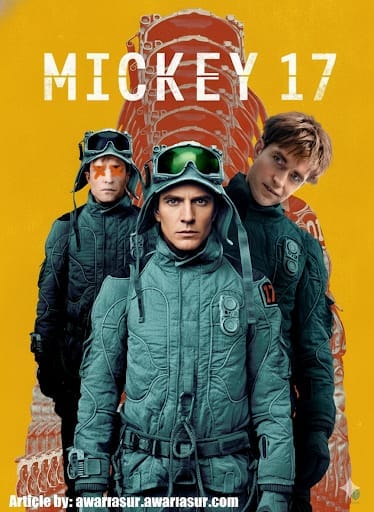
In the vast universe of Hollywood science fiction, most films aim to entertain with spectacular visuals, high-speed action, and futuristic technology. However, once in a while, a film emerges that does much more than entertain—it disturbs, provokes, and forces us to confront uncomfortable truths about our existence.
Mickey 17 is one such film.
Directed by Bong Joon-ho, the Oscar-winning filmmaker behind Parasite, Snowpiercer, and Memories of Murder, Mickey 17 is not just a sci-fi movie. It is a philosophical exploration of identity, mortality, human value, and the terrifying consequences of treating life as replaceable.
Based on Edward Ashton’s novel Mickey7, the film blends science fiction, psychological drama, dark humor, and existential philosophy, creating an experience that lingers long after the credits roll.
This is a story about a man who dies again and again—and yet never truly lives.
Who Is Bong Joon-ho and Why Mickey 17 Matters
Before understanding Mickey 17, it is important to understand its director.
Bong Joon-ho is known for using genre cinema as a weapon—a way to critique society, capitalism, class, power, and human behavior. Whether it is the social divide in Parasite or the dehumanization of labor in Snowpiercer, Bong’s films always carry layers beneath the surface.
Mickey 17 continues this tradition but on a cosmic scale.
Instead of trains or basements, the setting is deep space. Instead of class struggle, the focus is on existential disposability—what happens when human beings are treated like spare parts.
The World of Mickey 17: A Cold, Indifferent Future
Mickey 17 is set in a future where humanity has begun colonizing distant planets. These planets are hostile, frozen, and deadly—far from the warmth of Earth.
To survive such environments, corporations and governments rely on a brutal system: Expendables.
What Is an Expendable?
An Expendable is a human being assigned to the most dangerous tasks imaginable:
- Exploring toxic atmospheres
- Testing alien environments
- Handling lethal machinery
- Being the first to face unknown threats
Why? Because their death does not matter.
If an Expendable dies, a new body is cloned, and the previous version’s memories are uploaded into the new body.
The system sees this as efficiency.
The film sees it as horror.
Mickey Barnes: A Man Designed to Die
Who Is Mickey?
Mickey Barnes is an ordinary man—not a hero, not a genius, not a rebel. He becomes an Expendable not because he is brave, but because he is desperate.
He signs up for a job he does not fully understand, only to realize later that he has agreed to a life where:
Death is routine, and survival is temporary.
Each time Mickey dies, he is reborn as a new version:
- Mickey 1
- Mickey 2
- Mickey 3
- …
- Mickey 16
By the time the story begins, sixteen versions of Mickey have already died.
Now we meet Mickey 17.
What Does “Mickey 17” Really Mean?
The number “17” is not just a sequel count—it is a tombstone.
It represents:
- 16 deaths
- 16 erased lives
- 16 times pain was ignored
- 16 times society chose convenience over humanity
Each Mickey believes he is the same person as before—but is he?
This is the central question of the film.
The Cloning System: Science Without Soul
The cloning technology in Mickey 17 is precise, efficient, and terrifying.
How It Works
| Step | Description |
|---|---|
| Body Creation | A new physical body is grown |
| Memory Upload | Previous Mickey’s memories are transferred |
| Activation | The new Mickey “wakes up” |
| Deployment | Sent back to work immediately |
On paper, it sounds like immortality.
In reality, it is industrialized death.
The system does not care about trauma, fear, or psychological damage. It assumes that memories are enough.
But the film asks:
Are memories all that make a person human?
The System Glitch: When Two Mickeys Exist
The story takes a dramatic turn when a catastrophic system error occurs.
Mickey 17 survives a mission he was assumed to have died in.
Meanwhile, the system has already created Mickey 18.
Now, two Mickeys exist at the same time—a situation that is strictly forbidden.
Why?
Because if Expendables realize they are replaceable and still alive, the entire system collapses.
Robert Pattinson’s Career-Defining Performance
Robert Pattinson delivers one of the most complex performances of his career.
He does not just play one character—he plays multiple versions of the same soul, each slightly different.
Why This Role Is So Challenging
| Aspect | Difficulty |
|---|---|
| Multiple Personalities | Each Mickey behaves differently |
| Emotional Continuity | Same memories, different reactions |
| Psychological Depth | Fear, resignation, rebellion |
| Physical Acting | Body language changes subtly |
Some Mickeys are:
- More afraid
- More angry
- More accepting
- More rebellious
This subtle variation shows that identity is not fixed—it evolves through experience.
The Psychological Horror of Being Replaceable
The true horror of Mickey 17 is not death.
It is knowing your death does not matter.
Mickey knows:
- His colleagues see him as a tool
- His pain is expected
- His fear is irrelevant
- His death is scheduled
Over time, this creates a profound psychological conflict:
If I can be replaced, do I have any value?
The Central Philosophical Questions of the Film
Mickey 17 is packed with existential dilemmas.
Key Questions Explored
- Is the soul real, or are we just memory containers?
- If your clone has your memories, is it still you?
- Does repeated death reduce the value of life?
- Can technology erase suffering—or does it amplify it?
- Who decides whose life is expendable?
Theme Breakdown
1. Identity
The film challenges the idea that identity is stable. Even with the same memories, each Mickey evolves differently.
2. Capitalism and Exploitation
Expendables represent the working class taken to its extreme—workers who are literally consumed by the system.
3. Fear of Death
Even when resurrection is guaranteed, fear remains real. Death hurts every time.
4. Loneliness
Despite being surrounded by people, Mickey is fundamentally alone. No one truly sees him as human.
Visual Style and Direction
Bong Joon-ho uses visuals to reinforce emotional themes.
Visual Characteristics
| Element | Effect |
|---|---|
| Cold Color Palette | Emotional emptiness |
| Wide Empty Spaces | Isolation |
| Industrial Design | Dehumanization |
| Harsh Lighting | Psychological tension |
The future looks advanced—but soulless.
Mickey’s Inner Conflict: Body vs Mind
Each death leaves an invisible scar.
Even though memories are transferred, pain leaves echoes.
Some Mickeys become braver.
Some become numb.
Some quietly break inside.
The film suggests that:
Human beings are not just bodies or memories—we are shaped by suffering.
Why Mickey 17 Is Different from Typical Sci-Fi
| Typical Sci-Fi | Mickey 17 |
|---|---|
| Focus on action | Focus on psychology |
| Hero saves world | Man questions existence |
| Clear good vs evil | Moral ambiguity |
| Technology as solution | Technology as threat |
Symbolism Analysis of Mickey 17
What the Film Is Really Trying to Say
Mickey 17 may look like a science-fiction story about cloning and space travel, but beneath its surface, it is a dense symbolic text. Every major element in the film—numbers, technology, space, death, even Mickey’s body—functions as a metaphor for modern human existence.
Bong Joon-ho does not use symbolism as decoration. He uses it as a weapon.
Below is a detailed breakdown of the key symbols in Mickey 17 and what they represent.
1. Mickey as a Symbol of the Disposable Human
Mickey is not just a character.
He is a symbol of expendable humanity.
What Mickey Represents
- Low-value laborers
- Migrant workers
- Soldiers sent to die for politics
- Employees replaced by automation
- People whose suffering is invisible
The word “Expendable” itself is a brutal symbol. It reduces a living person into a resource.
Mickey’s repeated deaths symbolize how modern systems consume people without mourning them.
Every time Mickey dies, the system does not pause. There is no funeral. No silence. No guilt.
This reflects how society often reacts to:
- Workplace deaths
- War casualties
- Industrial accidents
Life continues—unchanged.
2. Cloning as a Symbol of Dehumanization
Cloning in Mickey 17 is not about immortality.
It is about control.
Symbolic Meaning of Cloning
| Surface Meaning | Symbolic Meaning |
|---|---|
| Resurrection | Denial of death’s importance |
| Memory upload | Reduction of humanity to data |
| Identical bodies | Loss of individuality |
| Infinite copies | Erasure of uniqueness |
The cloning machine symbolizes modern systems that treat humans like software—backups, versions, updates.
If a human can be copied, the system no longer needs empathy.
This mirrors:
- Corporate culture
- Algorithm-driven workplaces
- Surveillance capitalism
Where a person is valued only by function.
3. The Number “17” as a Symbol of Erased Lives
The number 17 is not arbitrary.
It functions as a count of forgotten deaths.
What the Number Symbolizes
- 16 silent deaths before Mickey 17
- The normalization of suffering
- Death turned into statistics
- Humans reduced to serial numbers
In many cultures, numbers replace names when individuality no longer matters:
- Prisoners
- Soldiers
- Factory workers
Mickey is no longer “Mickey Barnes.”
He is Mickey 17.
The number symbolizes how systems remember productivity, not people.
4. Multiple Mickeys: Fragmented Identity
When two Mickeys exist simultaneously, the film reaches its symbolic core.
Symbolism of Multiple Mickeys
They represent:
- Internal conflict
- Psychological fragmentation
- The divided modern self
Even though the Mickeys share memories, they behave differently.
This symbolizes:
- Trauma reshaping personality
- Fear altering morality
- Experience redefining identity
The film suggests that identity is not memory—it is lived experience.
This reflects real human psychology:
- People change after trauma
- Two people with the same past can choose different futures
5. Memory as an Incomplete Definition of Humanity
The system believes memories = identity.
The film disagrees.
Symbolic Role of Memory
Memory in Mickey 17 symbolizes:
- Institutional misunderstanding of humanity
- Reductionist thinking
- Emotional blindness
The clones remember dying—but they still fear death.
This shows:
Memory does not eliminate pain; it multiplies it.
Symbolically, the film argues:
- Pain lives in the body
- Fear lives in instinct
- Humanity lives beyond data
6. Death as a Repeated Ritual
Mickey’s deaths are routine.
They are not dramatic sacrifices—they are procedural.
Symbolism of Repeated Death
| Death Type | Symbolic Meaning |
|---|---|
| Repetitive | Normalized violence |
| Expected | Systemic cruelty |
| Unmourned | Loss of dignity |
| Fast replacement | Erasure of grief |
Death becomes a workflow.
This mirrors:
- War strategies
- Industrial exploitation
- Bureaucratic violence
When death becomes efficient, morality disappears.
7. The Space Colony as Emotional Isolation
Space in Mickey 17 is not adventurous.
It is empty, cold, and silent.
Symbolism of Space
- Emotional distance
- Lack of human connection
- Capitalist expansion without ethics
- Progress without compassion
The colony represents a future where:
- Technology advances
- Humanity regresses
Space is not the enemy—the system is.
8. The Cold Visual Palette
The film’s visual coldness is symbolic.
Symbolic Meaning of Color and Design
| Visual Element | Symbolism |
|---|---|
| Grey interiors | Emotional numbness |
| Blue lighting | Isolation |
| Metallic textures | Loss of warmth |
| Sterile labs | Dehumanization |
Warm colors appear rarely—and usually in moments of human connection.
This visually reinforces:
Humanity survives only in small, fragile moments.
9. Fear That Never Disappears
Despite resurrection, Mickey is always afraid.
Symbolism of Fear
Fear symbolizes:
- Instinctual humanity
- The soul’s resistance
- The body’s refusal to be mechanized
The system expects Mickey to be fearless.
But fear persists.
Fear proves Mickey is still human.
10. Expendables as a Metaphor for the Working Class
Expendables represent the extreme end of labor exploitation.
Symbolic Parallels
| Expendables | Real World |
|---|---|
| Disposable workers | Gig economy |
| Dangerous tasks | Hazardous labor |
| No recognition | Invisible workforce |
| Instant replacement | Automation |
The film warns:
A society that treats workers as disposable will eventually treat everyone that way.
11. Two Mickeys as Moral Choice
When Mickey 17 and Mickey 18 coexist, they symbolize choice.
- One represents obedience
- One represents self-awareness
They are not good vs evil—but survival vs dignity.
This reflects the question:
Do you live longer by complying—or live meaningfully by resisting?
12. The System as an Invisible Villain
There is no single antagonist.
The villain is the system itself.
Symbolism of the System
- Bureaucracy without conscience
- Technology without ethics
- Progress without empathy
This aligns with Bong Joon-ho’s recurring theme:
Systems are more dangerous than individuals.
13. The Body as a Battlefield
Mickey’s body is:
- Tested
- Destroyed
- Rebuilt
Symbolism of the Body
The body symbolizes:
- Labor
- Sacrifice
- Ownership
The system owns Mickey’s body—but not his fear.
14. The Film’s Ultimate Symbolic Message
Mickey 17 ultimately symbolizes one idea:
Human life loses value when it becomes replaceable.
The film argues:
- Mortality gives life meaning
- Suffering demands dignity
- Irreplaceability creates empathy
Final Interpretation
Mickey 17 is a warning.
Not about cloning.
Not about space.
But about a future where efficiency replaces compassion.
It asks the viewer:
If society can replace you tomorrow, who are you today?
And more importantly:
What makes your life worth protecting?
Emotional Impact
Mickey 17 is unsettling because it feels too plausible.
In a world already driven by productivity, efficiency, and replaceability, the film exaggerates reality just enough to expose its cruelty.
Conclusion: Why Mickey 17 Matters
Mickey 17 is not about space.
It is not about cloning.
It is not about the future.
It is about us.
It asks us to reconsider:
- How we value human life
- How systems treat individuals
- How easily empathy disappears
The film’s final message is clear:
Even if a human can be copied, every life is still unique.
And that uniqueness—fragile, temporary, painful—is what makes life meaningful.
Frequently Asked Questions (FAQs)
Q1. What is Mickey 17 about?
Mickey 17 is a science fiction film set in a future where humans are cloned after death to perform dangerous missions. It explores identity, mortality, and human value.
Q2. Why is Mickey called an Expendable?
Because his life is considered replaceable. If he dies, a new version is created.
Q3. What does the number 17 signify?
It represents the 17th version of Mickey—after 16 deaths.
Q4. Why is Robert Pattinson’s role special?
He plays multiple versions of the same character, each emotionally distinct.
Q5. What is the main message of the film?
That every human life has value—even in a system designed to erase it.
Up to mark